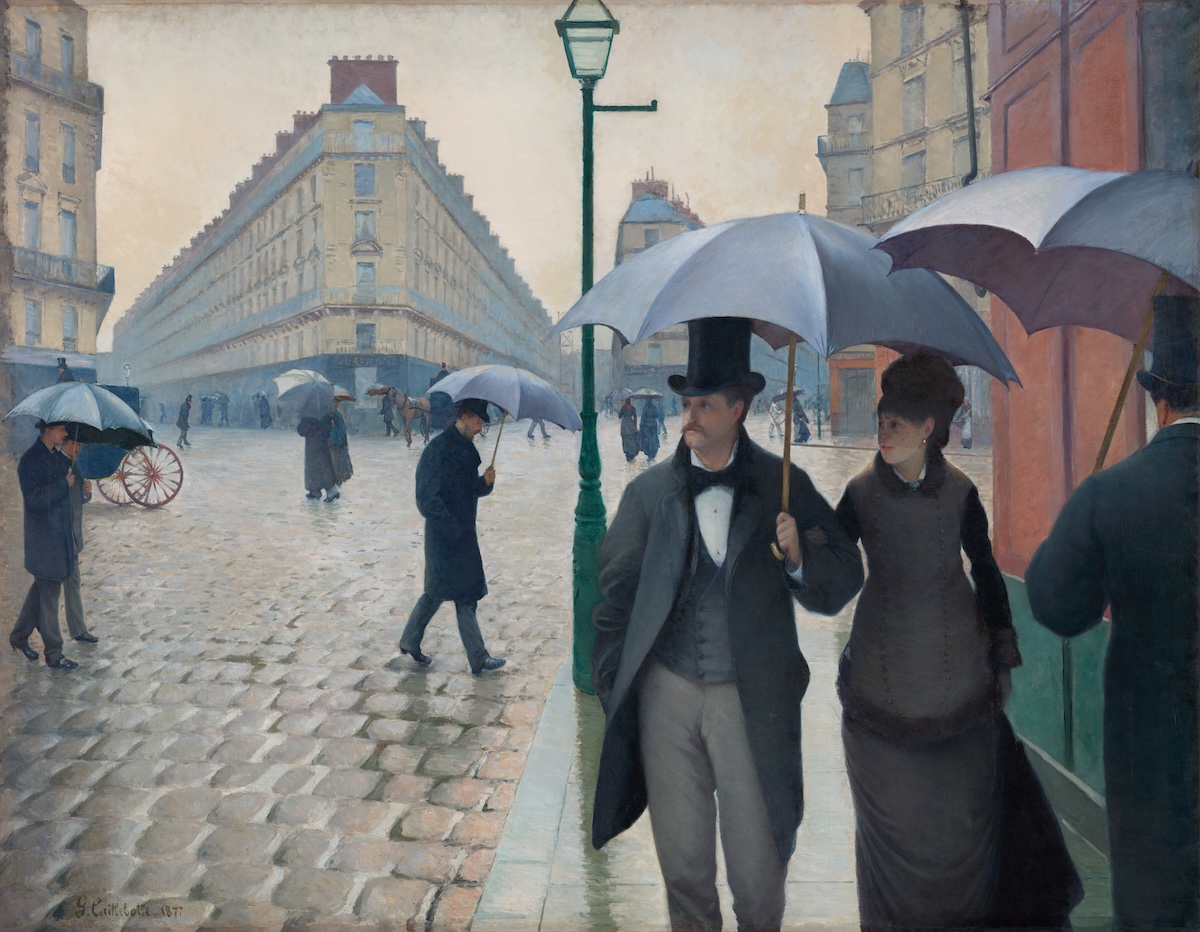
For the entirety of my life, growing up in Oak Park and visiting the Art Institute of Chicago first on school field trips and then as an adult whose favorite places are the great art museums of great cities, Gustave Caillebotte's Paris Street, Rainy Day has been a staple of the museum's robust Impressionist galleries and a personal highlight each time I visit. At roughly eight feet by ten feet, it's an almost overwhelming piece depicting everyday life, enveloping the viewer instantly in a gloomy but bustling Parisian day in the late 19th century.
The attention of the figures in the foreground is captured by something out of frame, while those behind them are in the midst of going wherever they're going and trying to stay dry while they do. Caillebotte's color scheme is muted but not absent, incorporating grays and blues to evoke the rainy day, though there's not a drop of rain anywhere to be found in the air. With a horizon line bisecting the painting, half of it is filled with glistening cobblestones while a grand Parisian building juts out from the street behind the subjects, all of it making us feel as if we may just walk onto the street at any moment and join the scene in progress. It's a monumental piece from an artist I, admittedly, didn't know a lot about, either individually or as a part of the Impressionist movement in 1860s Europe and beyond.
In collaboration with the Getty Museum in Los Angeles and Musée D'Orsay in Paris (more on their connection to Caillebotte momentarily), the Art Institute of Chicago presents Gustave Caillebotte: Painting His World, on view in the museum's special exhibit space now through October 5. This gallery space has hosted many an interesting exhibit over the years, most memorably an immersive Van Gogh exhibit that quite literally had attendees stepping into not only the cafés he frequented but the paintings themselves. It's a malleable space that the museum's smart curators have now transformed into a series of galleries that feel a bit like living space, gilded frames on the burgundy or mauve walls organized around the various stages and subjects of Caillebotte's influential work of the era.
Gustave Caillebotte was born the oldest of three sons to Martial and Céleste Caillebotte, in Paris in 1848; though he did not arrive with the proverbial silver spoon in his mouth, the Caillebottes enjoyed a comfortable existence in the city's upper class, his father having built wealth in the textile industry. This fact plays significantly into the younger Caillebotte's experience and career, as he never had to worry about finding regular work of his own. In fact, he would go on to become not only a great contributor to the Impressionist movement but a patron of it as well, supporting the likes of Renoir and Monet in their work. He amassed such a collection of his contemporaries' work that upon his death at just 45 years old in 1894, it was donated to the French state and ultimately created the first collection for the Musée D'Orsay.
It's the life and work in between his comfortable upbringing and his legacy in Impressionism that Painting His World explores, and it's an enlightening, engaging and comprehensive spotlight not just on all that he created but why and how. The exhibit features numerous aspects of his work, categorized both chronologically and by subject matter, proving quite informative through gallery information and graphics (a map of Caillebotte's Paris is particularly interesting), a small but interesting selection of audio commentary and even a short biographical video tying it all together between galleries.
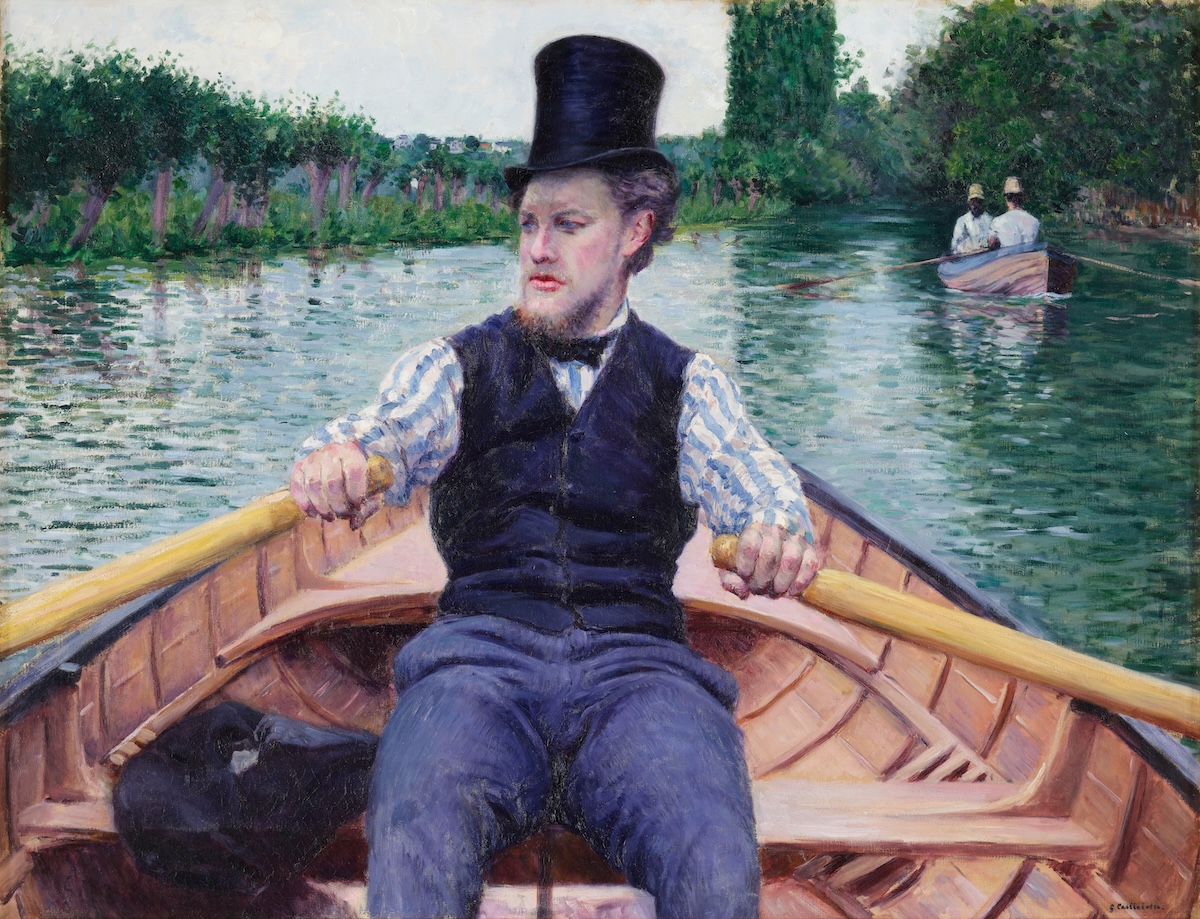
Paintings and sketches included are some of the Art Institute's own, as well as the Getty's and the Musée D'Orsay's (the exhibit has traveled to both of those museums as well; more on that momentarily, too), but also from other collections near and far. I noted pieces from Milwaukee and New York, Tokyo and Pasadena and beyond. And in a true stroke of curatorial genius, the exhibit even includes a brief vignette on the hats of Caillebotte's work, from soldier's caps to silk top hats and, when they couldn't find a vintage one, a straw sunhat made by the museum's resident milliner. It's a beautiful touch that makes the everyday subjects in his works that much more relatable.
Of note across the exhibit is the manner in which his works evolve as his talent and skill does as well; in the first galleries featuring portraits of his mother, his uncle, his brothers, the work is much more structured and polished, with brush strokes that are nearly imperceptible. As one moves through the galleries, however, his shift into Impressionism becomes vastly clear, with texture and brushstrokes becoming more important in what they evoke than what they are. But more so, the collection of galleries makes incredibly clear that Caillebotte, as the title of the show implies, focused on painting what surrounded him most closely. His Floor Scrapers takes deservedly prominent place in the exhibit as it highlights so beautifully not just the painter's fascination with the working man and blue-collar work but also his talent for capturing light and depth in an enclosed space.
Since the exhibit opened at the end of July, the Art Institute has come under some fire for the name chosen for the exhibit. In Los Angeles and Paris, it was referred to as "Gustave Caillebotte: Painting Men;" in fact, the shared exhibit book created by the three institutions reflects this name. According to the Art Institute, their name ("Painting His World") was chosen based on patron testing and other factors; there are some concerned that this title is minimizing or even erasing an inquiry into Caillebotte's sexuality. I think all of these conversations are necessary and it's incredibly important to ensure we are consuming art in its full context and history.
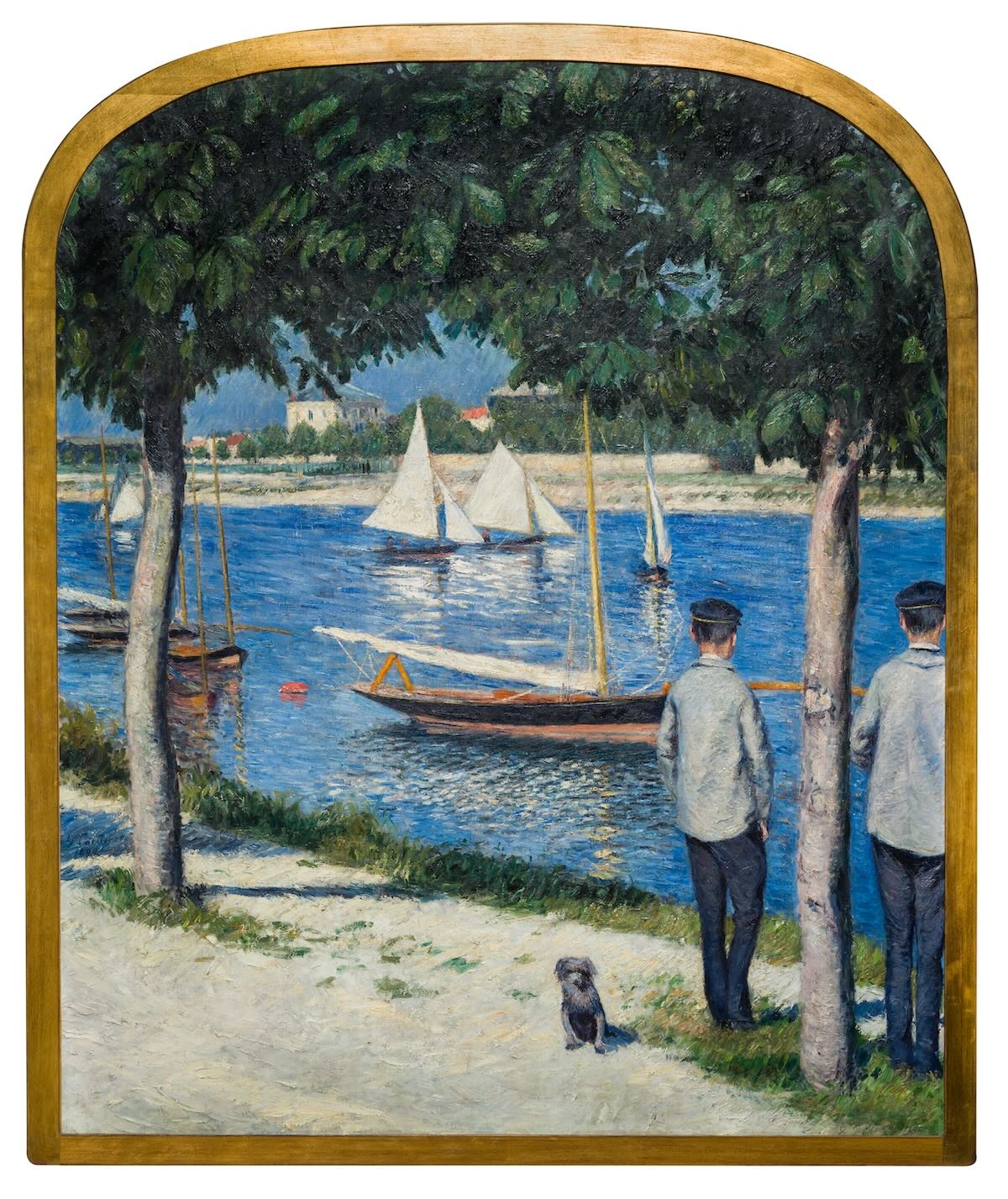
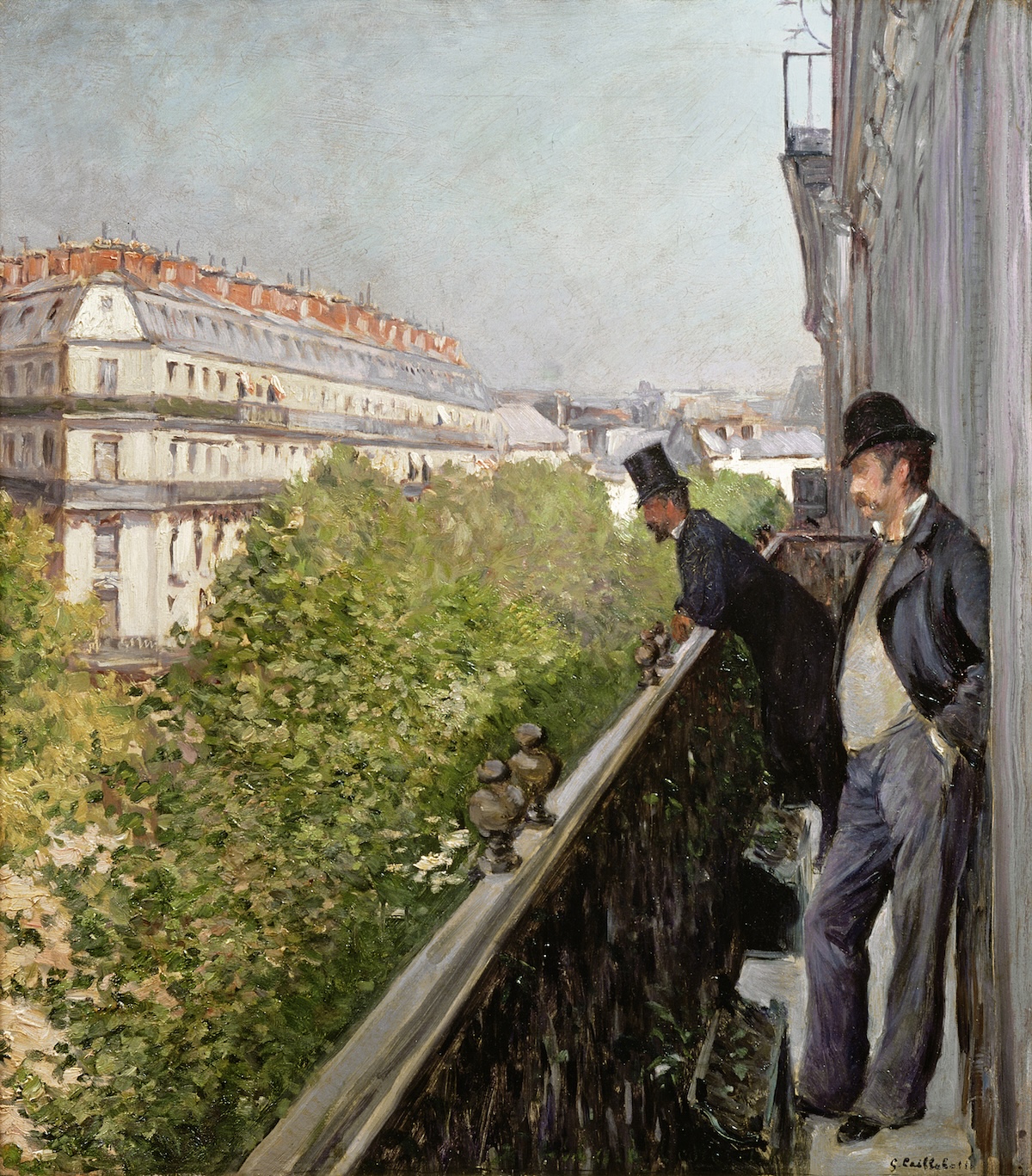
That said, in my opinion the exhibit at the Art Institute is appropriately titled; as presented, it explores every aspect of the artist's work and life, including mention of his personal life (he never married, but did have a long-standing female "companion" who shows up in several pieces). There is a gallery that focuses on his portraits of his male friends, and even the few nudes he painted; but there is also an exploration of his sports and nature paintings, noting how his framing and perspective brought a fresh new approach to the genre.
Beyond that and without any definitive record of his interpersonal relationships, it seems reasonable to expand the view of the exhibit to consider all aspects of an artist's persona. It's impossible—and dare I say unnecessary—to label Caillebotte as one thing or another given the historical records we have. There is no world in which anyone's identity should be denied or marginalized, but I fear the conversation may be overcorrecting for a problem that doesn't exist.
It's a true gift to have a world-class institution like the Art Institute of Chicago in our backyard and in my estimation, a membership is worth every penny; special exhibits like Gustave Caillebotte: Painting His World (alongside other recent showings like Frida Kahlo's Month in Paris and more) are treasures of their own we're lucky to have for months on end. And as art has a wonderful way of doing, this deep dive into Caillebotte's life, work and legacy is both gorgeous to take in as room after room unfolds with his impressive work, and inspiring to consider both in its own context and in ours.
Gustave Caillebotte: Painting His World is on view at the Art Institute of Chicago through October 5. Several tours and talks are available, including one on "the language of masculinity" on September 13 (free with museum admission, but registration is required).
If you enjoyed this post, please consider supporting Third Coast Review’s arts and culture coverage by making a donation. Choose the amount that works best for you, and know it goes directly to support our writers and contributors.
