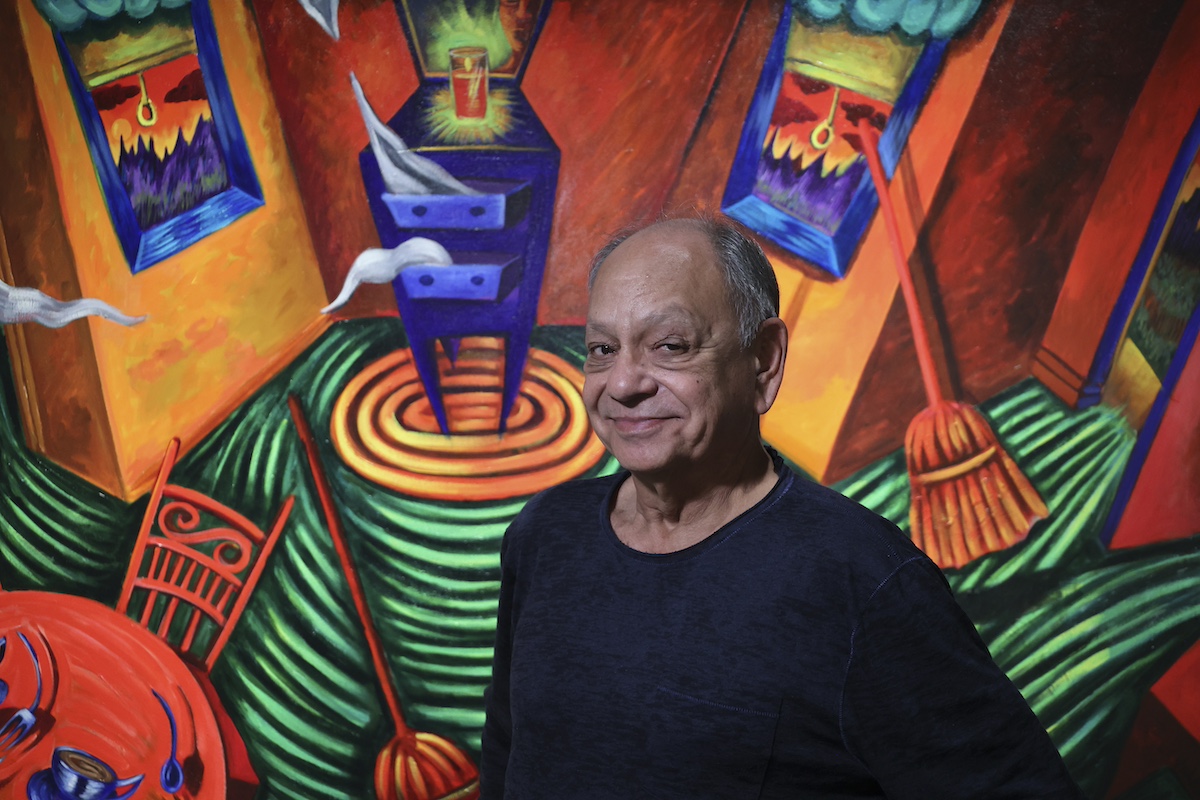
Though Cheech Marin first found fame while partnering with Tommy Chong to create some of the most iconic counterculture comedy of all time, stoner humor won’t be the main focus when he appears at the Chicago Humanities Festival this Sunday (though it’s unlikely he’ll be able to resist sneaking in a pot joke or two). Marin will chat with WBEZ journalist Michael Puente about his passion for Chicano art and culture.
Perhaps the movement’s greatest advocate, Marin says his goal is “to bring the term ‘Chicano’ to the forefront of the art world.” Beginning in 2001, art museums around the country exhibited pieces from his extensive private collection, and in 2022, he partnered with the Riverside Art Museum to create The Cheech Marin Center for Chicano Art and Culture—aka The Cheech—to permanently showcase more than 700 Chicano paintings, sculptures, and photographs.
We talked with Marin about his collection, why he considers himself Chicano and not Mexican, and the first time his son realized what that distinct odor was (you know exactly what we mean).
You have one of the most remarkable private collections of Chicano art—you’ve taken it all over the country, and now, of course, you have The Cheech. What was the first piece that you acquired in your collection, and what was it that drew you to it?
I bought three pieces at the same time from this one gallery, Robert Berman Gallery, which was a champion of Chicano art at the time. One was by Carlos Almaraz, one was by Frank Romero, and another one was by George Yepes. They were serious, humorous, and well-painted. The brush is the most primitive of tools, and they always expressed whatever they were trying to express with their art through the brush. I like that part of it.
How has your collection inspired your own art?
Well, it gives context for it. I always have this saying that every generation or every new wave that comes into the Chicano sphere is delivering news from the front. "This is what my neighborhood looks like. These are the issues in my neighborhood. These are the people in my neighborhood." You keep getting refreshed every so often by a new crop of painters that come into the sphere. That's kind of cool to have that ongoing reportage in an artistic way.
Which pieces have you found resonate with audiences the most at the museum?
Well, it depends on what you come in with, what your knowledge is. If you're coming and looking for your favorite pieces you've seen over the years in different publications or tours I've done, you're always looking for that. But then you get to see new art that's being added to the collection all the time. There was a thing going on for a little while that Chicanos weren't Chicanos any more; they were Chicanosauruses. Their time had come and passed. But I think the Chicanosphere I'm working on is Chicanos Progressosaurus. They keep evolving because it's a dynamic area of art.
How often do you add to the collection?
Whenever I find something good and I have enough money to buy it (laughs). That's the thing, I'm not a visionary. I can't say, "Oh yeah, send over two tons of that art." Every piece that I acquire is because I've got a job at that point.
Aside from having the necessary funds, what is the deciding factor in whether a piece of artwork is worthy of The Cheech?
If it starts haunting my dreams—if I've seen it and didn't buy it when I had the chance. There are pieces like that—I kept thinking about them, went back, and either the piece was sold or, in a couple of instances, it was still there. I couldn't believe it hadn't been bought. I blessed my lucky stars and acquired it at that point. You learn how to trust your intuition, and the more you trust your intuition, the easier it makes your collecting habits.
Are there any pieces that have haunted your dreams for a long time now?
Benito Huerta made this piece—I was in Houston at the time. I saw it in a big art show that had a lot of Chicano art in it. It was an artistic conversation between Picasso and (Russian painter Wassily) Kandinsky. If you didn't know art, you wouldn't know what the references were. I saw it; it was a big piece. As soon as I went into the show, I thought, "Oh, this is a great piece. I gotta get it, but let me see what else is around." It was a big auditorium, so I went around, and by the time I got back to that piece, it had been sold. I should have gotten it the moment I saw it, but I didn't. Years later, the person who bought it—he was a lawyer from Corpus Christi—had died, and his son knew that I liked that piece. He called me up and said, "You want to buy this piece?" I said, "Absolutely." So that was one I was grateful came back around.
How exactly do you personally define "Chicano," and why do you feel that it's the most fitting descriptor for you?
I think “Chicano” has always been in a state of evolution because it's an evolutionary process. What it signifies is people from my generation—I'm a boomer—and my father was born in the country, as well as my mother in Los Angeles. When their experience in the United States outweighs their experience or influence in Mexico, that's when they kind of plant their flag and say, "I'm this and not that. I'm part of that, but I'm more of this, and that's okay to be," and that's where Chicano was born and continues to be born and evolve.
I was always called Mexican. I was raised in a predominantly Black neighborhood for the first part of my life, and then an all-white neighborhood the second part of my life. I was always called Mexican in both. I said, "But I'm not Mexican.” At that point, I didn't speak Spanish. I traveled to Mexico once when I was a kid. They called me Mexican. I'm not Mexican. Maybe my grandparents were, but I'm not. I'm something else. I'm this other. Because Chicano, predominantly in its inception, was a derogatory term from Mexicans to other Mexicans living in the United States, the concept being that they were no longer Mexicanos because they had left their country. They were something less. They were chicos, little satellite Mexicans. They were Chicanos.
You’ve achieved a lot in your life and career: Grammy-winning musician, actor, writer, director, museum curator, humanitarian, activist for marijuana legalization…aside from “Chicano,” if you had to sum yourself up in one word, what would it be?
Curious.
I love that.
Curious and all-encompassing. I just welcome everybody. My kids are all with—not all of them, but different mothers, and they kind of incorporate that part of their heritage and their upbringing. My oldest kid is a cross between Chicano and Swedish-German.
Do your other kids identify as Chicano?
That's for them to decide what their identity is, because Chicano is a voluntary category. You have to declare yourself a Chicano in order to be a Chicano. Some people do, some people don't. My favorite kind of Chicano is the ones that don't know they're a Chicano yet.
Maybe your talk at the Chicago Humanities Festival will help them discover it! If you don’t mind indulging me, I told my father-in-law that I would be interviewing you, and he’s pretty envious. He wanted me to ask you about the inspiration behind “Sister Mary Elephant” and “Earache My Eye.”
I went to Catholic school from third grade to high school. “Sister Mary Elephant” was based on one of the nuns who taught me in grade school. I won't divulge the name for security reasons (laughs), but she was the model for that. There were a lot of elephant jokes going around at that time: “What's gray and…” That came up while we were making the album, and we named her that. Nothing denotes any disrespect; it denotes a kind of sense of humor, which they were in on.
“Earache My Eye,” the introduction, where the song comes on with a guitar solo, was written by one of our group members in Vancouver. His name was Gaye Delorme, who has passed away. It's a rock-and-roll anthem—every guitar player of his generation knew that riff. And then when the record gets scratched, that was my father waking me up every morning: “Alright, get out of bed, you're going to be in the Navy.” He was in the Navy and he wanted the family to be run like the Navy. Bless his soul.
I actually didn’t know that song was by Cheech and Chong until pretty recently. I knew the Soundgarden version. It’s been covered quite a few times. Any favorites of yours?
I like Korn's version. They called me up—it was my son's favorite group at the time. I even bought him one of those seven-string guitars so he could play all the songs. He wanted to go see them, and I hooked up with my people that I knew and we got in.
(Korn frontman) Jonathan (Davis) called me up and said, “We're recording ‘Earache’ and we want to know if you would come down and sing it for us on the record.” I said, “OK, that sounds good.” “By the way, we're previewing it at the Whisky a Go Go on Friday afternoon. Would you like to come and sing it on stage with us?” I said, “OK.”
It was my son's 14th birthday. I brought him along to witness the whole thing. He was wandering around with his eyes wide open; he'd never been in a club like that before. He was a musician but had never played the Whisky. I was very proud and I dedicated the song to him on stage; he was emotional about it. During the performance, he wandered around the club and said, “Hey, Dad, you know what? Now I know what that smell is” (laughs). With me as his father, he was going to find out sooner or later. Kids at that age put two and two together a lot.
The Cheech Marin: Culture, Comedy, and Chicano Art discussion will be held at 6pm this Sunday, September 21, at Apollo's 2000, 2875 W Cermak Rd. Tickets ($20-56) are on sale now.
