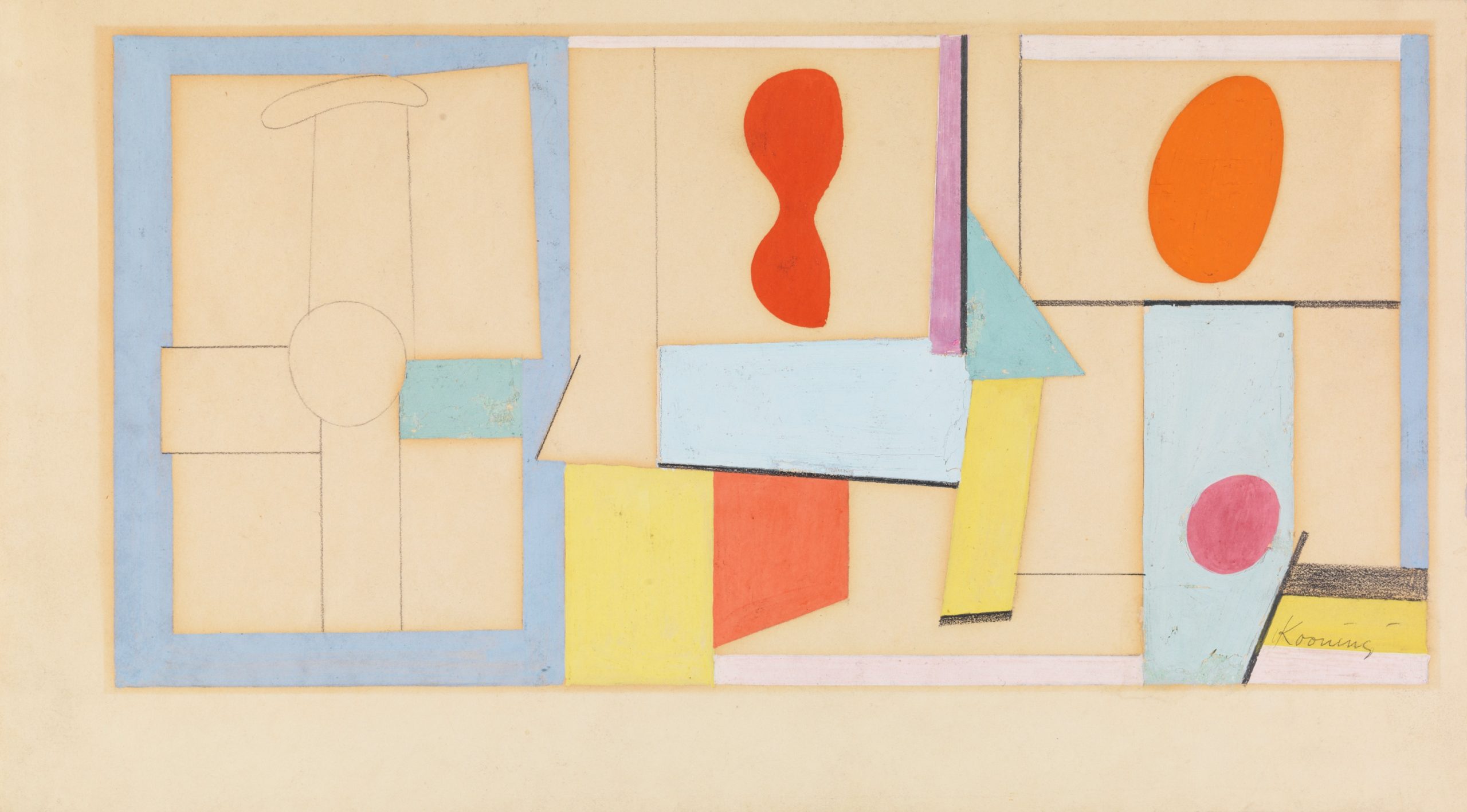

Dutch-American artist Willem de Kooning (1904-1997) and his evolution as an important Abstract Impressionist and producer of a dynamic, seven-decade-long body of work is chronicled in the riveting new Art Institute of Chicago exhibition titled Willem de Kooning Drawing, open through September 20, including its own painting Excavation (1950, permanent collection), among 200 others from around the world.
Yet it’s so much more than just drawing. Yes, de Kooning trained in technical drawing near his hometown in Rotterdam while still in his teens, focusing on the charcoal figures and naturalistic still lifes that would underpin his future output. He also apprenticed and learned stenciling and faux finishing when he was 12. But he wanted more in his life and career, so, at age 22, he stowed away on a steamship to New York in 1926. American magazines at that time were using bold lines, thick cartoon-like borders and narratives: “Those illustrations were way ahead of everyone in Holland, so what I really wanted to be in America was an illustrator,” he recalled.
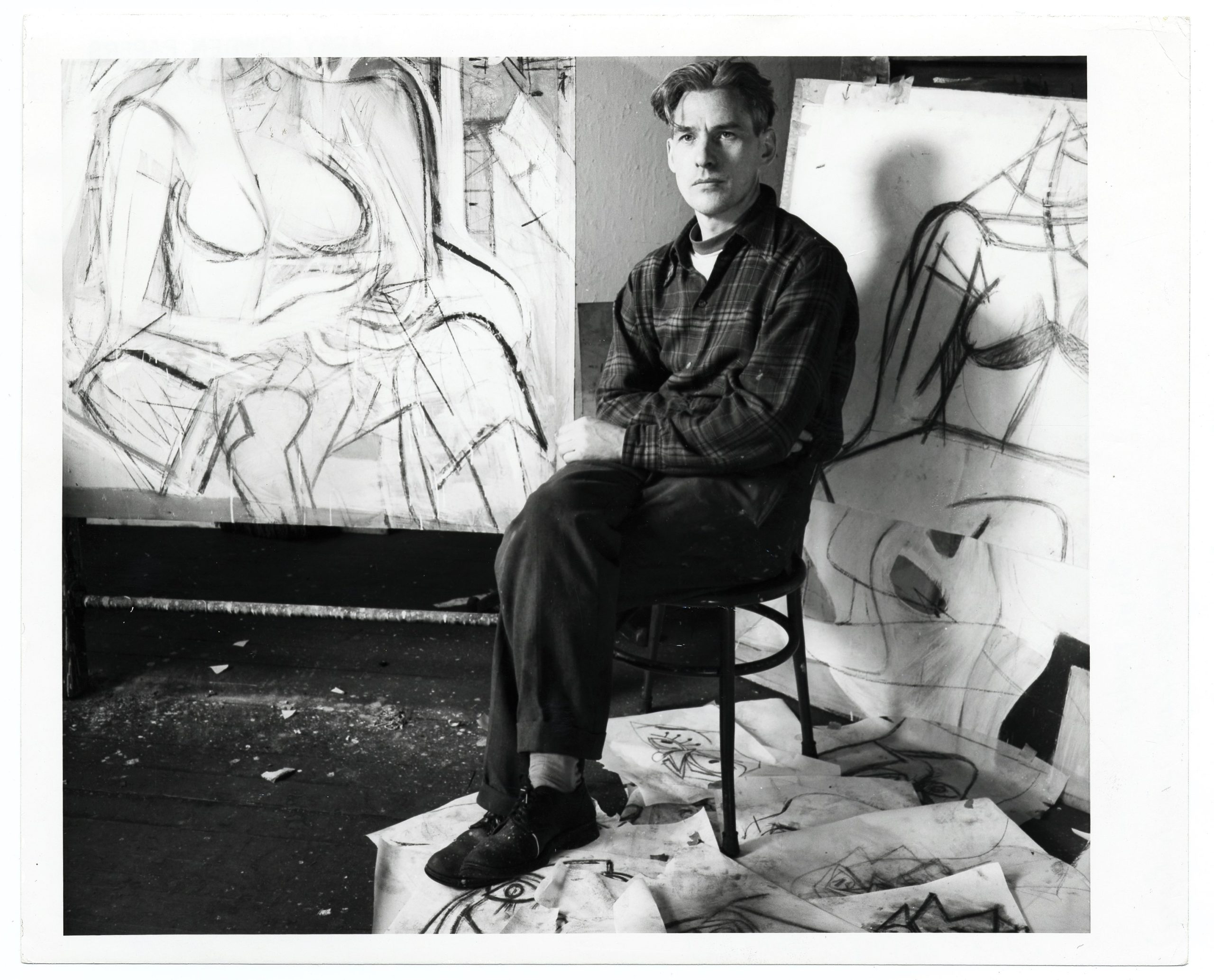
Once in the Big Apple, he worked as a house and sign painter, window display designer, freelance commercial artist and magazine illustrator (for publications such as Life, Fortune and Harper’s Bazaar). This is all evident throughout the thrilling works exhibited here: the way he innovatively mixed and used paint, thinners and spray fixatives; his references to mannequins; his use of typography, calligraphy, erasing, smudging, and cartooning (he said “I have a lot of cartoonist in me”). He employed vellum or carbon transfer paper overlays to reproduce common elements, like a human copier. He characterized this drawing as painting, saying “I draw in paint, and usually I don’t feel so much difference between drawing and painting.”
From 1935 to 1937, de Kooning worked in the mural division of the Works Progress Administration (WPA), the government program that provided jobs during the Great Depression. That position prepared him to create a large-scale mural for the New York World’s Fair Hall of Pharmacy in 1939. By the 1940s, he became an Abstract Impressionist alongside Mark Rothko, Lee Krasner and Jackson Pollock, a collective also termed the New York School. During this period, de Kooning both aligned with and strayed from these peers, again due to his foundations as a draftsman, using realistic structures on which to hang his artistic explorations, noting that “even abstract shapes must have a likeness.”
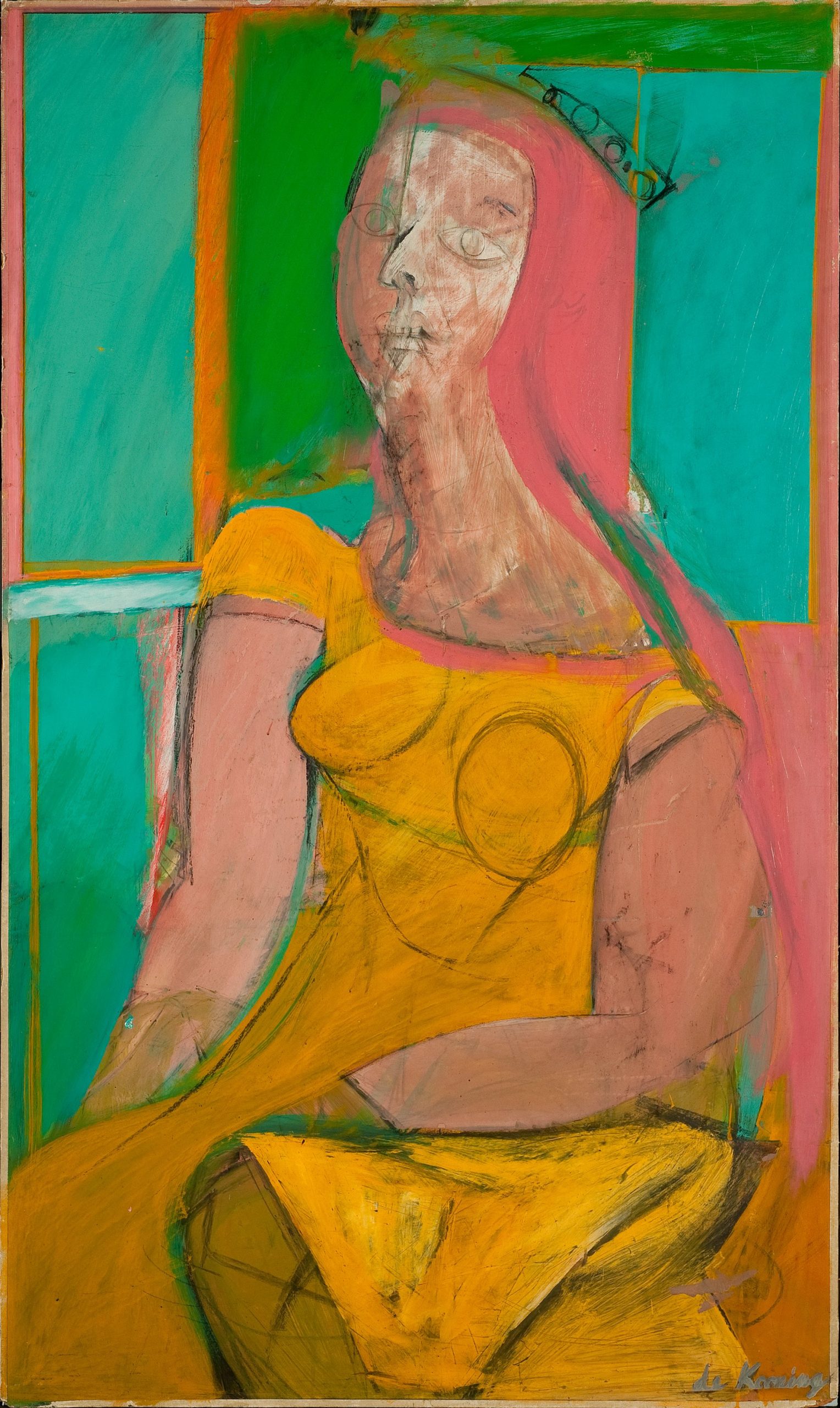
Before de Kooning made a comfortable living as a fine artist, he used and reused items like enamel house paint and salvaged paper. He also dabbled in Cubism, using monochromatic greys and geometric forms to depict human bodies. While not overtly political in most of his work, he did reflect human frailty during World War II in Untitled (Massacre Scene, 1941), and occasionally referenced Christian myths, like in his Judgement Day (1946), which includes four angels at the Gates of Paradise, and Abstraction (1949-50), which recounts the passion of Jesus.
De Kooning also didn’t seem to be afraid to evolve and experiment, moving from bright canvasses with exquisite mid-century palettes of yellow, pink and teal, to line drawings to sculpture. This dichotomy populates his ethos: an abstractionist who also painted portraits, explored both male and female forms, utilized both graphic and fine art techniques, employed themes of history and modernity, captured both sacred and profane subjects.
New York’s Charles Egan Gallery hosted his first solo exhibition in 1948, including abstract paintings in black-and-white oil and enamel, where he experimented with pouring, dripping and dragging the medium across the surfaces. In 1950, the Art Institute awarded and acquired his Excavation as one of his first major sales. De Kooning continued to use a wide variety of materials and styles, from mixed media for collages to pastels, wax crayons and even his own fingerprints.
That same year, his pieces began to focus more on the female form, calling his approach to represent women via the lineage of “the female painted through all the ages.” His DC-based Monumental Women retrospective in 1953 incorporated national monuments like the Thomas Jefferson Memorial and the Washington Monument into his female forms. “Two Women with Still Life” (1952) combines three genres: landscape painting with still life as well as the female nude. He also used collages to insert humor via commercial art techniques, and his travels to several locations in Italy and San Francisco also informed his output.
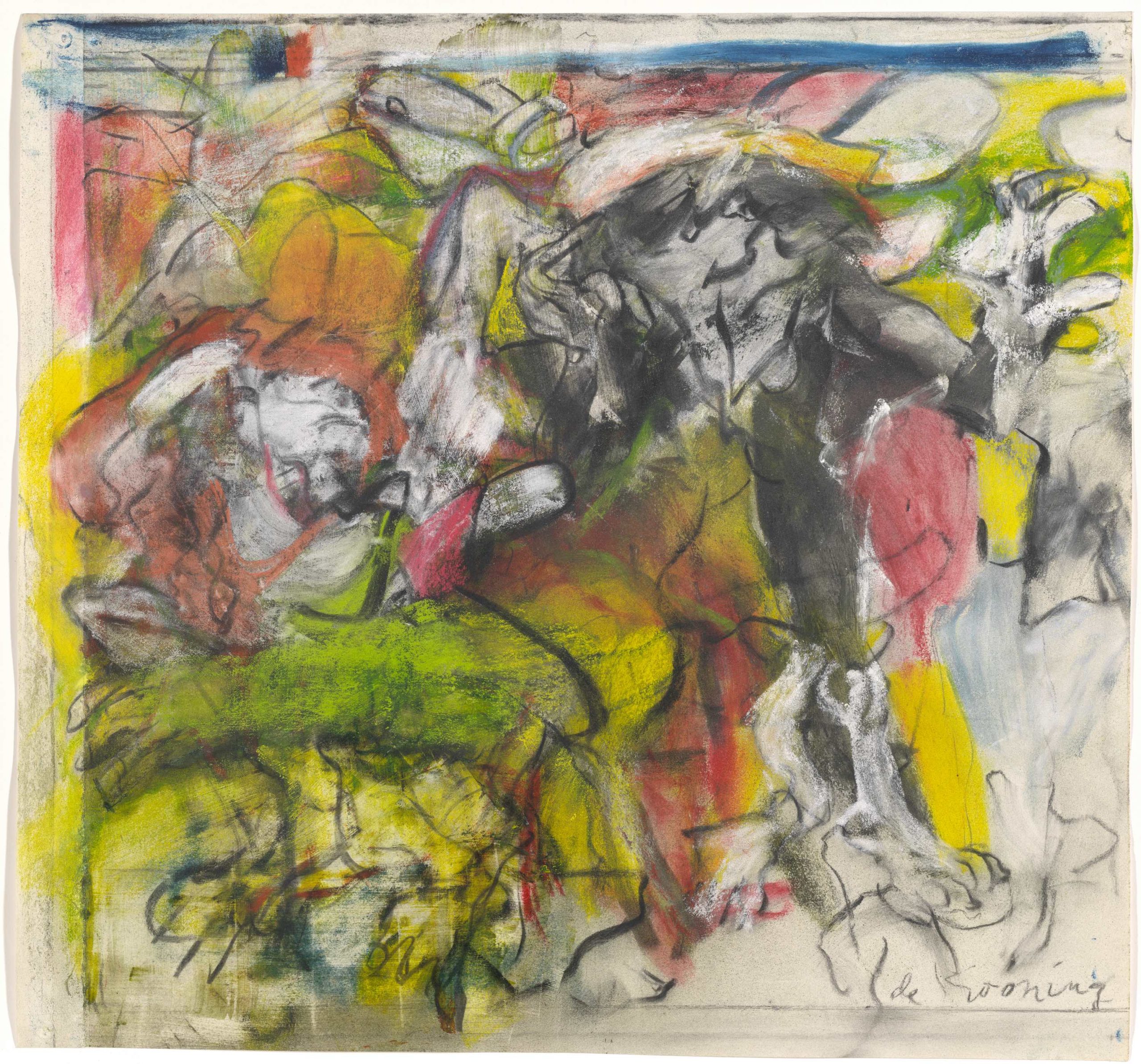
Finally leaving New York City in 1963, de Kooning moved to a new home and studio at Springs in the Hamptons. Riding his bike near the shoreline reminded him of the Netherlands, so more themes of water, light and beachcombers entered his oeuvre. He created “Screaming Girls” (1966-67) likely as a tribute to the response to the Beatles. At Springs, he had space to expand his painterly preparations, including color charts and projections. But he kept his work raw and gritty, occasionally funny or macabre, saying that “beauty becomes petulant to me. I like the grotesque. It’s more joyous.”
This exhilarating exhibition captures that joy, a time capsule of a dedicated experimenter, and once again reminds us that immigrants always make American life a richer, and more thoughtfully human, experience.
Willem de Kooning Drawing is organized by the Art Institute of Chicago, in collaboration with the Rijksmuseum, Amsterdam, and in consultation with the Willem de Kooning Foundation. The exhibition’s curatorial team includes the Art Institute of Chicago’s Kevin Salatino, Chair; and Anne Vogt Fuller and Marion Titus Searle, Curator, Prints and Drawings; Mel Becker Solomon, associate research curator, Prints and Drawings; and Charlotte Healy, senior research associate, Prints and Drawings, with contributions from Margaret Holben Ellis, exhibition paper conservator.
The Art Institute of Chicago is open 11-5 on Mondays, Wednesdays, Fridays, Saturdays and Sundays; 11-8 on Thursdays (closed Tuesdays). This de Kooning exhibit, his first ARTIC solo exhibition since 1969, runs until September 20. You can reach it via the 111 South Michigan entrance, in Regenstein Hall behind the first-floor Asian art area. Entrance tickets range from $21-27, and the de Kooning show is an additional $7. Free museum passes are also available with a Chicago Public Library card.
Support arts and culture journalism today. This work doesn't happen without your support. Contribute today and ensure we can continue to share the latest reviews, essays, and previews of the most anticipated arts and culture events across the city.
