In the mid-1960s, Anne Keegan wore white gloves to apply for a job as a reporter at City News Bureau of Chicago. She recalled riding the elevator to the wire service on the 12th floor of 188 West Randolph Street, on the western edge of the Loop.

The interior of the old City News offices looked as if Charles Dickens designed it. There were teletypes clacking, typewriters clicking, phones ringing, at least two people shouting, and everyone else hunched over phones, talking to some invisible source. Cigarette butts filled every ashtray next to cold coffee in beat-up cups. Paper was everywhere—spiked, piled, stacked, and crumpled.
I knew if I got the job, there would be something I had to do…immediately! I got the job and…I did it. I took off the white gloves!
Keegan “graduated” from City News in 1968, and had a long career as a reporter and columnist at the Chicago Tribune. She was one of maybe 2,000 reporters who, over the wire service’s 109-year history, learned journalism in the gritty trenches of big-city reporting on crime and fire, courts, elections, tragedies and disasters.
This, Keegan wrote, was a “world of ethnics, bungalows, parishes, and immigrants, and taking the Archer Avenue bus to a 2-11 fire that was out by the time I arrived…a world of typewriters, bulletins, phone headsets, coroner’s inquests, creative swearing, bottles of whiskey from judges at Christmas time, and desk sergeants.”
City News was a boot camp for reporters, a school of hard knocks where learning started through failure—such as failing to ask enough questions and being sent back by a growling rewrite person or editor to get the answers, often again and again and again—and then through the development of what became a deep street-level knowledge of Chicago and a confidence and an ability to cover basically any story, bar none.
No wonder that those of us who worked there describe ourselves as graduates of the place. After serving three years, I graduated in 1976 and began a 32-year career at the Tribune.
Odds are, unless you worked at City News, you’ve never heard of it. And, if you’ve never worked in Chicago journalism at one of the city or suburban papers or at a TV or radio station, you almost certainly know nothing about it, especially since it went out of business more than a quarter century ago on February 28, 1999.
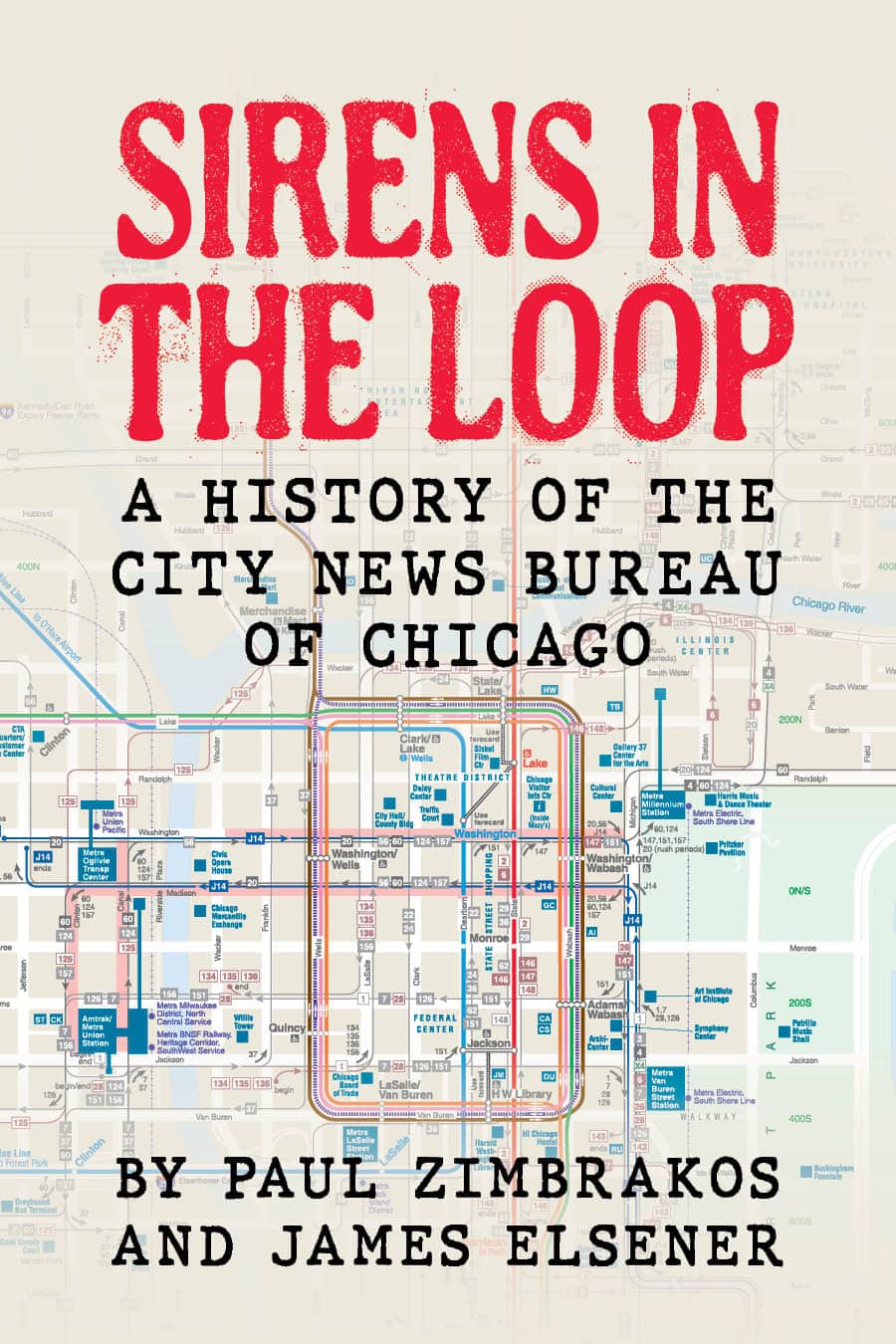
Now, though, you can learn about the local wire service through Sirens in the Loop: A History of the City News Bureau of Chicago by Paul Zimbrakos and James Elsener.
The title has to do with one of the essential roles of City News. The wire service was owned by the major Chicago newspapers and had contracts with local radio and TV stations. Its job was to cover the minutiae of what was happening in the city 24 hours a day for possible newsworthiness so the higher-paid professional reporters didn’t have to.
The wire service's job was to cover the minutiae of what was happening in the city 24 hours a day for possible newsworthiness so the higher-paid professional reporters didn’t have to.
Searching for Kernels of News
The goal of a City News reporter was to discover, in the midst of checking on a lot of uninteresting stuff, some kernel of news that could be delivered to a rewrite person and then to an editor and then—via pneumatic tubes or teletype or computer, depending on the era—to the wire service’s clients. Often, these kernels weren’t all that spectacular.
But, when a reporter had found something big, something that the newspaper, TV and radio reporters were going to want to start reporting themselves right away, the clients would be alerted with a BULLETIN. So, whenever a City News staffer in the Randolph Street office heard police or fire sirens somewhere downtown, a BULLETIN would be sent, “Sirens in the Loop.”
Such bulletins were about the possibility of news, but others broke big stories, such as the one Adrienne Drell covered in the mid-1970s when she was new to City News.
I was the first reporter on the scene of a double murder at a Montessori School in Maywood. Two college students were decapitated. I instinctively found a neighboring house and asked them to use their phone to call the office. John Gorman was my rewrite. Through his questioning, I learned everything about journalism that I had never learned while getting a master’s degree in English.
“How many feet from the body are the heads?” Gorman asked. “Is there blood? Is there a trail? What were they wearing? Did you see a knife?”
Elements of Drell’s story may seen quaint today when cellphones are ubiquitous, but, throughout most of City News’s history, reporters needing to reach the office had to find a pay phone nearby or ask somebody to use their house phone. I did that often enough in my time at City News.
And, like Drell, I learned how to be a reporter from turning in notes to John Gorman. On one story, I had to call the cops back three times to answer all his questions. I learned my lesson. Perhaps my proudest City News moment came at the end of a phone interview I did with a Chicago cop about a murder when he said to me with a kind of amazement that I asked as many questions as a prosecuting attorney. (By the way, Drell later worked a long time at the Chicago Sun-Times and Gorman at the Tribune.)
In addition to providing a way for the general reader to learn about City News and its particularly gritty form of journalism, Sirens in the Loop is a celebration of Paul Zimbrakos, who worked at the wire service for 43 years, most of it as city editor. He held that post when City News closed in 1999 and had a similar job at a much reduced Tribune-owned City News Service operated for a handful of clients until 2005.
As James Elsener explains in a preface, Zimbrakos had planned to write a history of City News and had elicited recollections from many who had worked there, but he died in 2022. Fulfilling a promise, Elsener (a 1972 graduate) took the research his friend and former boss had gathered and put together Sirens in the Loop.
The book is filled with paeans to Zimbrakos, such as this from Anne Hennessy (1976):
Paul was extraordinary. So many different personalities among his “students” over the years, wave after wave, yet he managed to forge a connection with the vast majority of them, teaching lifelong lessons.
Peter Waldstein (1985) recalled that he never worked as hard as he did at City News, adding that “it is unlikely to find another boss who gets as much hard work out of a person as Paul did. Trying to stay one step ahead of Paul Zimbrakos is like walking barefoot on hot coals. Either hop to it, or you won’t make it for long.”
Work Hated and Loved
At the core of Sirens in the Loop, however, are the memories that dozens of former CNB reporters share about the work they hated and loved, carried out in every sort of weather and on every sort of street in Chicago and Cook County.
At the core of Sirens in the Loop, however, are the memories that dozens of former CNB reporters share about the work they hated and loved, carried out in every sort of weather and on every sort of street in Chicago and Cook County.
For instance, on December 1, 1958, Chuck Remsberg from City News was the first reporter on the scene of the horrific fire at Our Lady of Angels School in which 92 children and three nuns died. Sirens in the Loop reproduces a seven-page letter he sent to his parents afterwards which included the comments of a woman with a thick Polish accent who witnessed the tragedy:
“The kids, oh, the kids. They were at the windows and jumping out. I pulled them out of the way as they hit the pavement. Some moved. Some didn’t. I must have pulled ten. I don’t know, I don’t know. It was terrible. It was terrible. I can’t believe it.”
And the book also includes this recollection from Wayne Klatt (1999):
On November 25, 1987, I heard over the police scanner, “Ambulance to the fifth floor—121 N. LaSalle.” I told Paul Zimbrakos, “Someone’s sick in the mayor’s office.”…Mayor Harold Washington, the city’s first black mayor, had suffered a heart attack…None of the daily newspapers or TV newsrooms had picked up on the scanner call. We owned the story…City News’s coverage received a Lisagor Award for Spot Reporting.
There are memories of youthful hijinks and shocking crime scenes, of being dressed down by Zimbrakos and of helping cops solve a crime, of calling the families of crime victims and of being spit on by a gangster.
Everyone who ever worked at City News dreaded the requirement each shift to check out several coroner’s cases. A coroner’s case was the name and address, often misspelled, of someone who had died and wasn’t under the care of a physician. City News reporters needed to determine if there was anything about the person that might be newsworthy.
There were many ways to do this, but, often, it came down to calling the family and asking in the politest of ways about the person’s background. Occasionally, surprise stories developed from these calls, but very infrequently.
It was a hard thing for young adults in their 20s to do, but we all did it. And my own memory of a coroner’s case—not in Sirens in the Loop, but it would have fit—has to do with a call I made from the press room of police headquarters one evening.
I explained who I was to the woman who answered, and she told me that the man who had died wasn’t anyone important. He was her husband. They were newly married. And he had a heart attack while bowling.
And, then, for half an hour, as I listened, she told me about her husband and about their courting and their marriage and his love of bowling. And I listened, and, when she was done with her bittersweet memories, she thanked me for calling.
There was much about the work at City News Bureau that created a hard emotional skin on a reporter. You had to see hard things and ask hard questions and tell hard stories. But, every once in a while, you felt like something of an angel.
Sirens in the Loop is available at bookstores and through the Eckhartz Press website.
