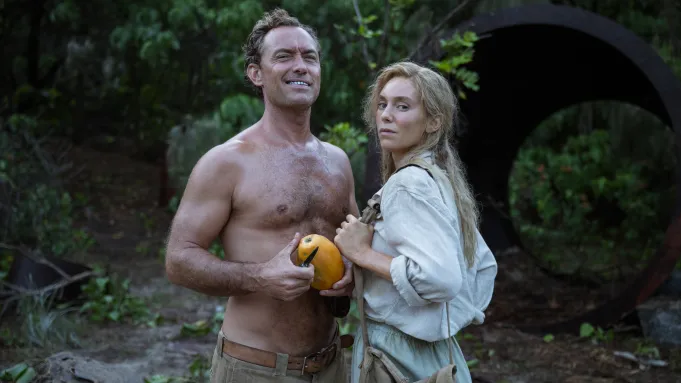

Based on a true story from about 100 years ago, writer Noah Pink and director Ron Howard tell the story of Dr. Friedrich Ritter (Jude Law) and his wife Dora Strauch (Vanessa Kirby) in Eden. The couple fled their native Germany in 1929 to escape the rising tide of fascism and settled on the near-uninhabitable island of Floreana (part of the Galapagos Islands in Ecuador). Friedrich begins writing a manifesto of his beliefs while Dora sets on a course to cure her MS through meditation; but mainly, they just want to be left alone.
The problem is, Friedrich’s letters back to Europe about his life on the island have been picked up by newspapers around the world, gaining him fame as a cult-like leader, and many want to come visit to see their life for themselves. Or worse, people want to live there with him, such as Heinz and Margret Wittmer (Daniel Bruehl and Sydney Sweeney), an ordinary couple with a child, Harry (from Heinz’s first marriage), who have become disillusioned with the world and also want to settle and live their lives as remotely as possible. With no readily available fresh water supply and no other natural resources on the island, the Wittmers have a tough time adjusting. But they are sturdy people who find a way to make it work and eventually earn the respect and tentative friendship of the Ritters, who initially actively want to see them fail.
Just as the Wittmers are starting to feel settled, a self-described Baroness, Eloise Bosquet de Wagner Wehrhorn (Ana de Armas), arrives with two devoted lovers, a servant, a wardrobe full of expensive clothes, and a dream to turn a large portion of the island into a high-end resort hotel. The problem is, she doesn’t really have a plan so much as a dream, and a loosely defined one at that. She’s also not above using her power over men to steal from her fellow islanders and pit them against each other so that she comes out on top. These extreme betrayals turn into a power struggle, and before long, tensions escalate and the fabric of this mini-society begins to turn violent, turning devoted pacifists into straight-up killers.
If I wasn’t aware going in that Eden was based on a well-documented true story, I’m not sure I would have believed it, especially once the Baroness arrives looking to charm and even seduce any man whom she deems useful. De Armas is especially enjoyable as the eccentric but not quite over-the-top character, who is more con artist than aristocrat. Howard has deliberately stripped this normally good-looking cast of most of their attractive qualities. For example, Law’s Friedrich has extracted all of his teeth so they don’t ever get infected and give him trouble. When he wants to eat, he inserts these terrifying metal teeth and chomps away. Only De Armas maintains some of her looks, simply because the Baroness is the only one who thinks looks are going to get her anywhere in this environment.
The most interesting part of Eden is observing it like a sociological experiment, waiting to see how long it takes for this isolated community to start devolving into a microcosm of the world they have tried so desperately to escape. Most fascinating is seeing footage of the real people during the film’s end credits and getting updates on what happened to them after the events of the movie. Director Howard is able to combine his recent fascination with documentary filmmaking with the type of storytelling that made him famous, and the result is an honest, grimy tale of a way of life that might not be possible or sustainable (or maybe it is with different participants). It’s a flawed telling, especially when the story sidelines Kirby for a great deal of the first half, but it’s still eminently watchable.
The film is now playing in theaters.
If you enjoyed this post, please consider supporting Third Coast Review’s arts and culture coverage by making a donation. Choose the amount that works best for you, and know it goes directly to support our writers and contributors.
