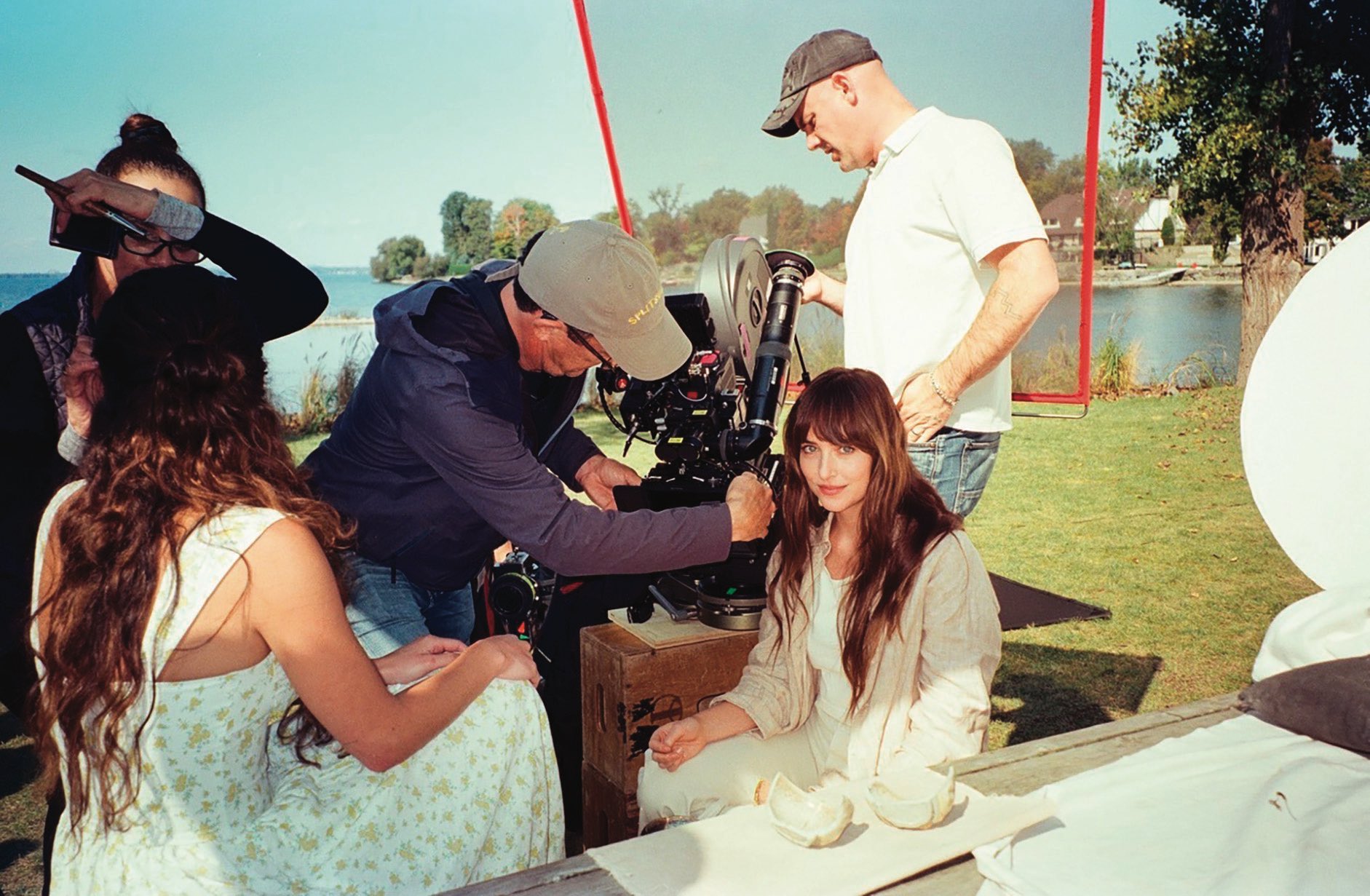
On the eve of chatting with Splitsville co-writers Kyle Marvin and Michael Angelo Covino (Covino also directed the film), it occurred to me that my last sit-down with them was in March 2020 for their previous film, The Climb, just days before the world shut down due to a global pandemic. That interview was the last in-person one I did for the better part of a year; my journey to meet them was my last trip on public transportation for even longer; and, they were the last people I shook hands with in 2020—all of which was probably a bad idea at the time, but I adored that movie and wanted to meet them.
With Splitsville, they do what they did for friendships in The Climb, applying that sensibility to marriage. It follows two couples whose friendship is jeopardized when Carey (Marvin), who has just found out his wife (Adria Arjona) wants to divorce him, ends up sleeping with the wife (Dakota Johnson) of his oldest friend (Covino); they say they are in an open marriage. The film examines just how open such marriages can actually be, jealousy, how foolish men can be, and the secret to happiness, in and out of a marriage. It’s a wildly funny, but also poignant, work that shows genuine growth in Marvin and Covino as filmmakers, actors, and commentators on how ridiculous people can be, especially those who think they know themselves inside and out (spoiler warning: they don’t).
I sat down with them last week to discuss the film and its origins, as well as dive deep into a hilarious extended fight sequence the two of them have in the movie.. Please enjoy our talk.
In the first 30 minutes or so of this film, you have a car incident—I don’t want to give anything away—followed by a huge fight sequence between the two of you. This movie has more action than most action movies I’ve seen this year. Was trying things you hadn’t done before one of the stated goals going into this movie? Sort of “Let’s see what our version of a fight scene looks like.”
Michael Angelo Covino: I think we’re always inspired to challenge ourselves, because if we’re challenged and doing things that are exciting to us, it usually comes through on screen. We also are constantly trying to find things that would be surprising in this style of film. When we came up with the ideas for those two scenes, those were the things that made us want to make this film, above all else. We said, “This will feel new and exciting to us. If we saw a film like this, with those things in the first 45 minutes, we’d go, What am I watching?” So that’s an exciting thing to us, purely because there’s a lot of options for what people can watch these days.
Working with a stunt coordinator on that fight scene, how do you describe to the guy “We want this to look messy and exhausting, un-choreographed"? You guys are panting at one point. And it looks like it’s the two of you the whole time, unless you found a clever way to include stunt doubles. Tell me about working with a stunt coordinator on that sequence.
Kyle Marvin: That fight sequence is just us; there were no stuntmen on that. Part of what we did from the get-go was work with this great stunt coordinator, who was awesome, and we would saying “Okay, you’ve read the pages, how do we do this one piece?” And he would tell us where the camera would be to hide the punch and maybe it moves a little to sell it. And we were like “That’s great, we’re not doing any of that. What’s the most impossible way to shoot this?” And he would say “Over here, because then you guys would have to actually hit each other.” “Great! That’s how we’re going.” A lot of the work with him was about breaking the expectations of the audience's wired brains to know what a fight looks like and make it feel as real as possible.
So the hits are real?
MAC: Some are and some aren’t, it just depends on the angle. We weren’t going to hit each other for the sake of hitting each other. If we could cheat, we would cheat. But there was this desire to capture it in a vérité style and not have the camera move, have it stay still, let the action play out so you could just watch what was going on. When you do that, you can’t hide as much because the camera is not moving, you can see full bodies, so you really have to do the things if you’re trying to sell it like it’s really happening. It puts the pressure on us as performers because it’s very clear if we’re faking it. As we did it, if it looked fake, we’d say “Forget that. Take that pad off because it’s bulging through the clothing. I need to flip you harder onto the table because it looks weird if you’re just jumping onto it.” Eventually, as we rehearsed it over and over again, it became more real in order to sell it better.
I want to talk about your writing process. How soon after you were done with The Climb did you start to think of new ideas? What was the beginning of that process like? Did you latch onto this concept right away, or were there other ideas first?
MAC: We’re never not writing three things at once. When we were finishing The Climb, we were writing another movie that we’ve since finished, and we’ll make at some point. And then we’d come up with a number of other ideas, we worked on adapting a television show, so we worked on a bunch of things, and this idea came about only in the last two years. In an attempt to return to something we could make in a way that we knew how to make it, and we could fully creatively control it from top to bottom. We could ensure, if we were given the resources to do it, we could make the movie we wanted to make, and that was always the hope. In this case, it was something that Kyle and I could act in as well.
As friends, is it more difficult to write the scenes in which the two of you are in conflict than it is to write scenes of you two being friends?
KM: I think the fighting stuff is more fun. Those dynamics are more heightened and more primed for comedy. Generally, when we’re fighting, we’re weaving in comedy because they go so well together, or they’re just natural cousins. The more heartfelt moments are funny as well, but those moments are as much in the performance as they are words on page. Across the board, we’re always going for simplicity—I know we put a lot of likes in here, and that’s probably counterintuitive to say—but I think we’re trying to go for the essence of things and get to the most distilled version of them, and that generally tends to lead us toward less exposition-heavy words…I can’t even speak .
MAC: As you talk about using the least amount of words, you use the most amount of words .
KM: Maybe I just can’t write.
MAC: The easiest scenes to write are the ones with the most clearly defined character motivations or intentions. So when we know where the characters are coming from, it comes out of us. When there’s vagueness in the characters and we don’t fully understand, that’s where it’s hard, because it requires that we put in exposition to expose where the character is coming from and you have to explain things. When there’s conflict between characters, it’s easy to write because you don’t have to do any of that exposition work.
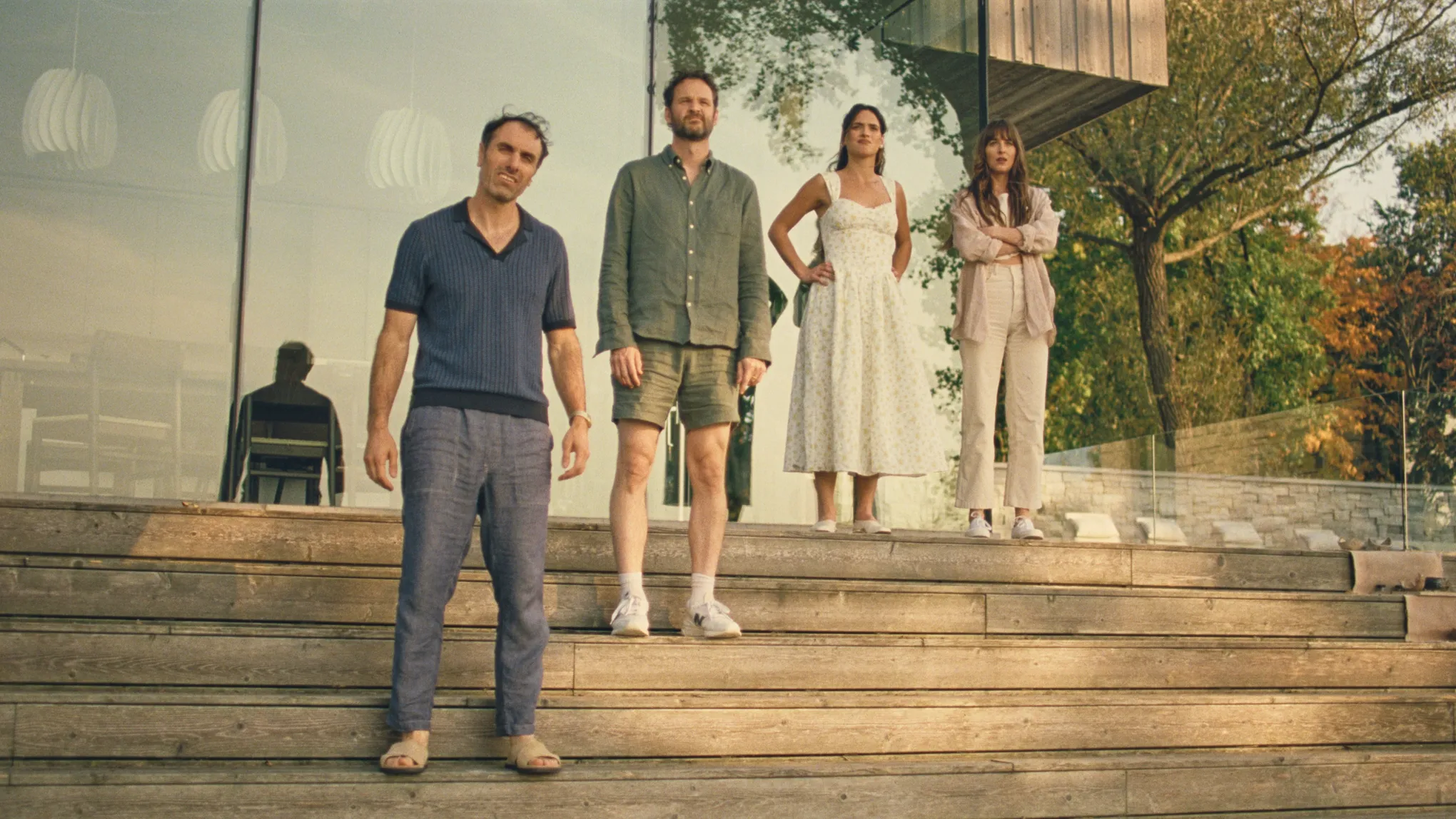
Much like The Climb, this film is told in chapters. Why do you choose to use that as your storytelling framework? Do you not like transitions?
MAC: There’s an elliptical nature to the storytelling in both The Climb and this, and because we’re jumping over periods of time, and the way were were trying to frame and structure the film, it felt like it could be broken up into chapters. But we also use chapters in this film in a counterintuitive way, where it doesn’t show a passage of time. There’s one chapter card in this film that breaks up the same shot, right after Kyle and Dakota sleep together, it hard cuts to me in the kitchen and Kyle on the couch, and then a title card comes in and then goes right back to that same shot. It’s playing with the expectation there, because it’s saying “Disclosure of Facts.” You know something just happened, a title card comes in and says “Disclosure of Facts,” and it tells you where the story is about to go, so there’s a bit of anticipation.
The usage of the title cards is different in each case, but our approach with it is to always be playful with the cinematic language. So many other aspects of the film are playful and reminding us we’re watching a film—it’s not intended to be some slice-of-life, vérité film; it’s intended to be a celebration of different types of cinematic language and constantly remind the audience to have fun and play around, and the title cards imbue that a little bit, even if they are divorce paper clauses and such.
Speaking of the cinematic language, I think your most cinematic sequence is the one in Carey and Ashley's apartment where you go through all of her different lovers. It looks like a one-shot—real or faked, I can’t tell—but I love that sequence. Tell me about planning that and making that work. How many times did you have to shoot that?
KM: We loved this idea of a bunch of lovers in an apartment, where there are no walls. From the get go, that was something we thought would be really entertaining. Within that framework, it felt more fun and natural and dynamic to have all the lovers coming in and out in a fluid way, where you felt the passage of those experiences without adding the staccato thing of introducing all of these characters and place them. We found that something interesting and compelling.
MAC: There’s something I also love doing—I don’t always want the audience to be ahead of the film. I want the audience to catch up sometimes. Sometimes, it’s nice to disorient a little and make the audience go “What is this?” whether it’s good or bad. If the whole movie is like that, it’s exhausting, but to have a moment where you’re in no man’s land and say “Where am I? What is happening?”, it’s a real gift to the audience, as long as you bring them back. So I personally love that, and subverting the expectation that we’ve been living in real time and now all of a sudden, 40 or 50 minutes into the movie, we say we’re doing in-camera lighting cues and people are changing off camera into new clothes in the same shot, and then the camera pans over and it’s as if a week has passed.
That felt playful and it energizes the movie, and it goes to the place of what these characters are experiencing, which is that time is blowing by and these things are happening, and it’s a bit of a blur. Anyone who has been through a breakup and then moved back in with their ex-wife while she dates other people would probably say that this is what it feels like. I don’t know because I’ve never experienced it, but I can only imagine.
You have lots of commentary on marriage, monogamy, and open relationships, but I don’t think you land on a specific statement on any of it. Was that deliberate, and when did you get interested in the concept of open marriages as the subject for this film?
KM: We’re definitely less interested in commentary and more in conversation, to be honest. That’s a better framework for what we’re interested in. We’re not trying to tell people what to take away from the movie or what to think or spoon feed them some outcome or perspective. If anything, we’re trying to say, here are these characters, here are what their needs and wants are, and let’s send them into this subject matter and these problem and see how they respond.
MAC: And I had just gotten engaged when we were starting to write this movie, so some of the interest in it came out of that decision.
The last thing I want to ask is about acting without pants on. You both get to do it in this film. I would find that so completely distracting, not because I’d be embarrassed, but I’d be so worried about getting caught in something.
KM: Getting caught in something is the best teaser for this movie ever .
MAC: When I did that scene with Adria, I remember the first take, both of us—and we’d rehearsed it a bunch of times—but we both just said completely the wrong lines and stumbled. It was so funny how neither of us was in the moment. Well, we were in the moment but we were completely flustered because it was the first take and I was stripped and getting naked, and she looks down and looks up, and we’re trying to deliver the lines, and it took a second for us to get it together. It was a really funny thing. There’s something so great about those dynamics, those unavoidable dynamics, to find their ways into performance. It’s real and unavoidable. When you’re naked, you’re vulnerable—both to other people and yourself. There’s something very recognizable to an audience in that.
For sure. Guys, thank you so much. It was good to see you again. Best of luck with this.
MAC: Loved seeing you again. Take care.
KM: Thanks.
If you enjoyed this post, please consider supporting Third Coast Review’s arts and culture coverage by making a donation. Choose the amount that works best for you, and know it goes directly to support our writers and contributors.
