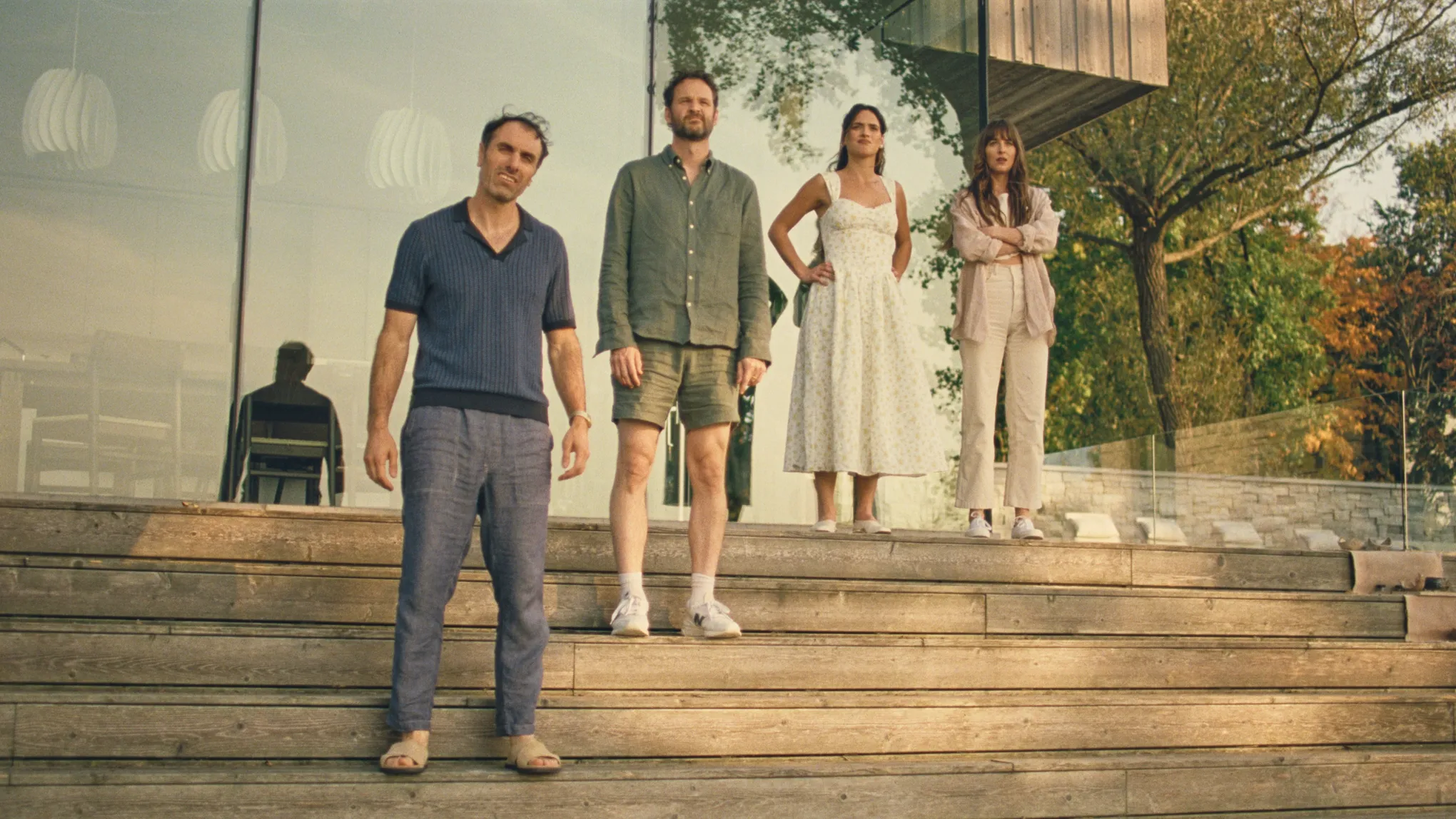

When writers Michael Angelo Covino and Kyle Marvin wrote their first feature, The Climb, some 5-6 years ago, they ended up making one of the definitive works about modern friendship and all of the love-hate connective tissue that comes with knowing someone since childhood. But now both men have grown up (or have they?), and with their latest work, Splitsville, they’ve moved onto the even more tangled relationship known as marriage, where both play married men involved in or contemplating open relationships in order to keep their married lives interesting—without considering all of the consequences.
The film opens with one of greatest sequences you’ll see this year (so I won’t spoil the details). Marvin plays Carey, driving to a rented vacation home where he and his wife, Ashley (Adria Arjona), are meeting his best friend Paul (director Covino), his wife Julie (Dakota Johnson), and their young son. But on the drive, Ashley announces that not only does she want a divorce but also that she’s been having affairs for the better part of the last year. This revelation causes Carey to pull the car over and flee the scene on foot in a panic. All of this occurs after she attempts to seduce him while driving (you can probably figure out the specifics on your own), with the end result being somewhat catastrophic, although they’re still able to drive away...only to break up a few minutes later.
Once Carey finally arrives at the vacation spot, he finds out that Ashley has already arrived, dropped off his stuff, explained the situation, and left again, living him alone with his long-time friend and a heart full of sadness. But not long after, as the three remaining adults begin discussing the secret to a happy marriage, it comes out that Paul and Julie have an open marriage and that they never discuss details of their affairs unless the other one asks, which they haven’t up to this point. Carey is stunned but intrigued, and not only decides to stay married to his wife but also not get jealous of her past or future affairs. As if to underscore his commitment to this new attitude, he and Julie sleep together one night while Paul leaves their vacation for a day to go into work, with Julie assuming he’s also meeting up with someone he’s sleeping with.
One of the many wonderful things about Splitsville is that, while it discusses the many pros and cons of the very modern concept of open marriages, it doesn’t judge the idea or come down for or against it. It simply presents the very real outcome of what can happen to a relationship when the participants think they’re ready to be open-minded about sharing sexual partners with strangers but are then faced with the reality of that situation. Everyone involved thinks they’re above getting jealous, and clearly none of them are.
The film is smart, hilariously funny, and incredibly real in its depiction of these various pairings. Ashley and Carey continue to live together, with her dating countless men, many of whom become good friends with Carey even after she breaks up with them, much to her annoyance. As she did in Hitman, Arjona shows that her straight-faced comic timing is devastating, while Johnson once again brings a kindness vibe to Julie that is somewhat deceptive and instantly collapses when Paul continually disappoints her with his action and attitudes.
There are moments of beautifully controlled chaos in Splitsville that are magnificently staged, including a continuous take where we (and Carey) meet several of Ashley’s lovers, and a finale set during a child’s birthday party featuring a mentalist (the great Nicholas Braun) who might actually be able to read minds (listen carefully to every word he says—not as easy as it sounds since people are talking over each other during the scene). With the end result being one of the best comedies of year so far, Covino and Marvin have stepped up their insightful and humorous game from The Climb and made something that is somehow funnier and more perceptive—no easy feat considering how high the bar already was.
The film is now playing in theaters.
If you enjoyed this post, please consider supporting Third Coast Review’s arts and culture coverage by making a donation. Choose the amount that works best for you, and know it goes directly to support our writers and contributors.
