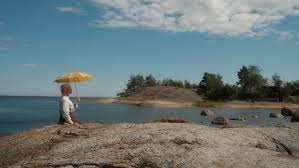

The Summer Book is a quietly powerful film, carried by Glenn Close’s quietly powerful performance. Director Charlie McDowell also gets credit for making this a great film that weaves together themes of grief, intergenerational connection, and nature into the story with subtlety.
Based on the novel of the same name by Tove Jansson, the narrative takes place on a remote island in Finland. Sophie (Emily Matthews), her father (Anders Danielsen Lie), and her grandmother (Glenn Close) are vacationing together at their family summer cabin. During this season, Sophie and her father try to process their grief from the death of Sophie’s mother, supported by Grandma (Close).
This film succeeds through Glenn Close’s nuanced physical performance, Charlie McDowell’s understated yet piercing direction, its expressive cinematography, and a calculated use of the symbolism of nature.
Easily the most praiseworthy aspect of this film is Glenn Close’s portrayal of Grandma. She embodies this character’s qualities viscerally; her wisdom, her strength, her experience all are apparent in the way this character carries herself. She moves gracefully, yet laboriously, feebly, yet with strength. Close’s nearly 80-year-old frame is one with the island. She hobbles with her cane across the rocks and beaches. She crawls under trees, she rows herself and her granddaughter to neighboring islands in their rowboat. Grandma is somehow strong and frail at the same time, and you can see it in her physicality.
Grandma alternates between expressiveness and silence. She speaks directly, and can be brash about emotional things, like the way she encourages her son to help Sophie grieve for her mother.
But we learn the most about her character in silence. We see her joy when she swims in the water and when her weathered face basks in the island sun. In one scene she walks naked through the woods, completely at peace. This image probably tells us the most about who she is and what makes her happy. We also see her at her most maternal when she comforts her son after he expresses being overwhelmed about taking care of Sophie. She does it without saying a word. Not many actors could literally embody Grandma the way Glenn Close does.
Close’s performance is enhanced by the direction of McDowell, who is no stranger to understated emotional plot lines taking place in confined spaces (see his previous work in The One I Love and Windfall). He artfully uses the lonely island setting to help us learn more about the film’s characters and the dynamics among them.
The Summer Book uses its wild yet isolated environment to mirror each character's inner life, each dealing with grief and change, carrying a great deal of internal activity, yet they’re isolated from one another. McDowell makes this comparison repeatedly but the symbolism never feels forced. It feels natural and true to each character.
Of course, the cinematography overall puts this movie in a class of its own. Watching this film is a sensory experience. The emotional weight of each character’s journey is conveyed through the use of light, the steadiness of the rocks, the rhythm of the sea, and the liveliness of the forest plants. When you watch this movie, you’ll feel what you see.
The final scene, in particular, is the film’s pièce de résistance, where Grandma feebly crawls up onto a rock at the water’s edge and looks out onto the sea, her heart beating in time with the waves. We know her heart will stop soon, but for now, she’s holding onto the beauty and pain of life. It’s a beautiful symbol of the film’s story, conveyed without any words, just an image.
The remote Finnish island provides a logical backdrop to embody the natural themes of grief, growth, life, and death. Even though this obvious metaphor is used over and over, it never feels trite. Summer itself is its own symbol in this story, as each character in some ways could be considered to be in their prime, full of life. Yet they must fight through the natural elements around them to thrive.
The Summer Book is a masterpiece that appeals to the senses. Carried by its small cast, especially Glenn Close, and strong direction from Charlie McDowell, it uses the story of a small family on a tiny, remote island to explore universal themes of grief, growth, life, and death.
The Summer Book is now playing in theaters.
If you enjoyed this post, please consider supporting Third Coast Review’s arts and culture coverage by making a donation. Choose the amount that works best for you, and know it goes directly to support our writers and contributors.
