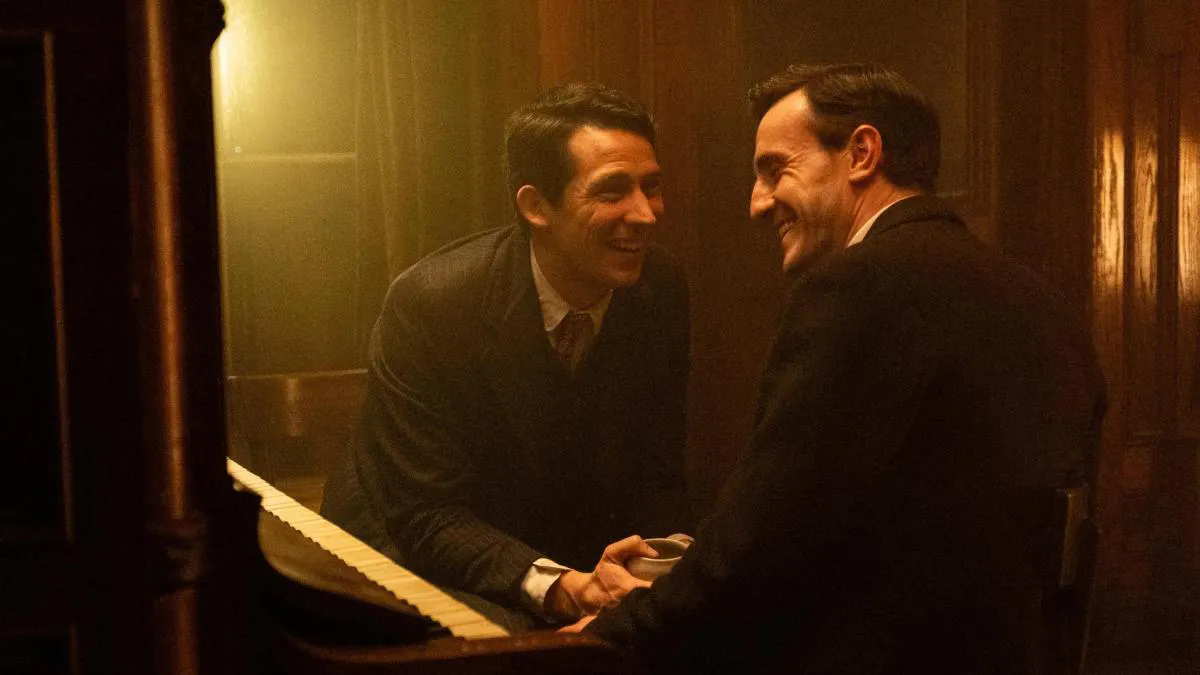

Too often in love stories, we are told two people are in love but we’re not shown whatever that inherent thing is that pulls them together. As in real life, it’s a difficult emotion to illustrate, but when a film gets it right, it borders on bliss.
With director Oliver Hermanus’ (Living) latest, The History of Sound, the connection between his two leads is clear: music. Specifically, it’s the characters’ shared love of folk music from the early part of the 1900s that brings them together initially when they both attend Boston Conservatory and again, years later, when the pair reconnect to go on a song-collecting trip through the most remote parts of Maine, making wax cylinder recordings and gathering any information they can about the songs.
We enter the story through the life of Lionel (Paul Mescal), who grew up with his parents (Raphael Sbarge and Molly Price) singing these songs to him; but he has a natural gift for singing, and that’s how he gets a scholarship to the conservatory in 1917. At a local pub near school, Lionel meets David (Josh O’Connor, who is set to be in four movies before the end of the year, including this one), who is playing piano and also singing familiar folk tunes, immediately making Lionel curious about him. The two fall deeply in love, and while it’s clear that their type of love would get them ridden out on a rail if they were discovered, the film doesn’t present them getting caught as a particularly real danger; there are other, more difficult to define forces threatening to drive them apart.
David goes off to fight in World War I, and when he returns in 1920, he enlists Lionel to take the song-collecting tour of backwater Maine with him as part of an academic research project. But after a unnecessary row, the two split again, pushing Lionel into academia in the UK and a relationship with a woman (Emma Canning) that becomes so serious she introduces him to her parents. On the other hand, David goes missing from Lionel’s life, and in desperation, he returns stateside to find his old friend and their recordings. Based on a pair of short stories by author Ben Shattuck (who also wrote the screenplay) and narrated by an older Lionel (Chris Cooper, who also voiced the audiobook version), the film looks deep into the painful process of longing.
There’s no doubt in Lionel’s mind who and what he wants, and the narrative explores memories and missed opportunities, assuming there were really any opportunities at all. When Lionel finally fills in the missing years of his friend's life, it’s devastating and impossible not to feel despair. The last new character we meet is David’s wife (Hadley Robinson), who is the only person who might understand what Lionel is going through and certainly has an inkling as to who Lionel was to her husband.
As a story set more than 100 years ago, don’t expect the film to be some pride-forward look at a gay relationship. These two are at the level of closeted to the point where having relationships with women was to be expected. They barely even talk about the forbidden nature of their coupling, but they don’t have to because for them, and us, it’s evident they are at their best when they are together. The History of Sound is a beautiful, quiet, intimate and impactful film that leans into its story of love in the time of soulful songs, and it doesn’t hurt that Mescal has a stunning voice.
The film is now playing in theaters.
If you enjoyed this post, please consider supporting Third Coast Review’s arts and culture coverage by making a donation. Choose the amount that works best for you, and know it goes directly to support our writers and contributors.
