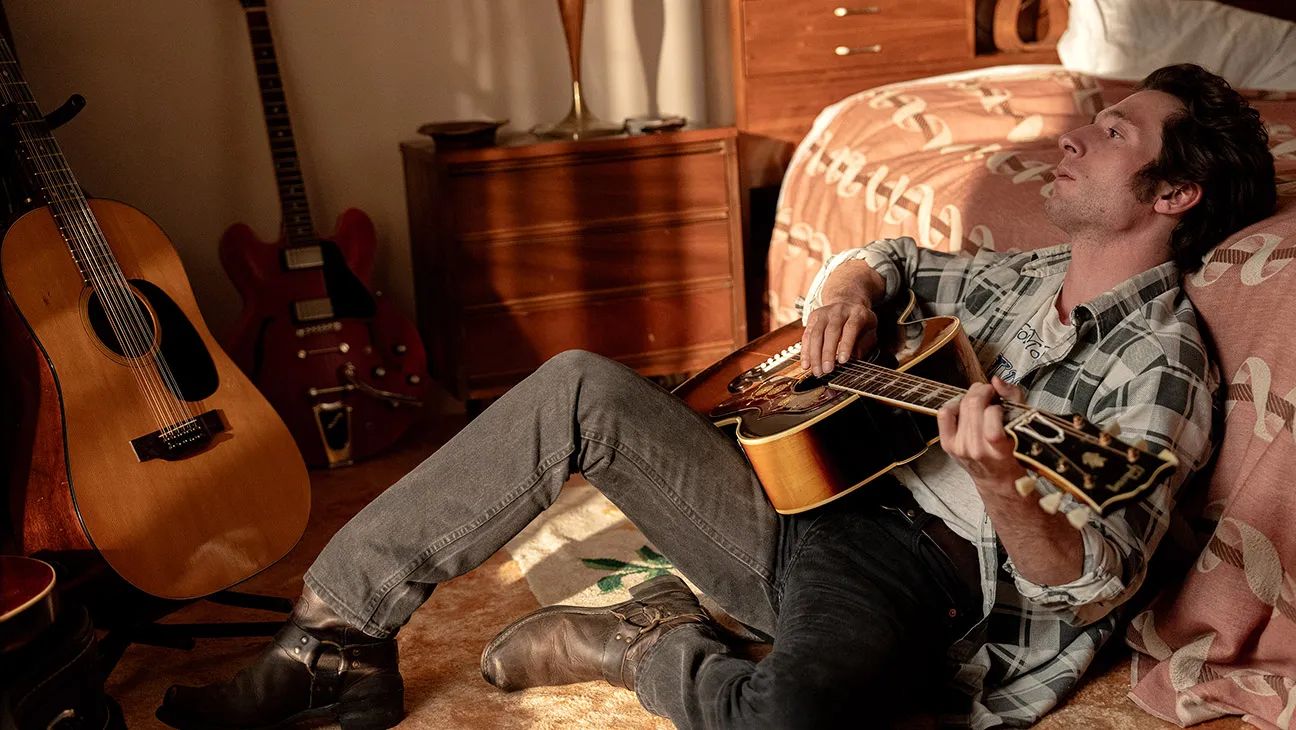

At some point years from now, I’m sure someone will attempt an actual biopic or biographical series about Bruce Springsteen. But for now, I think Springsteen: Deliver Me From Nowhere is the right approach to arguably his most inspired and inspirational work, the 1982 album Nebraska—a work that has influenced an army of rock and country musicians from both a songwriting standpoint and in terms of its lo-fi production approach.
Directed and adapted by Scott Cooper (Crazy Heart, Black Mass) and based on the effectively sanctioned book of the same name by Warren Zanes, the film presumes that everyone watching it has some working knowledge of both Springsteen (played beyond effectively by The Bear’s Jeremy Allen White) and the album that eventually became Born in the USA—a fairly safe bet. But the making of Nebraska has been the stuff of legend—perhaps more like mythology—until Zanes’ book was released. There have been bootlegs of outtakes recorded in the style of that album, some of which ended up on USA, and others that simply never surfaced officially. But the film isn’t concerned as much with potential track lists as it is Springsteen's state of mind before and during the recording.
The film opens at the end of 1981, with the final show in his year-long tour for The River—his first number one album, which included his first-ever top 10 single (“Hungry Heart”). He arranges with his manager, the former record critic Jon Landau (Jeremy Strong) to rent a home in Colts Neck, New Jersey, for some downtime and to maybe tinker around with a few new songs; Landau recommends he not waste time and money crafting his next album in the studio and instead, bring recorded demos to kickstart the work.
He buys the earliest version of a four-track recorder for $1,000 and gets his guitar tech Mike Batlan (Paul Walter Hauser) to set it up and record a handful of songs on January 3, 1982, resulting in most of the Nebraska album. Springsteen had always intended on taking these songs to the E Street Band, and we do see them record one of them, Born in the USA, pretty much how it sounds on that album. But most of those versions of the songs didn’t sound the way Springsteen wanted, and thus began the technical process, with the help of his engineer Chuck Plotkin (Marc Maron), of making the vinyl release of this new material sound as stark and haunting as they do on the cassette tape that he’d been carrying around with him (not even in the case) in his shirt pocket.
Throughout the film, we get brief, black-and-white flashbacks of Springsteen as a boy (a beautifully understated Matthew Pellicano Jr.) and various interactions with his father, Douglas (Stephen Graham), and mother Adele (Gaby Hoffman), but it’s the boy’s memories of his dad that haunt him, sometimes resulting in nightmares. Going into bars on his mother’s behalf to drag his father out, or his father trying to teach him to throw a punch to defend himself. Douglas’s ideas about being a man are base and abusive, and it didn’t help that all of these memories feature him being drunk. But a few also help shape the Nebraska record, such as his father driving their used car to park on the road and look up at a mansion at the end of a long driveway. His dad would imagine out loud what it must be like to have all that money, not knowing that 20 years later, his son would have that much and then some.
As the record takes shape and Springsteen temporarily shelves the material destined for USA, the battle with the record company begins, especially when Landau informs them that his client won’t be doing any interviews about the record, no singles will be released, and for the first time in his career, Bruce won’t tour with the new release; hell, his photo won’t even be on the album cover. Knowing that Springsteen is poised to become a superstar with his next big rock release, putting out Nebraska will basically delay that a couple years. But the film makes it clear why he needs to get this out of his system.
Perhaps the only part of the film that some might think is disposable involves a fictional relationship he has with a young single mother/waitress from Asbury Park named Faye (Odessa Young). The character is more of an amalgam of women that Springsteen dated at the time, but it’s clear that he really cares for her and her daughter, and like most things that scare him, he ultimately decides to run away from her when things get more serious. This is who he was at the time: he ran away from fame and anyone who really cared about him, more because he couldn’t trust himself than for any other reason.
And it’s this fear that drives the final act of the film, after the album is done, when Bruce and a friend drive across the country to California where his parents have since moved. During that journey, Bruce has an absolute mental collapse, and when he calls Landau for guidance, Landau wisely admits that his friend’s issue are more than he can handle and recommends professional help. So many of the characters on the Nebraska album are lost souls looking for connection, some are even looking for a reason to keep breathing, and that’s why Springsteen kept writing those dark songs—because he so fully identified with them. It's like group therapy in songwriting form, and the film and especially Jeremy Allen White capture Bruce at that fragile, critical juncture in his life, making it clear that this phase could have gone in a much more tragic direction.
Deliver Us From Nowhere is great for those who simply want to see how much of their encyclopedic knowledge of this period in Springsteen’s career is covered. And while it may take a little bit of dramatic license with the facts, it’s the tone of what was happening at this bleak moment in time that the film gets so strikingly correct. But there are little things—like Bruce changing “He” to “I” while hand writing the lyrics to “Nebraska” and making these songs all first-person stories rather than simply having a storyteller relate them—that add so much to the understanding of why these songs and this album shook so many people beyond just the one making the music. And White’s performance ties it all together, giving us a true understanding of not just the pain that had to be lived for this art to exist, but also how creating such music was the key to opening up the healing process for Springsteen. I’m desperate to watch this film again.
The film is now playing in theaters.
If you enjoyed this post, please consider supporting Third Coast Review’s arts and culture coverage by making a donation. Choose the amount that works best for you, and know it goes directly to support our writers and contributors.
