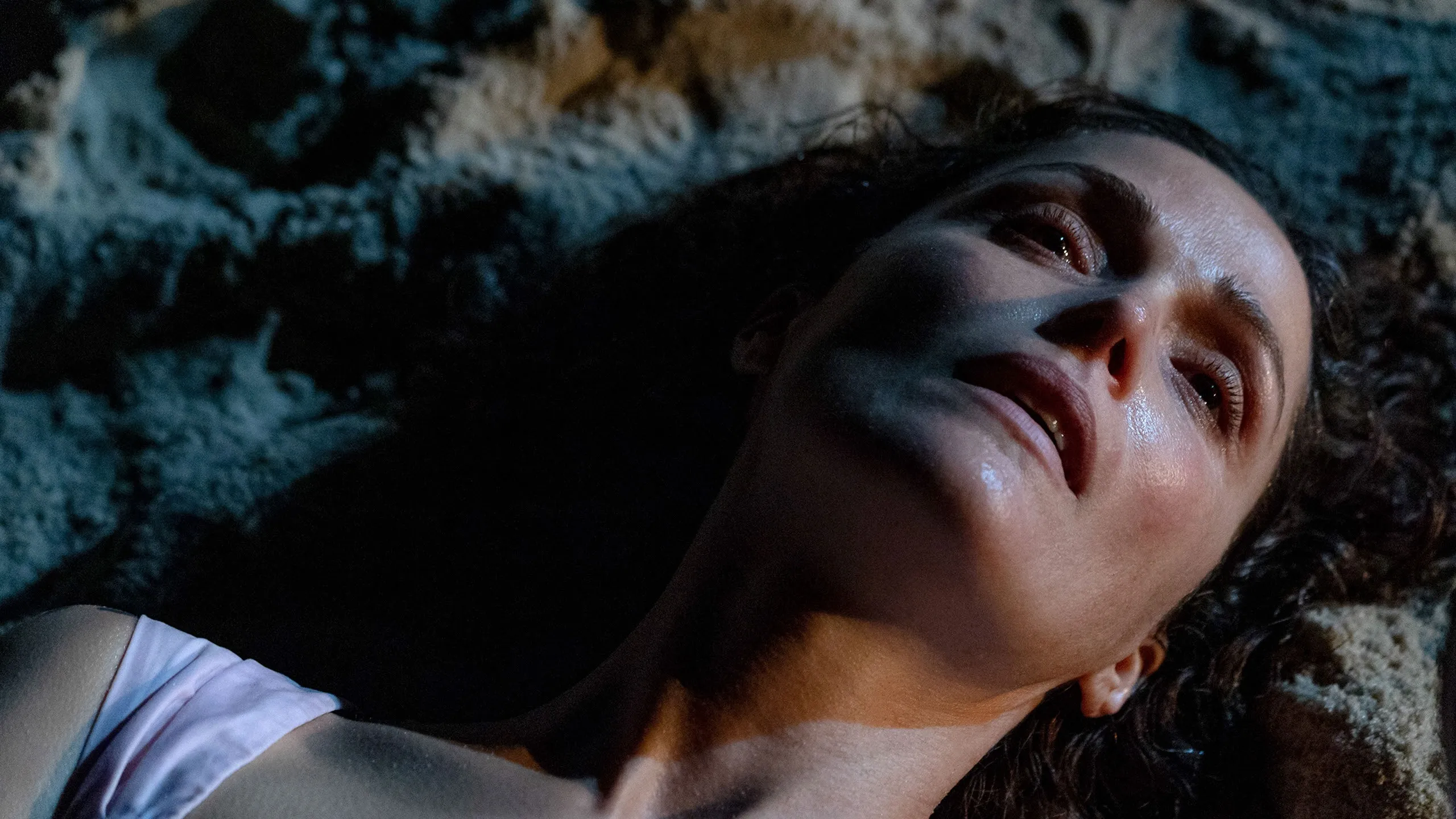
Currently in theaters, writer-director Mary Bronstein’s If I Had Legs I’d Kick You tells the story of a young mother and therapist named Linda (an edgy Rose Byrne) whose life is crashing down around her as she attempts to navigate her child’s mysterious illness, her absent husband (Christian Slater), a missing patient (Danielle McDonald), and her own therapist (Conan O’Brien) who refuses to actually give her any kind of advice or help. Anxiety is the dominant force in the film, much of which was based on Bronstein’s (Yeast) own experience as a mother who wanted to be a good caregiver but didn’t want to lose who she was in the process.
It takes a certain amount of bravery for a filmmaker (especially a female one) to say out loud that being a mother is not just hard but also a substantial pain in the ass, and this movie can get quite intense without ever forgetting to sometimes be funny and wholly relatable. If I Had Legs has frequently been compared to the Safdie brothers’ Uncut Gems in terms of the way it conveys stress and high-pressure situations, so it should come as no surprise that Josh Safdie is a producer on the film, or that Bronstein’s husband is frequent Safdie editor and co-writer Ronald Bronstein (also a producer on the film, and also worked on Uncut Gems as well as Josh’s upcoming Marty Supreme).
If I Had Legs is a powerful, one-of-a-kind sophomore effort that feels like an emotionally driven thriller filled with unexpected revelations about the pressures of parenthood and how often the world refuses help to those in need, even if those in need are staring them in the face begging for assistance. Bronstein was in Chicago recently as part of the 61st Chicago International Film Festival, and we had a chance to discuss the seismic event that is her new movie. Please enjoy our conversation…
I saw this at Sundance…
Oh wow, at the beginning of the journey.
Yes. And when they asked me if I wanted to see the movie again to refresh my memory, I said, “No, I remember it. It’s ingrained in my memory.”
That’s a great compliment.
Did you have to amass a certain type of courage to say some of the things you say in this film about motherhood?
Yes, I did. Starting on the page, what I wanted to do was capture feelings that I had had when I had a full existential crisis, where I felt myself disappearing in the task of caretaking, taking care of my daughter. Not only because she had a health issue—she was seven years old when that happened—but also the previous seven years, giving birth all the way through the health issue had just built up in me and then this happened, and I felt myself totally disappearing and feeling like “Who am I? What am I? And after she gets better, what the hell am I doing?” So I started writing this screenplay from that emotional space, and what I wanted to do was capture this very urgent and immediate feeling in the script and also have that be the feeling on screen.
There were some parts in the script, when I was refining and doing some drafts, where I took some things out because they were too much, but then I ended up putting those exact things back in because it was my intuition that they were in there, and anything that was scary because it was going to be too much for people, too uncomfortable or upsetting, that belongs in there, because that’s what this is about. So I ended up putting it back in, and then while making the film, it’s all encompassing—we did this is 27 days, and it’s 24/7. You’re filming all day, then you drop in your bed for a few hours, you get up, and you’re back in it. You’re living in the world fully for 27 days, and it was adrenaline and trying to keep at the center of it, this feeling, and never letting up on it. It was tenacity that got me through. It really was. That and being in lockstep with Rose.
Once she came on board, did the character change at all? I’m sure she had her own experiences and insight to add to yours. Tell me about those early conversations the two of you had.
She did, although the character didn’t change so much as came to life in a more full way than it was on the page. The character, Linda, is an idea of a person, and when Rose came on board and we started working together, which we did very intimately, more like you would prepare for a play than for a film. Rose kept saying “This is so luxurious; we never get to do this.” But we had 5-6 weeks where we would work together at my kitchen table and just go through the script and have personal conversation, get to the end of the script, and then go back to the beginning. Out of that work, we became very close as human beings and friends—I don’t know how we could have made this movie if we weren’t—and she brought a lot to it that I hadn’t thought about, which is “Who is this woman outside of this story? Who is this woman before her kid got sick? Who is this woman before she had a kid?” That opened up so much.
I don’t do exposition in the film on purpose. My concept was to just drop the viewer in, and they have to catch up. But it’s in the film, in that she’s a fully-formed, live human being that you really believe existed before the camera turned on and after the camera turns off. From those conversations about who she was outside of the story that I had written down, we get these details where she has tattoos, or maybe she didn’t always think she was going to be a therapist. She wears a band t-shirt at the end that has holes in it and is clearly old—that’s my Big Brother & the Holding Company, Cheap Thrills t-shirt from when I was 14 and I still had it. Then there’s one part of the movie where she puts her hair up, and you see that her head is shaved—that’s a certain type of person who does that. There are all of these little clues about Linda outside of her motherhood. I remember when we were discussing it at one point, Rose goes “Oh, Linda was cool.” And we made a playlist of stuff that Linda would listen to. Rose brought all of that to me, and it’s there in the performance.
That seems like one of the things that’s driving her and what’s making this so hard for her is not wanting to lose that person to motherhood. Things have to change, but she doesn’t want them to change so much that the old her is gone.
Exactly. Absolutely. She’s panicked. it’s that feeling I was talking about where I felt like I was disappearing. One of the central anxieties of the film is how do you hold onto yourself as a person and individual and not just so-and-so’s mom, while also being so-and-so’s mom? How do those things go together? What I’ve been hearing from a lot of women is that that’s something they really relate to. My daughter is a teenager now, and her friends don’t call me by name or even Mrs. Bronstein; they call me Faye’s mom. “Faye’s mom, can I have a glass of water?” I don’t have a name; they don’t care; they don’t ask me what my name is, so it’s that loss of identity, even in that simple example I just gave, that you can abstract out fully. When that kid goes to bed, there’s that stereotype that has a lot of truth to it where the mom opens a bottle of wine and tries to escape a little bit and relax and thinks, “For these hours until I got to be, I’m not their mom. I’m me.” And it’s difficult.
Linda asks for help sometimes, and people just don’t give it or even offer advice. She literally asks here therapist “What am I supposed to do?” And he says, “You know what to do.” That’s a wild moment.
And it’s very frustrating. She’s literally begging him him to tell her what to do. For me, that’s a moment that really reflects what it feels like to be a mother. When I had my baby, five minutes before the baby came out, I was not a mother, then I’m a mother, and then you’re supposed to somehow by osmosis or magic, know all of these things. I’m the same person I was five minutes ago, and in that moment, that represents what society does, which is say, “You’re supposed to know, because I’m a mom.” But I’m just a person. I don’t know, and there’s a real stigma to saying that; you’re not allowed to say you don’t know what you’re doing. You’re not allowed to seem like you don’t know what you’re doing, because how scary is that? It’s terrifying to your child, to the people around you, to admit that you don’t know what the hell you’re doing. In any other job, that wouldn’t be as scary. You can say to your boss or coworkers, “I don’t know what I’m doing. Can you help me out?” But when you’re a mom, it’s very isolating, and some of the tenacity I was talking about earlier comes into play, and I wanted to be very radical in having this character address those things that people in real life feel like they can’t.
I love the relationship she has with A$AP Rocky’s character because he’s the one person who’s paying attention to her and her needs. Her husband is a non-entity at this point.
Yes, yes. He shot this first and then went on to work with Spike Lee . It’s great year for him, and he’s wanted to act for a long time, and really made himself so open and vulnerable to me, fully trusted me, and this is a person who’s used to being in control of his work, and he fully availed himself to me. That character is so important because, as you said, he’s the one saying “Do you want to be friends? Wanna hang out?” As an individual and not as as mom, and she’s playing with that. That’s the cool her. But he’s also the only one who will call her on her bullshit. He sees her for her flaws and for what she’s doing “wrong,” but he’s not judging her, and she throws him under the bus so hard . At that point, he calls her Mother of the Year, sarcastically. There are other people…for example, she’s begging her therapist to judge her, and he won’t. “Tell me I’m not supposed to do that.” And he won’t do it.
I want to ask about the portal, the hole in their house. The soundscape is incredible. It feels like it represents this giant void in her life…
We called it the Void.
What does it represent to you?
I’m so interested in everyone’s different interpretations, so I don’t want to close it up for people in terms of giving my literal thoughts about it. But I will say, it’s that part that everyone has inside of them where they stuff everything that they don’t want to deal with, they don’t want to remember, that they’re denying. It’s the place where they stuff it down, and it exists there; it doesn’t disappear. It exists inside of you still, and if you have a trauma and don’t deal with it, it’s going to get you, just like in a horror movie where Michael Myers is going to get you no matter how slow he’s walking. He’s going to get you. And it’s that sort of terror, and it does end up getting her, and when it does, it’s a jettison all the way to the end of the film.
You do use the language of horror films in certain places.
Yes, I do. I’m a big horror film fan, and I looked back at horror films from my youth—Poltergeist a lot, I watched that with my cinematographer many times in preparation for some of the visual stuff, and the effects in my film are almost entirely practical; A Nightmare of Elm Street was another one. When you can feel that these things are happening in the room with the actor, it makes it that much scarier, and it looks different visually.
I’m sure everyone is asking you this, but I’ve avoided whatever your responses might have been to this question: Why don’t you show the child for most of this film?
There are two parts to it: one is manipulation and one is conceptual. The conceptual part is that I’ve never seen in a movie before where, we’re in Linda’s reality and she can’t see her daughter as anything but an obligation or something that is put upon her or something that is happening to her. So she’s not seeing her, and I’m making it literal. It was an experimental thing that I’d never seen in a film before, and it was a big Trust Me moment. I didn’t know if it would work. The manipulation part is that if you were to get to know the child as a real little girl and have in your head what she looks like, especially in the scenes in which Linda is doing something wrong or that could put the daughter in peril, if you see her face, unless you had no heart, your sympathy is going to go to the child. It is cruel in a certain sense because I’m locking you out from that, so that you only have Linda to stay with.
Makes perfect sense. Thank you so much for making this film and best of luck.
Thank you so much. I appreciate it.
If you enjoyed this post, please consider supporting Third Coast Review’s arts and culture coverage by making a donation. Choose the amount that works best for you, and know it goes directly to support our writers and contributors.
