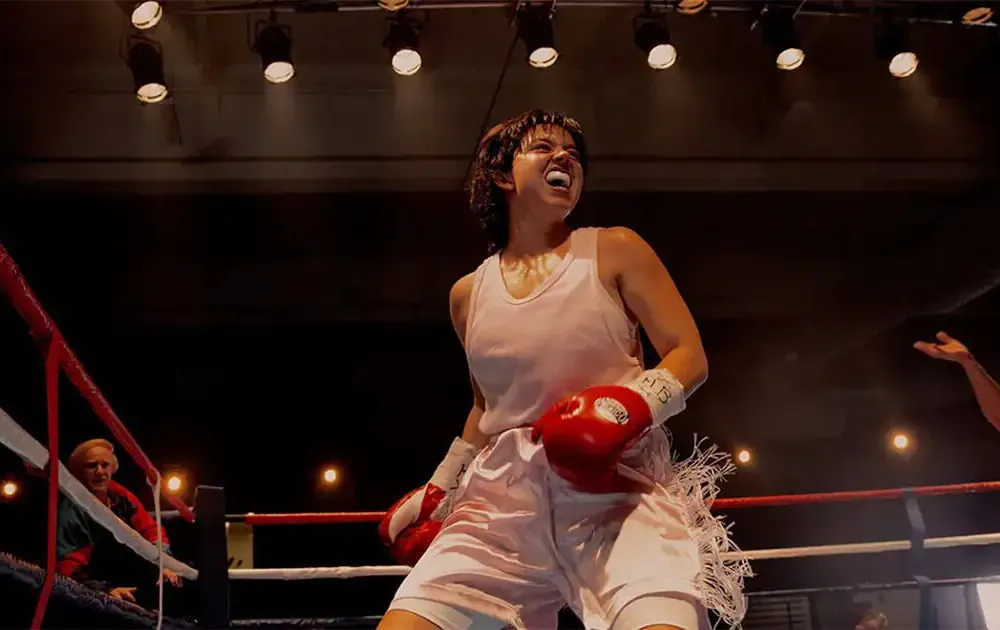
Because she was born in West Virginia and was the daughter of an actual coal miner, groundbreaking boxer Christy Martin was nicknamed the “Coal Miner’s Daughter” in the early part of her career. Although she had no formal boxing training in those early months, she did have a true love of knocking the stuffing out of opponents, a passion that got her noticed by promotors and the male-dominated boxing world.
Now, Martin’s life story has been turned into the film Christy, directed by Australian filmmaker David Michôd (Animal Kingdom, The Rover), and starring Sydney Sweeney, who put on an incredible amount of muscle for the role. Martin’s life was not easy, and not just because of the inherent sexism that went along with being a female boxer. She eventually married her manager, Jim (Ben Foster), who turned out to be a dominating, physically and mentally abusive husband who did everything to keep Christy from leaving him or getting out from under his control—including trying to kill her. The film also introduces us to her conservative parents (Merritt Wever and Ethan Embry) who refused to help her escape her terrible marriage. A solid 2021 documentary about her life, Untold: Deal with the Devil, is now running on Netflix.
Christy has a few high points as well, including Christy getting signed by Don King (Chad L. Coleman), who made her the first woman to fight in a pay-per-view event; and eventually meeting Lisa Holewyne (Katy O’Brian), her greatest boxing rival who ended up becoming part of her training team and eventually her wife. The film can be a tough watch, but it’s also incredibly inspirational and ultimately up-lifting.
I had the chance to chat with Martin when she was in Chicago recently, and we discussed her involvement with the film, how much Sweeney consulted with her, and how it feels watching some of the worst moments of her life re-created for the world to see. She’s a great talker, so please enjoy our conversation. The film will be released in theaters this Friday.
Let’s go back to the beginning. How did this whole process start?
There was the Netflix documentary, and then I have a book by Ron Borges, who was the hall of fame writer who wrote about boxing and other sports for the Boston Globe. It just caught fire once all of the production companies came on board and then Sydney Sweeney came on board, it was only months later that we were filming, and we finished filming last year in November, and here we are this year. They tell me by Hollywood standards, that’s pretty quick.
That’s true. Why was David Michôd the right guy to tell this story. Why did you trust him to get it right?
I had met him via Zoom a couple years before we started filming, and I just liked him. He seemed like a good guy. And I feel that Hollywood and boxing is similar, in that trust is something isn’t easily given, but I had some kind of connection with him. And his partner, Mirrah Foulkes was the writer, and I felt that they not only put the story out there but they kept me updated and kept everything real, and that was important to me.
Before shooting, were they checking in with you about certain scenes or moments, in terms of the direction they were going with them, or things they were including or not including?
I had lots of conversations with Mirrah, and I wouldn’t say they were constant, but they would check in from time to time just to say, “We’ve added this, changed this, cut this out.” That was probably the biggest thing: leaving something out because it was too much.
At what point did Sydney’s name get told to you, and what did it take in talking to her that made you feel she understood the assignment?
They basically told me it was going to be Sydney . I knew who she was a little bit. I’m old, so I didn’t watch Euphoria, but she’s sexy, she’s hot, she’s one of the it girls right now. And I thought it was a strange choice, but I think it was equal parts her choosing the movie and the movie choosing her. But when people see this, they’re going to go “Wow!” because they’ve never seen this Sydney Sweeney. She’s down and dirty and she’s Christy. She’s sweaty, boxing, and not what people are used to seeing.
With both the physical transformation and the things that your story puts her through, I don’t think we’ve seen her doing any of those things before. Leading up to shooting, how involved were you in her training, especially her fight training?
Her boxing trainer was Matt Baiamonte, who originally worked with Angelo Dundee, who worked with Mohammad Ali and Sugar Ray Leonard. Once I knew that Matt was her trainer, I knew she had this because I’ve known him for a long time, and he clearly watched me fight before. It’s fun to watch her be me, and she has me down pretty good.
Was it strange at first watching someone be you, or were you able to put some distance between your own life and the movie?
Last night was the third time I’ve seen the movie, and it’s still weird. But last night was the first time I watched it a little differently, like maybe it wasn’t me. The first time, the movie wasn’t really complete, the music was in there. But when we saw it in Toronto, it really affected me, so maybe I went into last night with a bit of a wall and tried to distance myself, but I still had to remind myself sometime that that was me, and sometimes I had to remind myself that it wasn’t me, because she’s very convincing.
I noticed part of your boxing outfit for many years included fringe on it. Was that a pain to box in something like that?
Not really, because it was pretty short. But today, people wear this stuff that’s crazy, and I wonder how in the world they are able to box in that.
You have the title of consultant on the film. What did that entail? Who consulted you the most, and what kind of guidance were you giving?
Mirrah was my number one contact. Sydney spoke to me some, especially after each scene, she would come back and have something to say, whether it was about the scene or not. She was very kind and sweet that I was on set. She said sometimes it made her nervous, like she felt a little extra pressure. But mainly I just watched. I’ll give you a great example: during the basketball scene, Sydney is not a basketball player. I actually took the basketball, went out on the court, and showed her how to throw a bounce pass. And then I went and sat down, and people were laughing because I wasn’t really supposed to do that. And maybe I wasn’t, but I wanted it to be realistic. She doesn’t know how to do it, and you don’t know what you don’t know, so I showed her.
Did you give her any tips about moving in the ring?
The first time I visited her in the gym, she was hitting the heavy bag, and I told her she was doing really well, but she needed to twist just a little more to feel that hook, put your foot behind it. Just little things like that.
Did she ever ask you questions about what was going on in your head in the other part of your life, the part at home?
We talked about who Jim Martin really was and how he made me feel, not even second best, but fifth best, and no matter what I did positively, he found some way to shine that light in a different direction. He could never let the light shine on me. I got a whole box of Sports Illustrated delivered to my door, and I was on the cover, and that’s pretty damn big. And he took the shine right off, saying I didn’t really deserve it and it wasn’t about me, it was about what he had done, which was bullshit. It was supposed to be a regional piece, but the fight was really good, so it became a feature piece, and they called me and said that as long as no one dies or does anything crazy, I was going to get the cover. It had nothing to do with Jim Martin.
Ben Foster has created one of the great screen villains I’ve seen in a while. He does so much with so little, with just a look. Sometimes this film is like watching a horror movie. How was that watching him?
On the set, I stayed away from Ben Foster, because he made my skin crawl. My friends, some of whom were extras, came on set, and I didn’t tell them who Ben Foster was. So just as he passed them, they held up their arms to show the hair on their arms standing up. And it wasn’t just once; two or three different people had that reaction. The worst part about this is that some people might not realize how great Ben Foster is in the movie because they didn’t know Jim Martin, but those that knew him, everyone has had the same reaction. “Oh my god, this guy killed it.” He was Jim Martin. But I stayed away from him for the entire 13 weeks or so. And I didn’t know I’d do this, but at the end when he finished his last scene, I came out of the dressing room and gave him a hug. It was emotional because he was still Jim Martin, still wearing boxing clothes. We’re friends now; he comes to support my fights. He lives in Nashville; I do promotions in Nashville. He’s a cool dude.
Merritt Wever is one of my favorite actors. And because you had such a mixed bag of feelings about your mother, especially. What was it like watching her embody her? Are your parents still alive, by the way?
My mom passed in February, so it’s still raw. Merritt killed it; she did a great job, very much like my mother, and some people in my family aren’t going to be happy, but it’s all the truth. What I hope it does it show other parents what not to do. Those are the things that are important about this movie. Dealing with sexuality, domestic violence, I was the ultimate underdog, from small town West Virginia, and I made it to the top of the boxing world. I’m not special; if I can do it, anybody can.
I didn’t know Katy O’Brian was in this, and when she pops up in anything, I get so excited. It must have been great having her place your wife, Lisa.
She does a good Lisa and is a really great person. Everybody in this cast, there wasn't one time when I walked on set that they made us feel uncomfortable or unwanted or unappreciated. They were all awesome, and they all seemed to get along with each other, and there were a lot of personalities around, so that isn’t easy.
Was the casting of Lisa just as important to you and who played you?
It was important, and they did a great job.
When you look back at the way you used to trash talk your opponents, do you have any regrets about that?
Do I regret questioning people’s sexuality and using certain words? Yes. Do I regret trash talking? Absolutely not. Loved it! That gave me my energy. And even today as as promotor, I’ll encourage my fighters to do a little trash talking.
What has been the reaction you’ve gotten from people, especially women, after they’ve seen this movie? What are they saying to you?
Just last night, one of the ladies there came to me crying and saying “Thank you, because I relate to so much that happened to you.” When you’re going through this, even though you know others are going through this, you feel alone. You don’t know where to reach out to or who or who you can trust, so I hope this shows people that there are so many people out there who want to help and can help. And you shouldn’t stay one day longer, because that could be the day that the switch flips and he decides he’s going to kill you.
This film goes a long way in cementing your legacy and making sure people know that you were this trailblazer. Was that anything you were thinking about when this was getting made?
The boxing part was the last thing on my list. That is what it is; the facts are out there. I had the fights, I did the shows, I did what I did. What was important to me was that this movie was not promoted as a sports movie or boxing movie; it should be promoted as a life movie. I mean, I wanted them to make me look like a great fighter, don’t get me wrong, but it was down the list.
It was so great to meet you. Thank you so much. Best of luck with this.
Thank you.
If you enjoyed this post, please consider supporting Third Coast Review’s arts and culture coverage by making a donation. Choose the amount that works best for you, and know it goes directly to support our writers and contributors.
