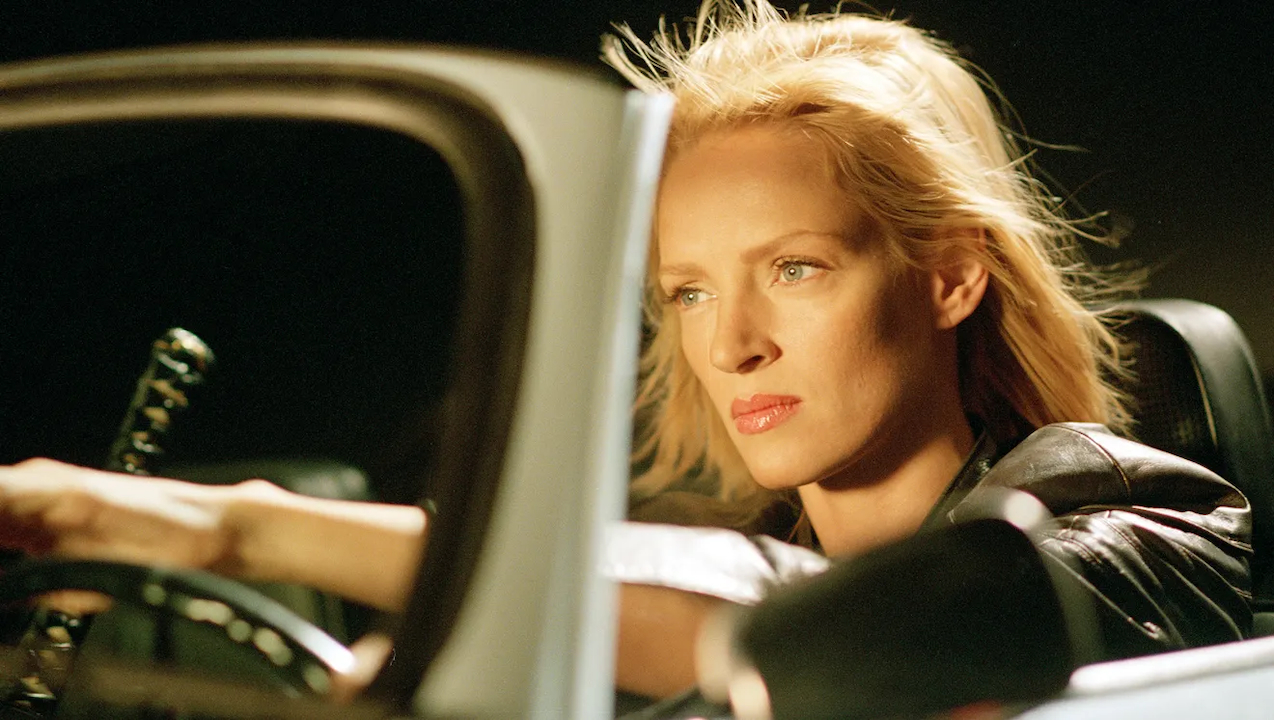

The theatrical release of Kill Bill: The Whole Bloody Affair justifies its own existence within moments, as the tremolo guitar of Nancy Sinatra’s “Bang Bang” sends tremors through our seat and bones. Miramax balked at Tarantino’s original idea for a four-hour saga in the early 2000s, urging the filmmaker to bifurcate the assassin revenge tale like a member of the Crazy 88. With the full vision spread before us, the arc becomes clearer. Quentin Tarantino’s resurrected monster is a vital theater experience, and an opportunity to revisit the project within the scope of his filmography.
Before viewing The Whole Bloody Affair, I had always preferred Kill Bill: Vol. 2 (2004) to Vol. 1 (2003). The second film stretches deep as the first does wide, with the most satisfying emotional beats, and of course, “The Cruel Tutelage of Pai Mei,” still my favorite chapter of either film. I felt frustrated by the first film’s fractured narrative, which indulges several narrative digressions and doesn’t really gain steam until the second act.
The Whole Bloody Affair lets Vol. 1 breathe, allowing its detours to become part of the bigger canvas. Most significantly, this release reinstates a section previously cut from O-Ren Ishii’s (Lucy Liu) bloody backstory. The extended version of this anime sequence would certainly have flagged the standalone Vol. 1, but as one of many offshoots over the course of four-plus hours, it sits comfortably. It more effectively reminds us that the Bride’s (Uma Thurman) story represents only a slice of this violent, unjust universe. Everyone has their own revenge to chase.
The long cut of this film also dispenses with the cliffhanger at the end of Vol. 1 and the recap at the start of Vol. 2; in their place are a 15-minute intermission and a stronger sense of continuity. This version has two main beneficiaries, whose abilities to glue the whole thing together shine brighter on this stage. The first is Uma Thurman, who dives headlong into every idea in Tarantino’s head. Delivering some of the most heightened dialogue of the filmmaker’s career (“I have vermin to kill.”), she maintains a thespian conviction. Fending off Japanese steel, kung fu moves, and my favorite, a spiked ball and chain, she leaves no doubt of her skill. She also emotes herself raw when dealing with anything involving her lost daughter. It’s a remarkable physical performance, on par with anything an action star has produced in the two decades since.
The other star of The Whole Bloody Affair is editor Sally Menke, who cut each of QT’s films until her untimely death in 2010. Her katana-sharp instincts lent the director’s work a rough-hewn quality. His first three films, in particular (Reservoir Dogs (1992), Pulp Fiction (1994), and Jackie Brown (1997), feel alive in a way his later work doesn’t. Kill Bill carries on the last vestiges of that human quality, even as his style becomes more comic-book-oriented. Once Tarantino lost Menke after Inglourious Basterds (2009), he became more and more willing to let his characters’ unfocused exchanges hijack his narratives (The Hateful Eight , though fun, is the primary offender). With Menke in the editing bay, the mammoth Whole Bloody Affair remains breezy and coherent.
The main exception comes at the end of the journey, in the confrontation with Bill (David Carradine). After several hours of sitting, the distended finale feels more bloated than it does in Vol. 2. I love the depiction of Bill as this verbose philosopher, but after so much action, he rambles about Superman a bit too long for my taste. The low-key climax feels a touch more underwhelming here.
Ultimately, the sheer size of the cinema screen makes The Whole Bloody Affair worth seeking. The desert the Bride crosses to reach Budd’s trailer feels longer. The stairs she climbs to reach Master Pai Mei’s temple seem endless. And the extended buildup to “The Showdown at House of Blue Leaves” allows us to absorb the place before it's torn down and painted crimson. I’ve never so appreciated the pains Tarantino and director of photography Robert Richardson take to establish the geography of this battlefield. But it feels effortless.
The full-size presentation also highlights this film as perhaps Tarantino’s most maximalist. Kill Bill insists on having most of everything: the biggest fight sequence with the Crazy 88, the deadliest martial arts move in the “Five-Point Palm Exploding Heart Technique,” and certainly the most blood spilt by gallon. I yearn to learn about the Foley work done to craft the squirting sounds for every arm and neck stump. In the Bride's arc, and her yearning for her lost baby, this movie may well contain Tarantino’s biggest emotional swings, too.
Put together as originally intended, The Whole Bloody Affair surpasses Vol. 1 and Vol. 2. The additional material may not be extensive, but the complete package, with a theatrical screen and sound system, lifts Kill Bill to a higher tier in Tarantino’s body of work. Take this chance to witness one of cinema’s most expressionistic stories at full impact.
Kill Bill: The Whole Bloody Affair is playing in wide release.
Now through December 31, Third Coast Review is raising money to support the diverse roster of writers you know and appreciate for their thoughtful, insightful arts and culture coverage in Chicago and beyond. Everything raised during this time will go directly to paying these writers a well-deserved year-end stipend; you can make a contribution here. Thank you!
