
For reasons that are beyond my comprehension, James Cameron's Avatar films continue to land with mass, global audiences in an unexpected way. To be clear, I’m not someone who dislikes these films entirely in the kind of knee-jerk manner that some critics do. I see their artistic value; I certainly enjoy their value to the world of 3D moviegoing (they’re basically the only films I have any desire to see in 3D); and I even occasionally appreciate their storytelling. But with the third installment, Avatar: Fire and Ash, my enjoyment is waning, primarily because I think the Na’vi vs. earthling storyline has played itself out.
I do love director/co-writer Cameron’s repeated attempts to portray humans as destructive, self-serving, greedy creatures who are not satisfied with destroying our own planet but seem intent on hollowing out other worlds for their natural resources. Other filmmakers have tackled this subject, but Cameron does it on an unsurpassed scale. But now we’re entering our third installment of this humans-are-bad franchise, and maybe it’s time we move on to a new, more original threat, if only to let us know more about the greater universe out there.
Still set on the world of Pandora, the film picks up shortly after The Way of Water, when we meet the the water-based Metkayina clan. Jake (Sam Worthington) and Neytiri (Zoe Saldaña) are still grieving the loss of their son and are also helping their Na’vi tribe settle in with the Metkayina. Led by Gen. Ardmore (Edie Falco) and the fully avatar’d Quaritch (Stephen Lang), the humans are plotting another surge in which they herd these whale-like creatures for their natural essence that could be used as a power source on Earth. But seemingly out of nowhere, we meet a new, aggressive Na’vi tribe known as the Mangkwan clan (also called the Ash People), led by tribe leader Varang (Oona Chaplin), who eventually allies with Quaritch to take down those who stand in their way. Why would the Ash People do this? It’s one of many unanswered questions in Fire and Ash, and it makes the film all the more frustrating to engage with.
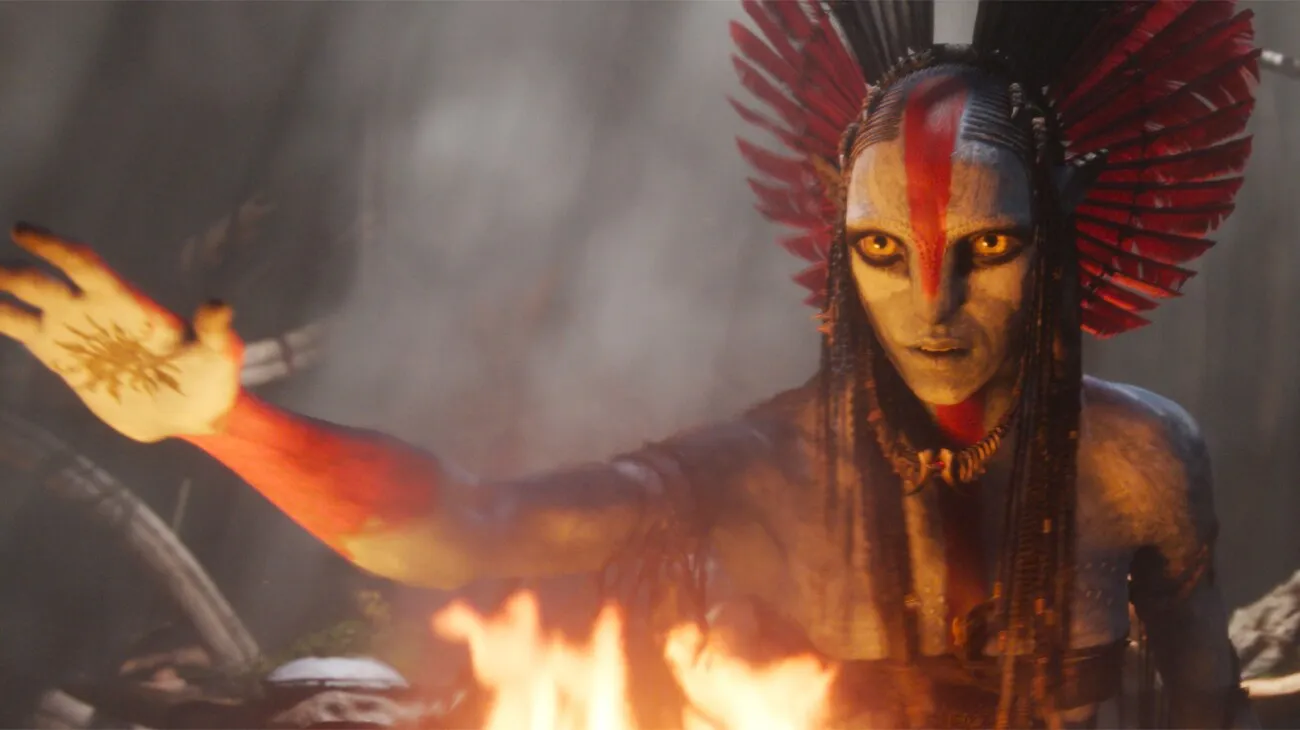
With a script by Cameron, Rick Jaffa, and Amanda Silver, this third installment feels more like episodic television than a feature film. With a running time of well over three hours, Fire and Ash has one character or another get captured by the enemy, then they get saved, all within the space of about an hour; then the cycle repeats with a new character getting caught, and so on. It’s tedious, predictable, and even with eye-popping visuals serving as a visual feast throughout, it doesn’t really cover up the film's standard action-movie structure. I did enjoy the look of the Mangkwan clan members, which incorporate new features and sharp colors. And as much as their angry personalities aren’t really explained, it’s at least something we haven’t seen from the Na’vi before, so it feels new.
I fully understand that every performance in the Avatar movies is created using motion-capture technology and is not simply generated by computers and AI, and I applaud that. But that doesn’t take away from the fact that it looks like we’re watching a videogame with hints of anime mixed in. More than that, it feels like we’re watching someone else playing a videogame (which I realize is a very popular thing in certain circles). But for some of us, it’s boring, despite the technological splendor of it all.
Back in the cast are the likes of Sigourney Weaver, Kate Winslet, Cliff Curtis, and CCH Pounder as key Na’vi characters, while live-action characters played by Joel David Moore and Giovanni Ribisi (veterans of all three Avatar movies) are essentially sidelined, once again, for a majority of the film. The exception to that is Jemaine Clement’s Dr. Garvin, who was mostly on the humans' team in the last film and does an about-face when he learns how sweepingly destructive things are about to get.
But the other primary human character is Jake and Neytiri’s adoptive son Spider (Jack Champion), who continues to be one of the single most annoying characters ever created. For reasons I will never understand, he’s actually pushed to the front and center of this storyline, beginning with being given the ability to breathe Pandora’s air without an oxygen mask, for reasons that don’t really make sense. As established in the last movie, he’s also Quaritch’s estranged son, and we’re meant to believe he’s being tempted by the other humans to turn tail on his friends, though we know he never will. There’s literally nothing for him to do besides run around in a loin cloth and be obnoxious.
Avatar: Fire and Ash also attempts to deepen the mythology of the Na’vi and their physical and spiritual connection to Pandora, but like so much of this franchise, they seem to be making up the rules as they go along. Characters simply attach their glowing braids to whatever they feel like, and that seems to solve all the problems. It’s simplistic and lazy writing, and while I don’t expect Tolkien-level universe building from Cameron and his people, I’d like some hard and fast rules about how this planet works, because I found that part of the first Avatar movie some of its most interesting. More than being disappointed, I was frustrated with Fire and Ash, and I hope that if Cameron does attempt additional films (as he’s said he would), they are into storylines that are more than simply a retread, of both his own work and standard-issue science fiction.
The film is now playing in theaters.
Now through December 31, Third Coast Review is raising money to support the diverse roster of writers you know and appreciate for their thoughtful, insightful arts and culture coverage in Chicago and beyond. Everything raised during this time will go directly to paying these writers a well-deserved year-end stipend; you can make a contribution here. Thank you!
