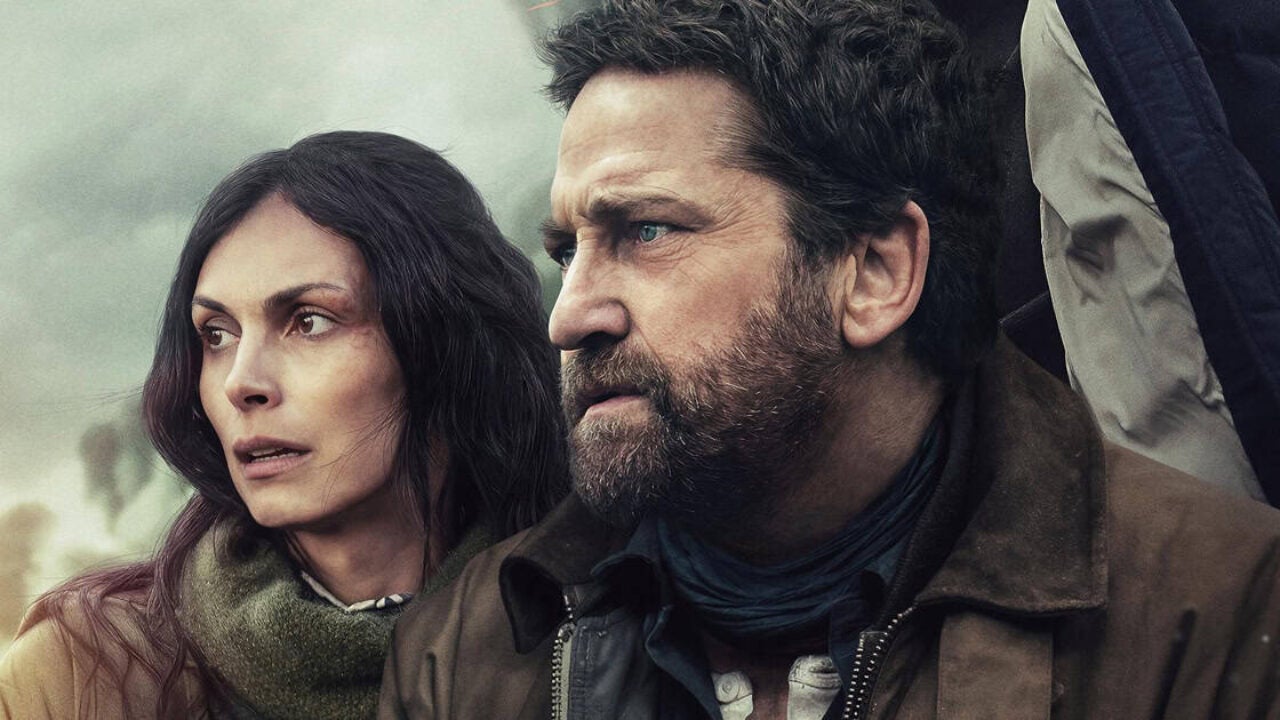

Set five years after the original Greenland (2020), Greenland 2: Migration continues the story of the Garrity family and how they manage to survive a planet that was decimated by a massive comet strike (followed by many comet fragments) that wiped out approximately 75 percent of all life on Earth and making most of the air toxic.
Gerard Butler (as John Garrity) and Morena Baccarin (Allison) return, with Roman Griffin Davis taking over the role of their son Nathan; the family have lived the last five years in a well-stocked bunker in Greenland with hundreds of other survivors. But the land around their haven is becoming increasingly unstable with fissures in the earth opening up and lava coming through, endangering the safety of their bunker. They have no other choice but to leave and find a new home, which they hope will be a rumored massive crater in the south of France where new plant life, clean water, and breathable air is said to exist.
But time and fortune are frequently not on their side, especially when John reveals to his wife that he has some form of cancer due to the radioactivity in the world outside the bunker, where he frequently journeys on scouting expeditions looking for supplies. So John makes it his personal mission to take his family to safety before he goes to that great Greenland in the sky. I said that fortune isn’t often on their side, and this is true to a point, but man, I’ve also never met a luckier family during the apocalypse, where complete strangers are practically lining up to help them when we all know most people are only looking out for themselves. It’s one thing to suspend disbelief when watching an end-of-the-world movie; it’s another thing to believe people would be decent in such times.
Returning director Ric Roman Waugh (Angel Has Fallen, Kandahar, and the upcoming Jason Statham actioner Shelter, opening January 30) seems to have set aside most of the action set pieces and special effect destruction sequences that populated most of the first film in favor of more contemplative scenes dealing with the long-term mental impact of living in a shattered world. There are still the occasional comet fragments falling to the ground and flattening entire forests and firefights are breaking out over scarce resources, but for the most part, the people the Garritys run into are eager, or at least willing, to help.
It’s both strange and oddly refreshing to watch a disaster movie that is more meditative. In most family dramas, the decision is usually do it or don’t do it, but in Greenland 2: Migration, it’s move forward and succeed or die. And so the Garritys press on through their own personal odyssey (them crawling across the now-above-ground English Channel on a rickety ladder is wild). I’m not saying the movie is great or even good, but it is a fascinating take on the apocalypse, so I’ll give them points for originality...but not on much else.
The film is now playing theatrically.
If you enjoyed this post, please consider supporting Third Coast Review’s arts and culture coverage by making a donation. Choose the amount that works best for you, and know it goes directly to support our writers and contributors.
