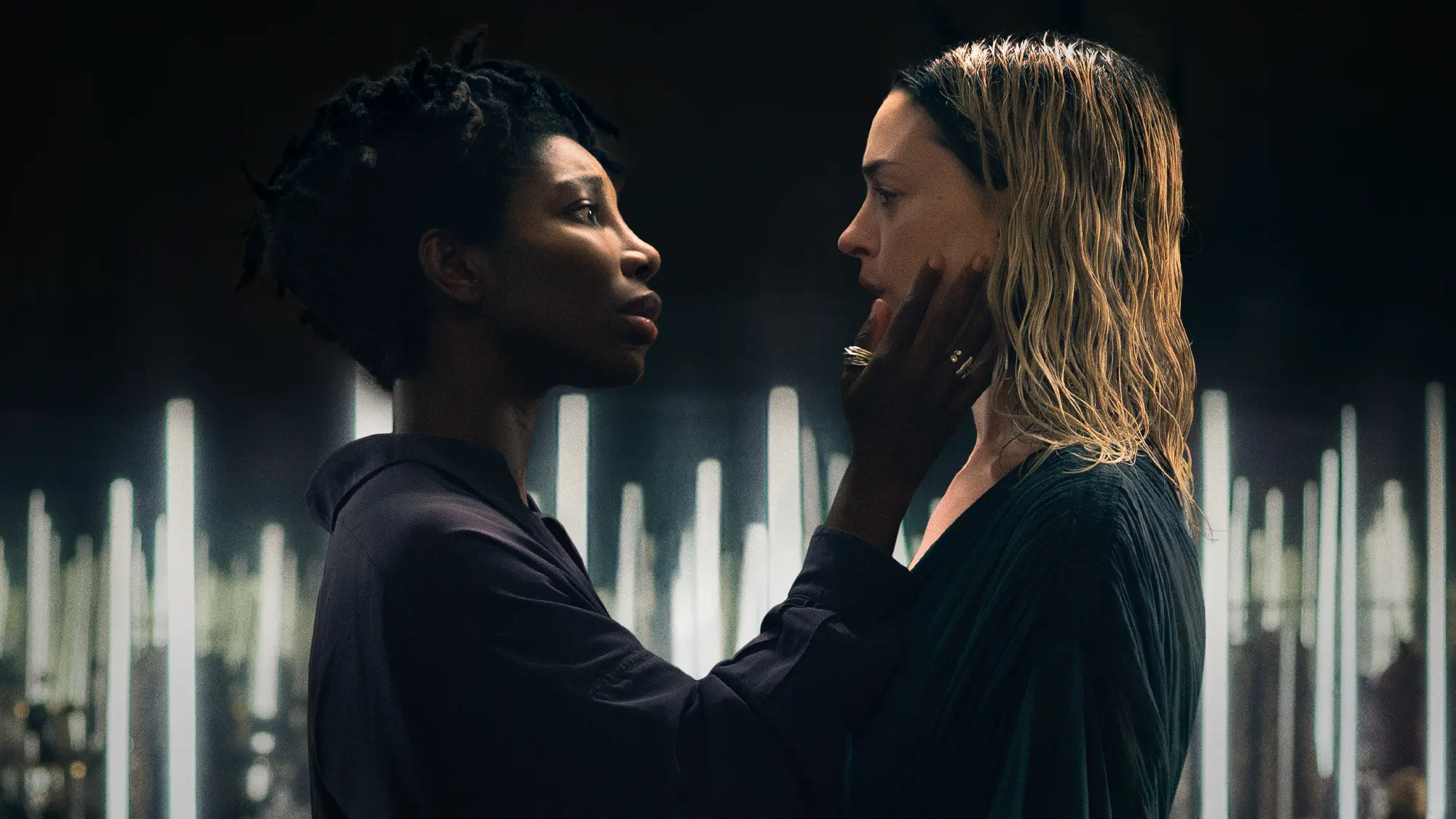

Depending on where you stand, writer/director/editor David Lowery’s Mother Mary can be seen as a trippy relationship drama, a full-on psychological horror attack, a story about the lengths an artist will go to to self-actualize through expression, or a line-blurring tale of public vs. private personas. Whatever angle you view the film from, none of these stories would work without supremely confident, layered direction from Lowery (A Ghost Story, The Green Knight) and two of the better performances you’re likely to see this year, especially from returning champ Michaela Coel, who just floored me with her work in The Christophers last week. This cautionary tale of a pop star in crisis is also elevated by fantastic songs, contributed by the likes of Charli xcx (who shockingly doesn’t appear in the movie), Jack Antonoff, and FKA Twigs (who also has a memorable role in the film).
Anne Hathaway plays the fictional, iconic singer called Mother Mary, who is just days away from a hugely important comeback performance, her first since what some believe was a horrible, on-stage accident—although it may also have been quite deliberate. She wants this show to not only reconnect her with her fanbase but also to be as honest and true to who she is behind the persona. But she can’t do that with the dress she’s currently planning to wear during the show opener. As a result, she flees rehearsals to an isolated residence in the English countryside and reconnects with old friend and world-famous clothing designer Sam Anselm (Coel), with whom she had a brutal falling out many years earlier for reasons we don’t initially understand.
Coel has the ability to make any line of dialogue sound like Shakespeare, and when she’s fully focused on another person, her eyes lock in and there’s no escaping her pull. It’s often been said that you can only truly hate someone that you once truly loved, and that is clearly the feeling Sam has for Mary, but somehow their bond still makes her curious to see what kind of dress she might be able to create that would fully represent her old friend. Before Sam even starts thinking about design ideas, she interrogates Mary about her life, her reasons for walking out on their creative partnership, and what Mary is trying to accomplish with this show. But what she really drills down on is the “accident” and Mary’s state of mind leading up to it.
Their conversation takes wild, unexpected turns, and director Lowery eventually moves his visuals to places that suggest one or both of them is being possessed by demons that are either fueling their creativity or stifling it. I’m mostly over this idea that the life of a pop star is so difficult that they simply want to disappear or sabotage their work (Charli xcx’s recent The Moment featured a similar concept). I do believe it takes a great deal of work, dedication, and stamina, while everyone around you wants something from you or demands you pay attention to their needs—even fans. And while Hathaway is quite good playing this character, she has become somewhat paralyzed by fear and uncertainty, and I never fully bought it.
With thankless but still fascinating support work from Jessica Brown Findlay and Kaia Gerber, Mother Mary is at its best when Lowery focuses on the film's core relationship. Emotions are running high for Mary and Sam, and only part of the reason for this is the feelings they have about being brought together again under these circumstances. For once, Sam holds the power in their friendship, and she’s well aware of it, always leaving open the possibility that she won’t even make the dress. Resentment runs high, but Sam also seems to enjoy seeing her estranged friend struggle as the world of show business is actively crushing Mary. There is an undercurrent of violence—emotional and physical—running through this film, and it’s that almost unbearable tension that keeps the wheels turning, and keeps us on edge about what’s going to happen next. I’m not sure this is Lowery’s best film (I still think A Ghost Story is unbeatable), but it’s his most daring and ambitious, and that still makes for a helluva experience.
The film is now playing in theaters.
If you enjoyed this post, please consider supporting Third Coast Review’s arts and culture coverage by making a donation. Choose the amount that works best for you, and know it goes directly to support our writers and contributors.
