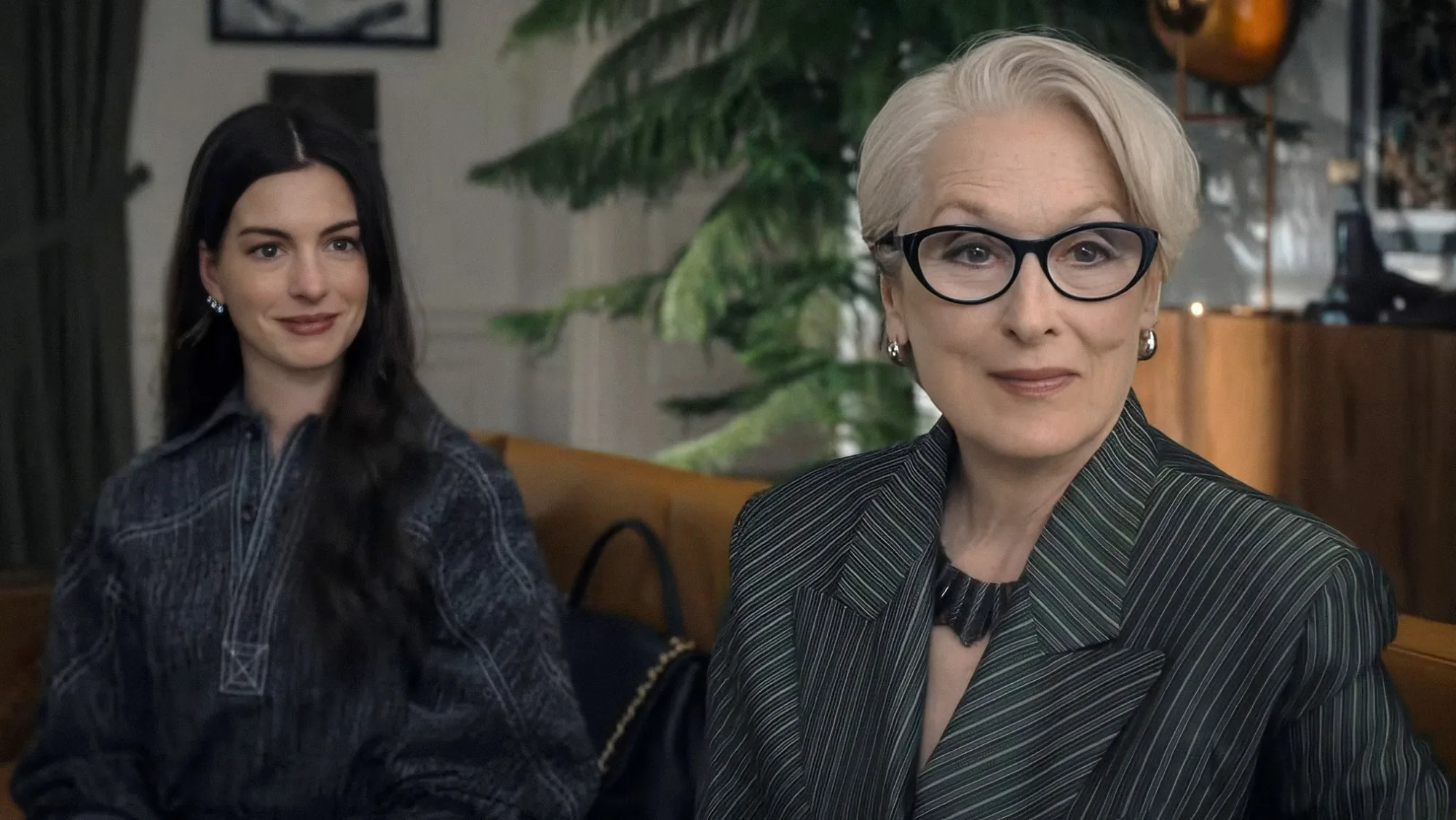

As I was experiencing the 20-years-later sequel to The Devil Wears Prada the other day, I found myself repeatedly astonished at how much I was enjoying not just the jokes and familiar characters, but also the places these characters have gone and the growth they all seem to have experienced in that time. None of our favorites—Miranda, Andy, Emily, and Nigel—are the same people they were 20 years ago, and it’s that growth and expansion that made me curious about where they would take us in The Devil Wears Prada 2.
Everybody’s is back: Anne Hathaway’s Andy Sachs became a real-life, celebrated journalist after leaving Runway magazine, and, as the film opens, she’s winning an award for her writing and getting laid off in the same breath. (If Prada 2 is nothing else, its a cheerleader for print journalism and non-sponsored, non-corporate news content, so good for that.) Shortly after this happens, she gets a call from Runway’s chairman Irv Ravit (Tibor Feldman) and his son Jay (B.J. Novak, in full asshole mode), who want Andy to return to the book to run its features department, after a disastrous story ran about a company that swore they didn’t run sweatshops when they absolutely did. Andy’s first piece is an apology letter to readers and a promise that the magazine will do better, which everyone loves and buys her enough time to pull together a solid team of news writers who all worked with her at her previous publication.
When she walks into the office of Miranda Priestly (Meryl Streep) for the first time in two decades, not surprisingly, Miranda doesn’t recognize her (or so she claims). Naturally, Miranda’s right-hand, Nigel (Stanley Tucci), is still around, anticipating every need and smoothing over edges that Miranda has made rough. One of the things that impressed me most about this film is the way it transforms Miranda from the supporting role of the tyrant boss that she was in the first movie and has now made her a full-fledged character, with nuances, emotions, layers, and something resembling a heart. A great deal of that transformation has to do with the time we spend with her and her new husband, Stuart (Kenneth Branagh), who is the most patient man, fully not threatened by her success or power.
Also back is writer Aline Brosh McKenna (who also penned We Bought a Zoo and 27 Dresses) and director David Frankel (Collateral Beauty, Marley & Me), who bring exactly the right amount whimsy and drama to a film that is primarily about fashion but touches on such themes as corporate billionaire ninnies taking over publishing companies, the new media landscape, and recognizing talent when its standing right in front of you. Case in point, the film also brings back Emily Blunt’s Emily character, Miranda’s former first assistant and now a senior exec at Dior. She’s dating filthy rich tech bro Benji Barnes (Justin Theroux), who used to be married to Sasha Barnes (Lucy Liu), who not only made billions in the divorce but is the one interview Miranda wants Andy to get if she wants to keep her job...and so Andy does, in spectacular fashion.
The relationships among the four leads has shifted to varying degrees, and it’s fascinating to see Emily in a position of power as one of Runway’s top advertisers. Miranda doesn’t seem convinced that Andy is the right one for her job, leaving her in an awkward but not entirely powerless position, especially after she lands the white-whale interview with Sasha. Less interested in catch phrases and iconic moments (like the first film), Prada 2 is surprisingly adept at focusing on character development. Everybody here finds ways to grow that they weren’t anticipating, both professionally and personally. The film also finds interesting ways to incorporate New York City into its story, as well as maximize stunning locations in Milan, Italy during Fashion Week, all while Andy, Miranda, and others attempt to keep Jay from selling off Runway to Benji so that Emily can take over the magazine.
What’s also interesting is the way the screenplay seems to be setting up Andy to fail and humiliate herself at various points in the story; but instead of that happening and giving Miranda another reason to resent her, Andy succeeds and gives herself and the audience a much needed boost of encouragement. Hathaway is playing Andy as a far more confident version of the young woman from 20 years ago, and it makes her even more appealing, so much so that she really didn’t need to be saddled with a new love interest in the Australian Peter (Patrick Brammall) as a potential love interest.
I love the addition of new characters and some familiar smaller parts, such as Jin Chao (Helen J. Shen), Andy’s assistant; Amari (Simone Ashley), Miranda’s current first assistant; Lily (Tracie Thomas), Andy’s best friend; and Charlie (comedian Caleb Hearson, recently a standout in Pizza Movie), Miranda’s current second assistant, who isn’t allowed to leave his desk without permission (some things never change). Ultimately, the film is uplifting, charming and funny, but also filled with a certain amount of insight into the difficult business of publishing. More than anything, it’s about these timeless relationships and the advantages of keeping your greatest assets close and happy with their place of work, with compromise. I’m not sure we needed another Prada feature, but I’m happy to have caught up with the old gang again.
The film is now playing in theaters.
If you enjoyed this post, please consider supporting Third Coast Review’s arts and culture coverage by making a donation. Choose the amount that works best for you, and know it goes directly to support our writers and contributors.
