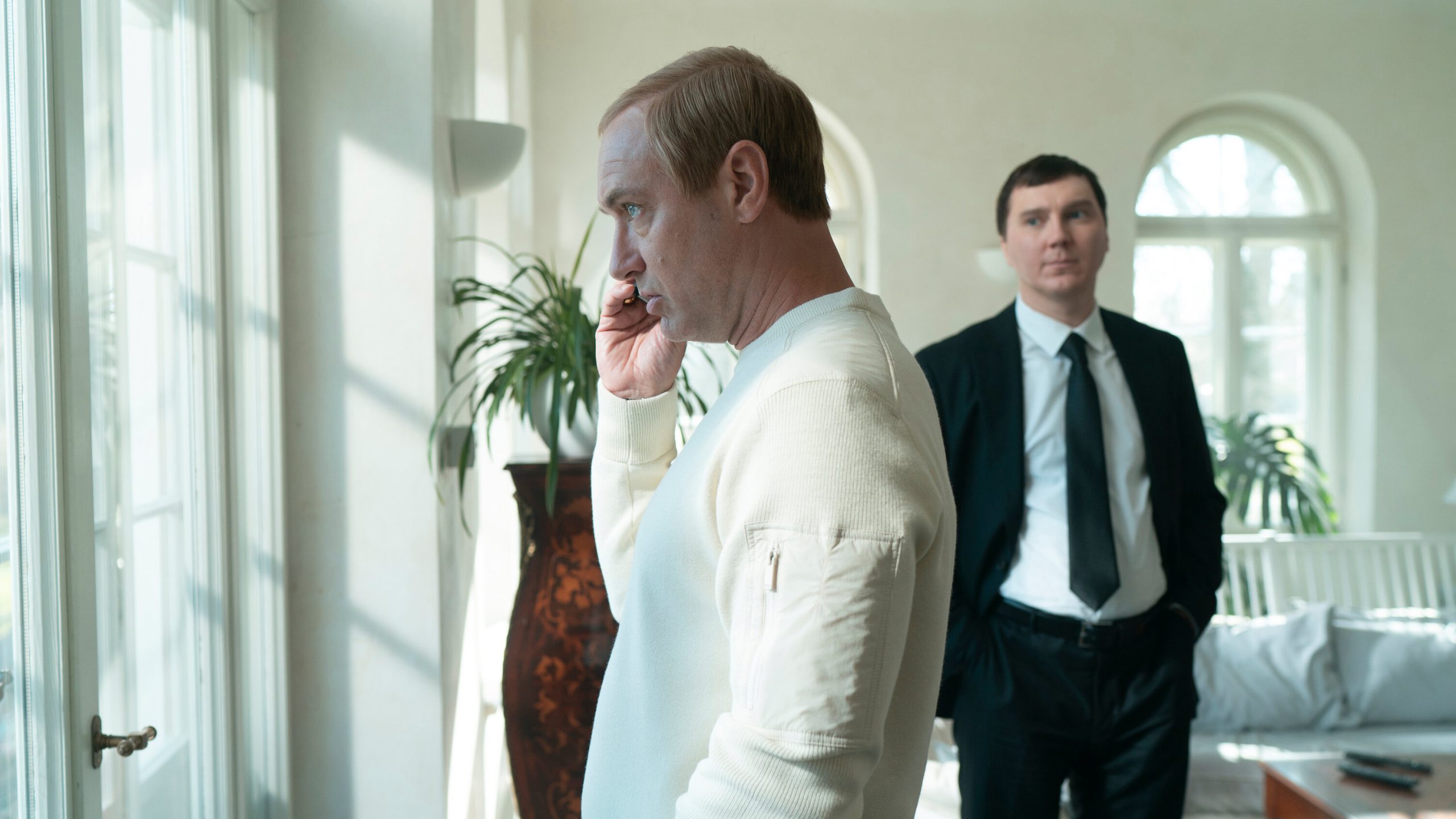

There’s no escaping the truth that The Wizard of the Kremlin, the latest work from the great Olivier Assayas (Personal Shopper, Non-Fiction, Demonlover, Irma Vep series), is long, dense, complex, and perhaps even confusing at times. And I’d have it no other way. This is a film about politics, specifically eastern European politics, which is all of these things and duller. So it’s a remarkable feat that Assayas (working from the book of the same name by Giuliano da Empoli, adapted by the director and Emmanuel Carrére) made it as interesting as it is without sacrificing any of its more intriguing turns.
The film tells the story of the chaotic world of post-Soviet Russia and how a rising star in the KGB named Vladimir Putin (played magnificently by Jude Law) joined forces with master manipulators in his country to not only take power but reshape life—in Russia and the world—using violence and deception. The story is told from the perspective of a Russian spin doctor named Vadim Baranov (Paul Dano, playing a fictionalized character inspired by Vladislav Surkov). The film’s framework finds Baranov at his isolated home, living in retirement and telling his story to a journalist named Rowland (Jeffrey Wright). As a youth, Baranov was an artist, all about freedom and democracy as the Iron Curtain came down. He dated a lovely young woman named Ksenia (Alicia Vikander), who had ambitions of her own and was easily swayed by men with money and personality, including Baranov’s old friend Dmitri Sidorov (Tom Sturridge), who eventually steals Ksenia away from him.
In what could be described as a fit of revenge-success, Baranov aligns himself with media giant Boris Berezovsky (Will Keen) and changes the role of the press in government. The pair actually select Putin as the candidate to replace Boris Yeltsin and assist in making him less hard-edged and more relatable to the Russian people, but once Putin takes full control, he starts making changes of his own and pushes Berezovsky out of the equation, while leaving Baranov one of his top advisers (and nicknamed the Wizard of the Kremlin). The film gives Baranov credit for the online landscape we live in today, including fake news stories, election tampering, and even placing an agent of chaos in charge of the United States. He doesn’t necessarily want people to know that Russia is responsible; it makes his country’s power stronger if people think they are doing this, whether they are or not, so taking credit is never the goal. Meanwhile, Putin is using more familiar methods to deal with enemies, including assassinations, economic manipulation, controlling the media, and war.
Although the two never seem at odds, once Baranov has outlived his usefulness, he simply decides to leave service, but we sense that his days are numbered. The fact that he’s even having this meeting with Rowland seems risky. The inner workings of the Russian government may not sound like the subject of a fascinating drama, but Assayas makes it work. This is all recent history, likely in your lifetime, and when you start lining up what Baranov and Putin were up to at certain points in world chronology, it’s fairly shocking. The Wizard of the Kremlin makes it clear that parts of its storytelling are fiction, but I don’t think it’s much.
The American definition of power is money, but to Russians, it’s simply about gaining access and influence over time. Coming from money is frowned upon; being self-made is the ideal, and it doesn’t seem to matter if you gained that power through corruption, deception, or manipulation. The is a film about the birth of 21st century tyranny, and it actually helps me understand the goals of other leaders who have vocally said they admire what Putin has achieved. And that makes this film all the more terrifying. It’s not a perfect film, but the performances are terrific (especially Dano), and it opened my eyes in ways I wasn’t expecting.
The film is now playing in theaters.
If you enjoyed this post, please consider supporting Third Coast Review’s arts and culture coverage by making a donation. Choose the amount that works best for you, and know it goes directly to support our writers and contributors.
