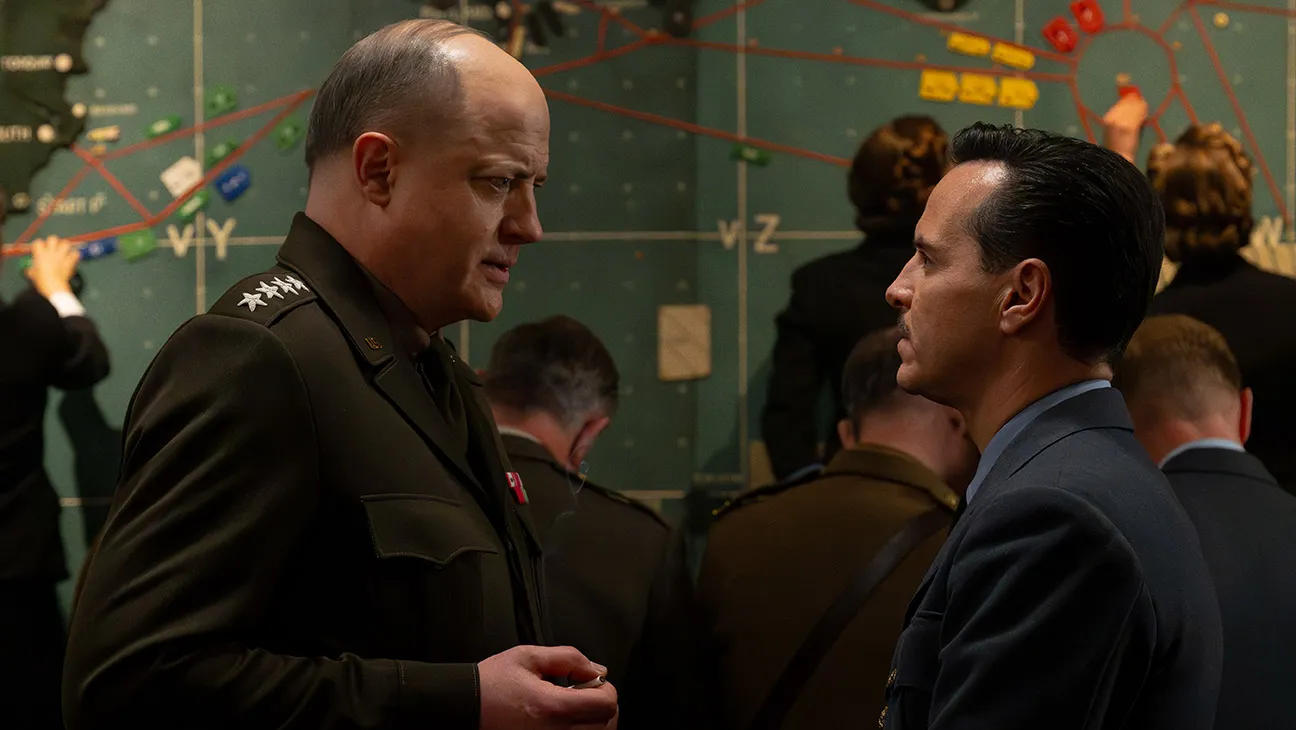

I’ve said it before, but I’ll repeat myself until I pass out if I have to: docudramas are not documentaries; they don’t show us exactly what happened because they are trying to tell the best cinematic version of a true story. Admittedly, I’d prefer they don’t outright lie to the audience (I’m looking at you, Bohemian Rhapsody), but if something needs to be altered slightly or characters need to be combined for efficiency’s sake, I’m fine with that. Pressure is director and TV veteran Anthony Maras’ second feature (after Hotel Mumbai, also based on horrific true events), and I have no real issues with its account of the 72 hours leading up to the D-Day invasion of Normandy in June 1944, the largest and most dangerous seaborne invasion in history that effectively decided the fate of World War II.
The actual focus of Pressure isn’t the Allied commander, Gen. Dwight D. Eisenhower (played with appropriate bluster by Brendan Fraser). Instead, the film centers on Group Capt. James Martin Stagg (Andrew Scott), a Scottish meteorologist who was called in by Eisenhower to give as accurate an account as possible about the weather on the proposed date of invasion. In the minds of many, Stagg was brought in as backup for Eisenhower’s trusted weather expert Irving P. Krick (Chris Messina), who used historical trends to predict current weather rather than Stagg’s approach of using current data. It just so happens that Stagg’s forecasting predicted hurricane-force winds that would have made a successful invasion impossible—a prediction that Krick believed was wrong and others simply didn’t want to accept.
In a way, Stagg’s battle is as old as recorded history: science vs. a gut feeling. And I love that we have a film (based on the stage play by actor-turned-writer David Haig, who co-wrote the screenplay with director Maras) that portrays the resistance to actual scientific knowledge. A version of this story could have been written about events in the last 10 years. It just so happens that a weatherman was put in charge of deciding the fate of the Allied forces, and very few people seem to know this. The staggeringly solid cast also includes Damian Lewis as Field Marshall Bernard Montgomery, who was fully ready to send men into the storm, regardless of the outcome; and Kerry Condon as Eisenhower’s Irish-born personal secretary Kay Summersby, who was Stagg’s direct line to the Allied commander.
While all of the actors are good, Scott’s performance is what sold me on this character and the film overall. Stagg had to leave his pregnant wife at home to take this assignment, and when word reaches him that the bomb shelter where she would have taken shelter was directly hit during an air raid, he is overcome with guilt and worry, almost causing him to lose sight of his objective. As portrayed here, Stagg was a rule follower who believes he has the most important work of his life ahead of him once he arrives at Allied headquarters, and the reality that the current facts he was delivering were being dismissed was more than he could comprehend.
The way the story plays out is almost impossible to believe for a couple of reasons, the main one being that I can’t believe I hadn’t heard this story before. Certainly there were dangers if the invasion was delayed too long—namely that the enemy would eventually find out about this secret operation—so the priority to hold the original date is understandable. But Eisenhower oversaw a dry run weeks earlier, and the results were disastrous, which is why Stagg was called in in the first place. The drama is heightened, tense, and mostly believable. Anchored by performances that capture the egos involved, Pressure is one for the history buffs who are a little more flexible with 100 percent accuracy if the actors are worthy.
The film is now playing in theaters.
If you enjoyed this post, please consider supporting Third Coast Review’s arts and culture coverage by making a donation. Choose the amount that works best for you, and know it goes directly to support our writers and contributors.
