Writer, director, cinematographer, editor, and producer Adam Carter Rehmeier first got no small amount of recognition for his divisive 2011 horror film The Bunny Game, about a prostitute searching for her next fix who is kidnapped by a truck driver and subjected to extreme torture. It may come as no surprise that the film was immediately banned in the UK, but it was based on the real-life story of the lead actor. Having helmed the film as a favor for the actor, he quickly moved into less severe territory with the largely unseen Jonas (2013), and the very much seen Dinner In America (2020). That film got a bit of a rebirth a couple years after the film’s release thanks to the song “Watermelon” by John + Jane Q. Public, which gained a massive cult following on TikTok. Rehmeier and co-stars Kyle Gallner and Emily Skeggs took the film around the country for a series of sold-out shows (including one at Chicago's own Music Box Theatre).
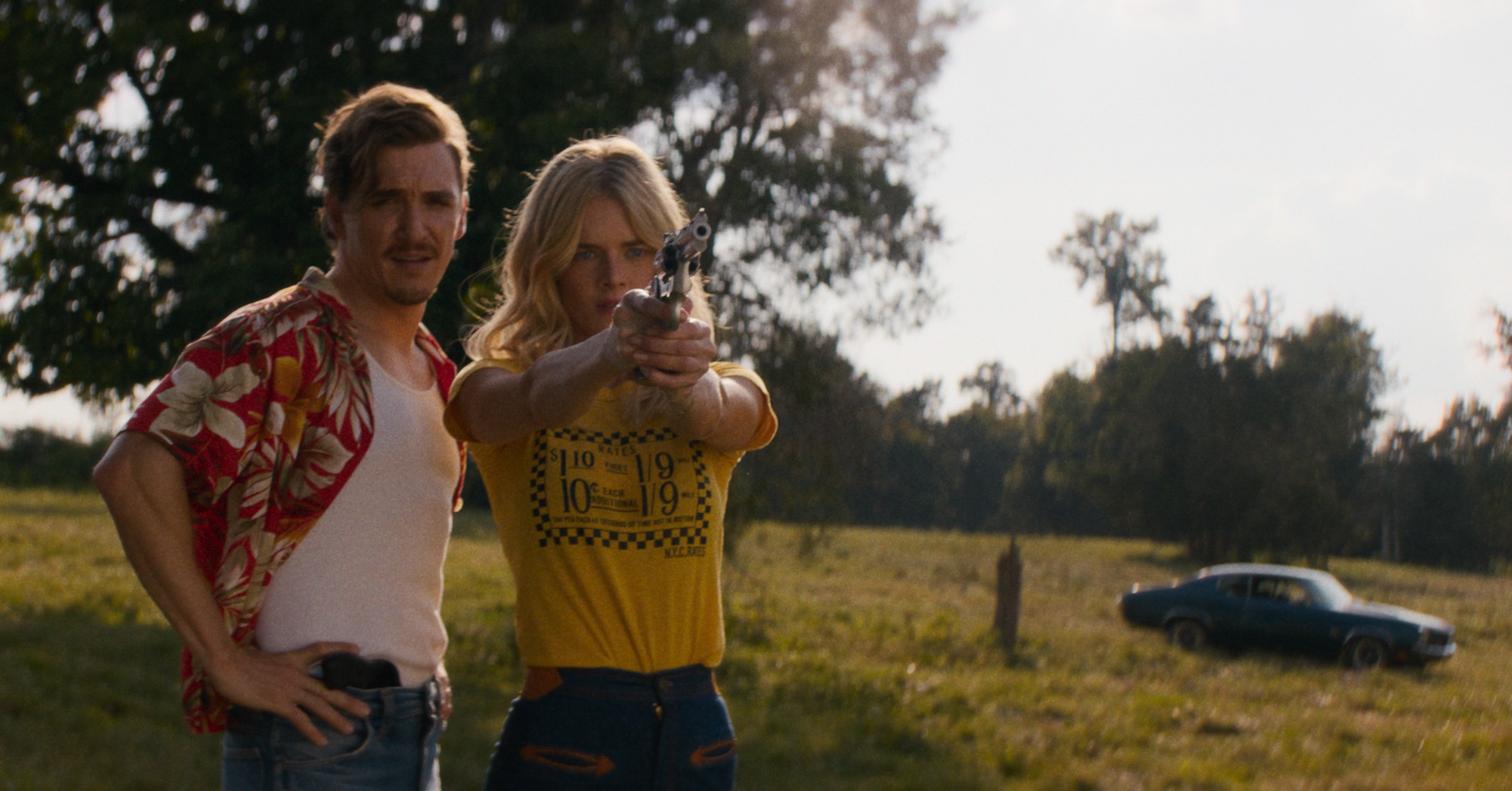
The writer-director followed up Dinner in America with Snack Shack, a personal story about a pair of teen friends working together at a local public pool. The film got solid critical reviews, but got a crap release from its distributor. Determined to make a film both personal and commercial, Rehmeier followed that with his current film, Carolina Caroline (written by Tom Dean), a romantic crime thriller about a Texas gas station attendant named Caroline (Samara Weaving, seen earlier this year in Ready or Not 2 and Over Your Dead Body) who falls for a conman named Oliver (Gallner), and the two take an extended road trip to South Carolina to hopefully meet the mother (Kyra Sedgwick) who abandoned her when she was just an infant. Caroline is not content to simply let Oliver teach her short-change scams along the way, and the two begin robbing banks and are rather good at it for a time.
Needless to say, we’ve seen hundreds of crime-couple movies over the years, probably dating back to film noir days, but Rehmeier sells the love story of Carolina Caroline so convincingly, and the chemistry between the two leads is so electric, that you can’t help but root for this couple, even though they’re breaking the law with impunity. To top things off, the film also has a killer soundtrack of new and legendary country artists that makes their journey seem like a great southeast fantasy ride.
After moderating the Dinner In America Q&A at the Music Box last year, I had the chance to sit down with Rehmeier once again for an actual interview (and just for good measure, we did Q&A for Carolina Caroline as well) to discuss his approach to this relationship, finding the right actor to play Caroline, and possibly a bit about what he has coming up (hint: his next film is already shot, with the post-production nearly completed). The film is now in theaters, including at the Music Box Theatre. Please enjoy our talk:
A lot of your films are about outliers—not just people but places; these are people and places that don’t get films made about them very often. What about that is the draw for you as a subject in your films?
Even as far back as I can remember, I think I’ve been more attracted to underdogs and misfits. One of my Top 5 films of all time is Rocky, and it's one of the greatest underdog stories of all time. Everyone tells Rocky he can’t win that fight. If you’re not rooting for Rocky, it’s crazy; I love that movie so much. I just gravitate towards characters like that because I always want to root for the underdog.
You didn’t write this film. Did you getting this script have to do with somebody seeing that it would appeal to you because it had characters like that, or was it one of many that makes it to you these days?
I get sent a lot things through my agents, or we take meetings because people are thinking about you for certain things. I had met with Trevor and Tim White for another project that I didn’t get prior to this, and I really wanted that film. And they said they’d keep me in mind for other things. Six or seven months had elapsed before I heard from them again. As a writer, I have a few projects that have been optioned several times that haven’t come to fruition; I have two TV projects that got really close that fell apart last minute or something changed. And I have another feature that I just shot that I also wrote and is in the can and I’m editing right now. We’re very close to being done. So I’ve written almost everything with the exception of this. I’m also attached to other things that I didn’t write, and there are two or three of them that I consider perfect scripts that I wouldn’t touch a single word, which is rare.
But things come to me, and sometimes Hollywood wants to pigeonhole you, you know, if you do something funny, they think you only do comedy—he doesn’t do horror. Once you do a movie like Dinner In America, the volume of stuff coming in is a lot of comedy, and I’m not necessarily interested in that. That film was a music/comedy mashup; Snack Shack was my coming-of-age story.
So you’ve gone out of your way to make sure you don’t get pigeonholed.
I absolutely have. Like most cinema-goers, I like a wide range of things; I don’t just like one genre. That’s why I love the audience for Dinner In America so much, because they are a crowd that loves horror movies, punk rock music, heavy metal, cartoons, everything. The easiest way to win me over is if a script is really good, then I’m going to be attracted to it. When this script came to me, while I did like it, it played more like a crime thriller, and I was attracted to the first act, which is this sexy dance between the characters. So here was this opportunity to make a ’70s-style road movie, and it wants to do that, so I think we needed to modify the second and third acts accordingly. In the original draft, Oliver wore a suit; he was described like a Kennedy. He had a Rolex and drove a Mercedes. And I was like “In order for this young lady to be with this guy, he needs to be in a Canadian tuxedo and drive a classic American muscle car, and the iconography of that harkens images of Badlands or Dirty Mary, Crazy Larry or Thunderbolt and Lightfoot.
We’ve seen variations of the lovable crime couple, going back to film noir if you wanted to…
It’s a trope I like and a trope I wanted to put my stamp on.
That was my question: what makes your version of that different?
Making it character focused. Sometimes in this genre, they maybe don’t feel like they deep dive enough into the characters and the romance. I like to build out memorable characters, so I saw it as an opportunity. Here’s the backdrop, but here’s what’s really happening. We’re watching two actors with really electric chemistry dance. That to me is more interesting than anything. And people might say, “This is kind of a modern Bonnie and Clyde.” Sure, but I’m getting to watch these two quality actors move in the same space, so there’s an execution aspect to it that becomes very interesting. And you still obey the tropes because that’s what a 1970s road movie does; I just wanted it set in a an early 2000s backdrop. It was a fun area to play in and a fun design to do.
The film doesn’t work if you don’t buy into the romance. It’s not just about characters; you have to see these two fall in love. Caroline is interesting because she has no aspirations. She’s happy living with her single dad, she’s got this dead-end job that she’s fine with; she’s not thinking about leaving until she meets this guy. This is a coming-of-age film for someone in their 20s.
There are a lot of people like that, you’d be surprised. Oliver brings up some good points when he asks “What are you still doing here?” But the reality is she’s caring for her father; we see that they have—I wouldn’t say it’s a co-dependent thing, but you feel this subtle sense of it. There’s a scene we cut where she’s cooking for him and made a whole dinner, and you see a bit more of their relationship and dynamic.
I love the scene where she’s saying goodbye to her father, and he seems okay with her leaving because I think he knows it’s time. He’s going to miss her but he’s glad she’s finally growing up.
But you also see a look in his eyes. He knows she's of-age, and she’s fine to go, but you also see a little bit of “I hope this goes right for her.” Again, I’ve known people from the small town I grew up in; that part feels very grounded in reality for me.
Kyle has said that you have given him opportunities as an actor that others haven’t or won’t. Now that you’ve worked with him a couple times, what's special about your collaborative relationship?
When we were here last year, we’d already shot this movie, and I was editing it.
I remember you saying as much.
Dinner In America was such a journey, and then to have the realization that the outcome of all of the hard work that all of us put into it was going to equal nothing in the pandemic. The types of offers we got on the film were insulting, and part of it was the pandemic, and also, distributors didn’t believe in the movie at all. They thought that we were going to offend the bulk of the audience that saw the movie. What the distributors don’t realize is that the audience is so much smarter than they are, and there was no punching down in that film, and the audience knew it. So what happened was that we had this lackluster release, and we were forced to release the film in a situation we did not want to do—it broke our hearts not having theatrical for it, which we wanted to. We knew that it would find its audience, and we’d hoped distributors would help us get it to the audience; that didn’t happen, and we were very heartbroken.
Fast forward to shooting Carolina Caroline, and we’re shooting the big chase sequence in the movie, and we start getting these text messages from fans asking if we’ve seen what’s happening on TikTok with Dinner in America—the song goes nuclear viral, we get over two billion impressions on TikTok, the song has over 140 million streams on Spotify. It found the young women that we knew were waiting for that movie. It found them organically, without marketing dollars, and when you tap into something that somebody needs, and you don’t have to spend money on it, and they do the distribution for you, it is fucking glorious. I have nothing but respect for our real fans. At one point, I was getting between 600-700 DMs per day for months on end—it was bonkers. People felt seen, and if you can do that, it’s a tremendous feeling. Guess what? It was all the people distributors said we would offend.
So I have a distrust for people in authority that are telling you definitively. I have all the respect for the “weird girls,” as they call themselves, who championed this movie and sing into their bedroom mirrors and danced.
I read an interview with you around the time the film debuted at the Toronto Film Festival in which you said you thought this was your most commercial film, potentially. Was that a deliberate attempt on your part to make something with a broader appeal, or was that something you realized once it was done?
I think it was through the process of actually doing the work, where we ended with it. With Snack Shack, it was about two spiky young men; you’re not really sure what a larger audience is going to think. It could be the next Superbad, or it could go nowhere. Post-Snack Shack, it’s very similar to Dinner in America; it’s a cult classic. Everybody talks about the film, from Hollywood actors to producers, they love that film, and it’s always the first thing they want to talk about, either of those films. The release date of March 15 is not where I would have put it out—I would have gone for early June—but again, it was people failing to place it in the right way. And this is life or death for me. So if I said that about Carolina, it’s because it’s so romantic and a different shade, that might have been wishful thinking that this could be the one that appeals to a broader audience. My next movie is definitely a hardcore genre film.
I believe I heard the word “grindhouse” used to describe it.
That’s about right. It’s really fun.
Having Samara in this and having this be her third genre film this year alone is really lovely. How did you connect to her? I’m guessing you knew you had Kyle in this already…
Actually, I didn’t have Kyle; I had to push for Kyle.
But you wanted Kyle.
I wanted Kyle, yes. For sure.
But for Caroline, was there one of these epic casting calls to find just the right person?
Not really. Samara was at the top of my list and Trevor and Tim’s list. She was one of the first actors I met with, and when I met with her, we had breakfast, and she came in very dressed down, no makeup, very chill—she was very much an every-girl. She’s very funny and quick, and her humor really won me over too. Making a movie, with regards to character, 90 percent of it is casting, and I could see that chemistry between her and Kyle. I knew that he could do anything and knew he’d be perfect opposite her. She had seen Dinner in America and had flipped out about Kyle and really liked him. Also, Kyra Sedgwick was pushing for Kyle because her daughter Sosie had done Smile with him; she knew what a fantastic actor he was, so we’re all saying “Kyle Kyle Kyle.” And it all worked out in my favor because we got him.
I used to work at a drug store in high school, and I had someone pull that short-change scam on me once, and I knew it was happening while the guy was doing it, and I was powerless to stop it. But the one thing you might have gotten wrong about the way Kyle does it that first time is that these scammers very often wait until there’s a long line at the cash register before they jump in. That added pressure that a cashier feels of keeping their line down makes you pay less attention.
Yes, absolutely. They want to get you when you’re flustered and busy. But he didn’t have to do that with Charlie. He knew that Charlie was a special case, and I think Kyle wasn’t going to do it at first, but then he comes back and goes “By the way…” I think he knew that in his brief conversation with Charlie that he could get away with it. You have to size up each person first. I liked the fact that there wasn’t anybody around except for Caroline; it would have been distracting in that scene. You wanted that town so sleepy. Plus, he does it at the bar right after, and it’s busy, people everywhere. But with Charlie, it was about mental aptitude; this was the perfect guy to do it with.
Did you have Kyle or Samara try that out in public to see if they were actually good at it?
No, but I almost did, and then I chose not to because when I was going to do it, I looked up, and there were cameras, and it was across from the hotel, and I’d been going in there a bunch to get water and stuff for the hotel room. I couldn’t stop thinking that in 2024, I’m going to get popped. They’re going to realize they’re $10 short, check the video, and know that the only time it could have happened was when this guy was doing all of this shit with the money. So the next time I walk in, I’ll get arrested.
You were talking before about music, and obviously music is a huge part of this film as well. Tell me about selecting the songs for this film.
I would love to say that I was some sort of country music guru, but the reality on my previous two films, I was super active with the music, but on this one, my editor, Justin Krohn, was pulling the deep guts and curated this whole thing himself. Obviously, we’re sitting in the editing bay together, and he’s auditioning things for me, but they weren’t things where I would say, “No, what about this song?” He had two or three things for each scene, and they were all great. I’d just say, “Let’s go with that one here. Maybe we could put that other one here.” So it’s collaborative in that way, but the selects themselves were all Justin.
The Emmylou Harris cover of Bruce Springsteen’s “My Father’s House” is an all-timer for me, and you use it so beautifully here. And the fact that Bruce’s version is featured quite prominently in last year’s Deliver Me from Nowhere is funny because I think you use it better.
That sequence is a really beautiful montage, and it ends very hauntingly with her on the phone talking to her dad. I absolutely love the use of the song there. That was one of those where Justin had the weekend, and Monday morning he drops that sequence on me with that song, and holy shit, I loved it. Usually with montages, I’ll give him first pass on them, but I remember with that one specifically, I just let it go as he cut it. It was beautiful.
Because in the past you have shot, edited, written and directed your own films, does it seem essential to you that you have that intimate knowledge of those jobs in order to make a quality film in short amount of time you had. You actually delegated most of those jobs to other people this time, but does it help knowing those skills to get things done more efficiently?
It absolutely does. Your crew just respects you that much more when you have pulled focus or whatever. I actually shot the scene in the quarry in Carolina when they’re swimming. In Snack Shack too, I shot the water scene, mainly because my DP is 5 ft. 6 in. and I’m 6 ft. 2 in., so I have a bit of an advantage in the water.
How many days did you have to shoot in this?
We had 25 in almost 100 locations.
The number of banks alone…
Six banks, actually seven banks total. It was really hard.
I wanted to ask about Kyra Sedgwick, because that scene with her feels like you came in that day and said, “We’re going to shoot a one-act play and just go.” I don’t know when in the process you shot it, but the whole tone of the film shifts after that sequence.
Surprisingly, it was in the schedule where I didn’t want it because it was based on Kyra’s schedule, so we had to do it in week two. We had her for two days, but I told her I would shoot everything continuous. She did about 12 takes in different shot sizes of her coverage, then we flipped it on Samara, and she did 9 or 10 takes of hers, and each take is 12 minutes long, and that’s the day right there. Then in the morning, we cleaned it up with stuff we needed with PJ, the bartender, and Greg, who comes in, and some of the other stuff we needed, so maybe it added a third of a day. Then we went out and shot Sam leaving the bar, and it was a wrap at that point. We maybe did them breaking into a car or something like that—there are so many little things in the montages that you have to strategically place—like a one-shot thing, so we’re trying to figure out when we can shoot that stuff.
Even the second time I watched the film, I forgot the scene with Kyra was coming, and you remember the whole point of this road trip in the first place is Caroline trying to find her mother. That’s the reason for her journey. What did you want to get out of that scene? What was the shift you wanted us to feel after that moment?
That scene is super important because it’s really the catalyst of everything that’s going down and spiraling out of control. Without that scene, there’s no beautiful Nebraska montage, followed by the phone call, followed by her getting in the car and saying “Fuck it, let’s rob the whole world.” She’s angry and starting to think this is her fate, this is in her blood. She thinks that she’s a carbon-copy of her mom, and her dad can’t give her a satisfying answer over the phone. “Am I like her? What’s going on?” So it’s the beginning of things spiraling out of control.
Mission: accomplished. Best of luck with this one, seriously.
That’s really kind of you, thanks.
If you enjoyed this post, please consider supporting Third Coast Review’s arts and culture coverage by making a donation. Choose the amount that works best for you, and know it goes directly to support our writers and contributors.
