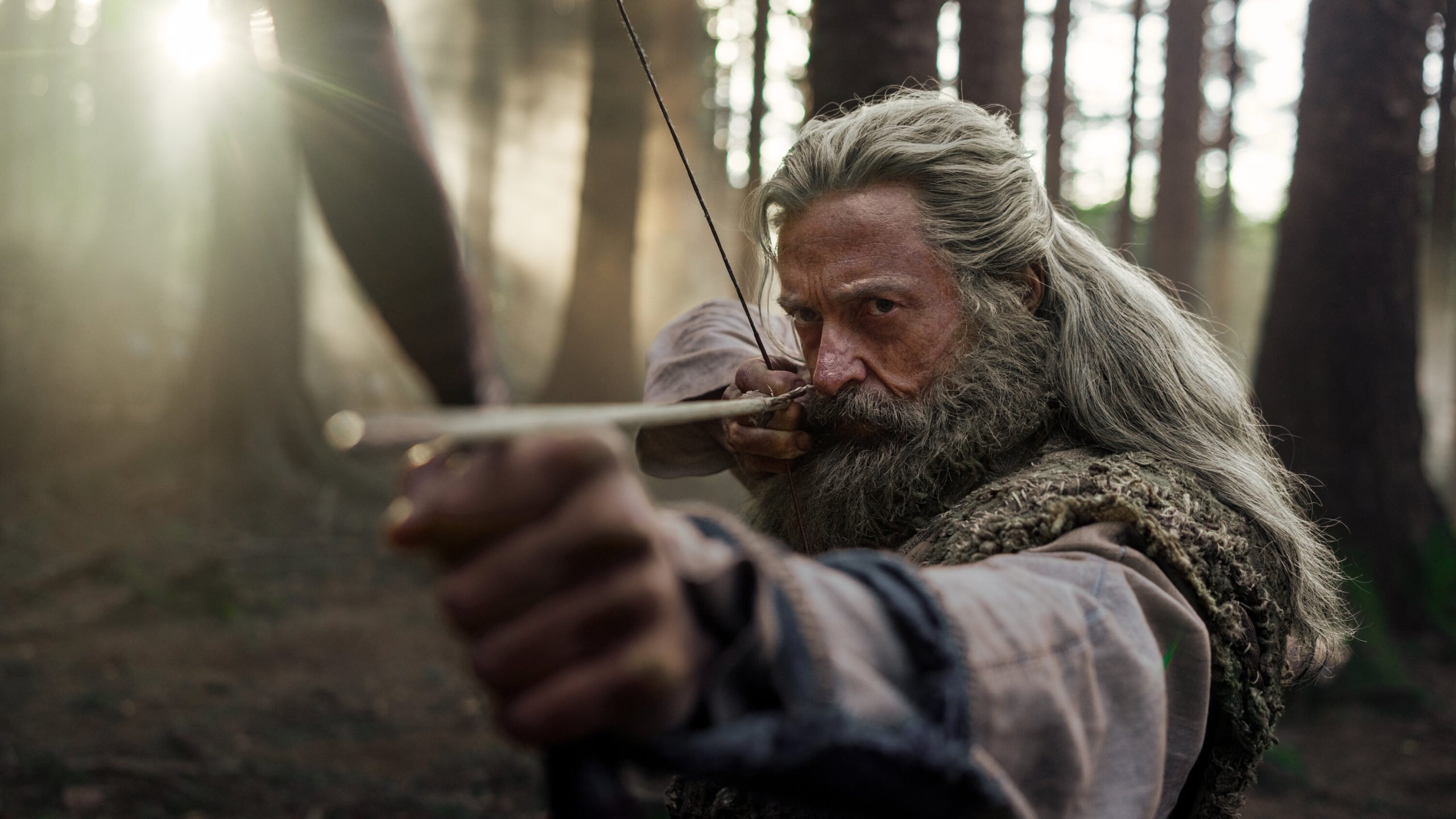

Anyone going into The Death of Robin Hood expecting a traditional telling of the Robin Hood legend is in for the rudest of awakenings. If anything, the latest from writer/director Michael Sarnoski (Pig, A Quiet Place: Day One) is a version of the 14th- and 15th-century story about tearing down mythology and coming face to face with one’s true legacy. In the case of the aging Robin Hood we meet in this film (played magnificently by Hugh Jackman), it turns out most of the fabled stories about him that people are familiar with were invented by the outlaw archer himself, in order to throw the general populace off the scent of the truth about him. The truth is that he and his companion, Little John (an unrecognizable Bill Skarsgard), were a band of cold-blooded murderers and criminals who often killed innocent people (including children) so that they would not seek revenge for Robin killing those close to them.
As introduced here, Robin is tired, in constant pain, and sick of all the death, and he enters into a battle he believes will be his last. Nearly dead, he is rescued and brought to an isolated island where a nun named Sister Brigid (Jodie Comer) nurses him back to health. She eventually introduces him to the community she built up on the island, which includes orphaned children, a leper (Murray Bartlett), and other outcasts in need of a community where they don’t have to fear death. Naturally, Robin Hood doesn’t trust the place, but after befriending a young girl named Margaret (Faith Delaney) and getting to know more details about the place, mostly from the leper, he starts to become a contributing member of the society and its protector. And without really intending to, Robin begins to feel good about himself and life in general, and even wonders if there’s a chance for salvation for him after the countless sins he’s committed in his lifetime.
Eventually, a young man (Noah Jupe) arrives on the island, saying that his family has been killed. Robin sniffs out the truth about the boy and rather than simply kill him in his tracks, he attempts to reason with him, guessing that he’s never hurt anybody before and has no interest in starting now. As the film goes on, it parcels out character details about everyone Robin grows close to, including Margaret, the leper, and Sister Brigid, whose past might be more closely tied to Robin’s than either of them would like. The Death of Robin Hood is emotionally agonizing at times, but this is a story about trying desperately to leave one’s past behind, hoping that good deeds will cover up the pain of what came before—sometimes it works, frequently it does not, which doesn’t mean it isn’t worth trying.
Between this film and Song Sung Blue last year, Jackman might be doing the best work of his career. You can feel his bones crackle and his muscles burn with every movement, but you can also look into his eyes and see decades of regret for his life, and that look lingers long after the movie ends. But the real heart of the movie is Comer, a woman living so deep in denial, she probably doesn’t realize it. When she discovers certain truths about the man she’s come to rely on, her facade crumbles beyond repair. It’s a stunning, remarkable performance, and if this film was coming out in the fall, I’d say she’d be a sure-thing awards contender; she still might be.
Director Sarnoski is a solid 3-for-3 track record, and in many ways, The Death of Robin Hood harkens back to his first film, Pig, with both works being about men looking back on lives that they would rather not remember, and both films bringing out highly memorable performances from their lead actors. Make no mistake, this movie is bleak, violent at times, grimy, and generally unpleasant as a sensory experience—you can almost smell how bad the people in this must stink—but it’s all part of the last journey of Robin Hood (that’s not a spoiler; it’s right there in the damn title), and it all works in telling a fantastic, authentic-feeling myth.
The film is now playing in theaters.
If you enjoyed this post, please consider supporting Third Coast Review’s arts and culture coverage by making a donation. Choose the amount that works best for you, and know it goes directly to support our writers and contributors.
