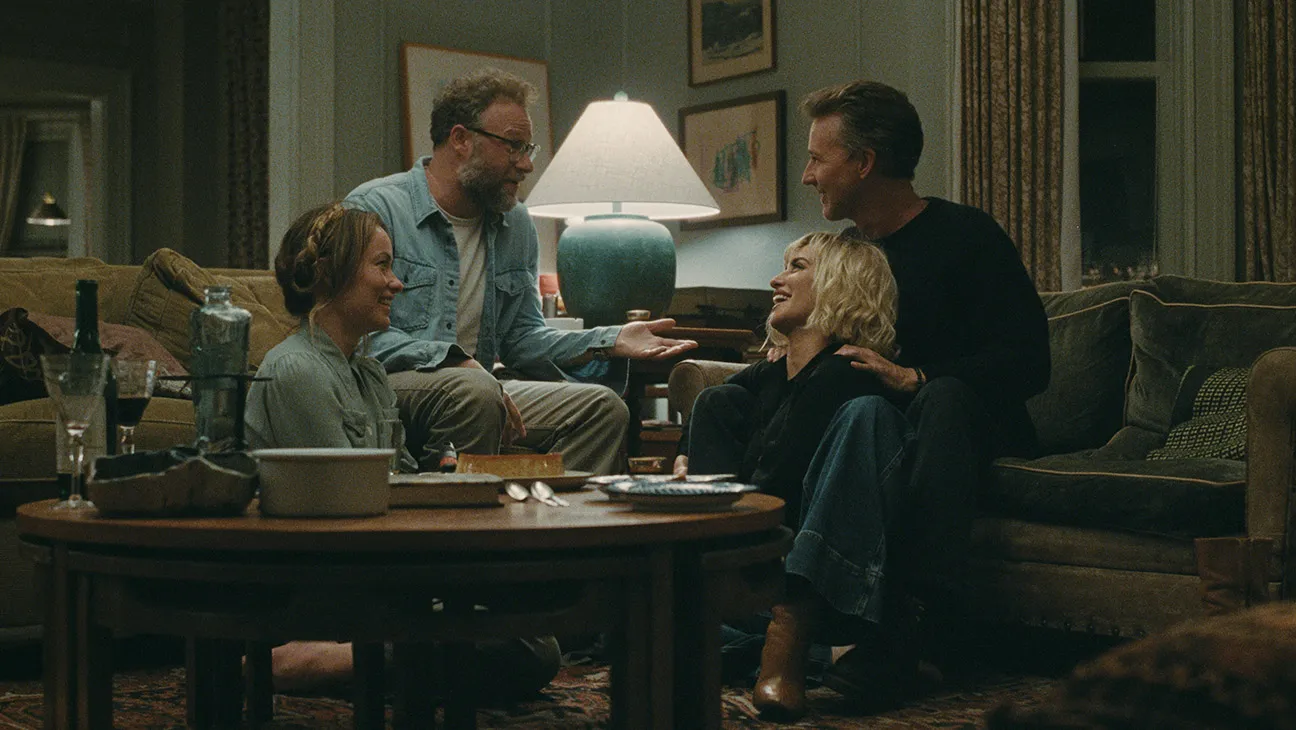

The opening credits of The Invite, Olivia Wilde's latest directing effort, acknowledge that the film is based on Cesc Gay's 2020 dark comedy Sentimental (or "The People Upstairs"). That original film has had quite the journey in six years, having been remade in Italy, Switzerland, France and South Korea all before it landed in the hands of Will McCormack and Rashida Jones, who co-wrote this adaptation helmed by Wilde. I admittedly haven't seen any of those versions, so this can't be (and shouldn't be) a comparison of what this iteration does better or differently than its predecessors. All I can do is delve into what Wilde has created with a cast of four (including herself, Seth Rogen, Edward Norton and Penelope Cruz) and a single setting: a spacious city apartment that provides ample space for the stories various scenes and adventures.
Wilde and Rogen are Angela and Joe, a long-married couple living in the apartment he inherited from his parents with their tween daughter; he's a one-hit-wonder who now teaches at a middling music conservatory and she's a stay-at-home-mom with...time on her hands? The film is so hyper-focused on this one night and these four people that we never actually get into much of their past. Joe is just arriving home from another unfulfilling day at work when Angela informs him—nay, reminds him—that their upstairs neighbors, Piña (Cruz) and Hawk (Norton) are coming down for dinner. The former have just finished a renovation, apparently, and the latter are interested in seeing the results. Joe, however, is more interested in finally confronting his neighbors about all the loud and disruptive sex they're having at all hours of the night, despite Angela's adamant protestations against this idea.
In the film's first 15 minutes, we understand that Joe and Angela are walking a tight-wire in their relationship, snipping at each other constantly in the way two people can when they've known each other more intimately than anyone else for decades. There is no pretense or subtlety, but there is also little to no civility or mutual respect. They bicker over the not-so-foldable bike he's supposed to use on his commute through the hills of San Francisco, about the wine he "forgot" to pick up even though Angela only texted him about it on said commute home. The dialogue is sharp both in words and delivery; neither Rogen nor Wilde have difficulty getting to a place defined by barbs and steely looks. Joe is a depressed, checked-out husband doing the bare minimum to get by and Angela is a gold-medal people pleaser to the point that she's lost all ability to discern what she actually wants or desires.
When Piña and Hawk do show up, the couple couldn't be more different than their neighbors (or, frankly, each other—the casting in this movie is one of its more curious choices). Both dressed in black, Hawk is a tall, soft-spoken drink of water who's mainly interested in keeping the peace and spreading the love, man; Piña is walking sex, with cleavage for days and an unaffected air about her surroundings—for all the effort Angela has gone to to create an unforgettable spread, Piña doesn't miss a beat in informing her hostess that she doesn't eat meat. Or cheese. Or sugar. Or gluten...
The next 90 minutes or so are such a tonal hodge-podge that one may just get whiplash bouncing between the harsh pivots; generally speaking, I was along for the ride as we navigate the cringe of the early small talk, the absurdity of the proposition at the center of the film (I'll let you use your imagination...) and the drama of the third act baring-of-the-souls. Whether it all works together is another question entirely, and at least for me the answer is...sorta?
I genuinely found this small ensemble to be engrossing as a foursome (sorry); more than once throughout the film I kept thinking of them each as actors outside of the role in front of me, yet still connected to it. How wonderful it is to see Norton on screen again (after his bravura turn in A Complete Unknown). How Rogen really leans into Rogen-ing (the laugh, the one-liners). How Cruz got her eye-makeup so dang perfect. How Wilde managed to direct these intense scenes while inhabiting them herself. From a craft and casting perspective, then, it's a fascinating accomplishment, a fully contemporary adult comedy with hints of Allen, Rohmer, Meyers and so many others who've brought their brand of interpersonal relationships to the screen over the generations. What it lacks, I'm afraid, is any sense of Wilde, any discernible directorial vision like those aforementioned greats (well, at least the last two).
It's unclear who exactly is going to "enjoy" The Invite, as I'm not entirely sure it's a film meant to be a romp through a dinner party gone awry. It's funny, to be sure. It's thoughtful and it's challenging. It's fast-paced and surprisingly self-aware. And as far as I'm concerned, these are all descriptors that recommend a film just as much as "entertaining" and "amusing." Not every film has to be easy and accessible to be watchable and worth one's time. The Invite is uneven and unpredictable, but it's not poorly executed, and on Wilde's journey behind the camera, that might just be recommendation enough to RSVP yes.
The Invite is now in theaters and opens in Chicago on Thursday, July 2.
If you enjoyed this post, please consider supporting Third Coast Review’s arts and culture coverage by making a donation. Choose the amount that works best for you, and know it goes directly to support our writers and contributors.
