Thanks to a couple key roles on two of the most consistently funny TV series in history, Tony Hale has established himself as a comedic genius. After doing smaller roles in movies and one-off episodes on various TV series, he landed the role of the neurotic Buster Bluth on Arrested Development from 2003-06 (and also 2013, 2018, and 2019). After bouncing around various series again, he landed the role on Veep from 2012–19, playing Gary Walsh, the personal assistant to Vice President-turned-President Selina Meyer. Hale won Emmys for the part in the show’s second and fourth season, and from there his career became firmly established.
After continuing to work steadily, in 2019 Hale voiced the character Forky in Pixar’s Toy Story 4, a role he reprised for the 10-episode Disney+ short-form education series Forky Asks a Question. Being a spork with googly eyes and pipe cleaners for arms created by his kid, Bonnie, Forky is worried that people will see him as trash rather than a proper toy; this existential dilemma drives a lot of what makes the film so funny and moving, and the character became an instant classic in the Toy Story universe. Since then, Hale has had a supporting role in Hocus Pocus 2, voiced the character of Fear in Pixar’s Inside Out 2 (taking over from Bill Hader), and most recently, he played a hapless HR manager for a big airline in Netflix’s Office Romance, starring Jennifer Lopez and Brett Goldstein.
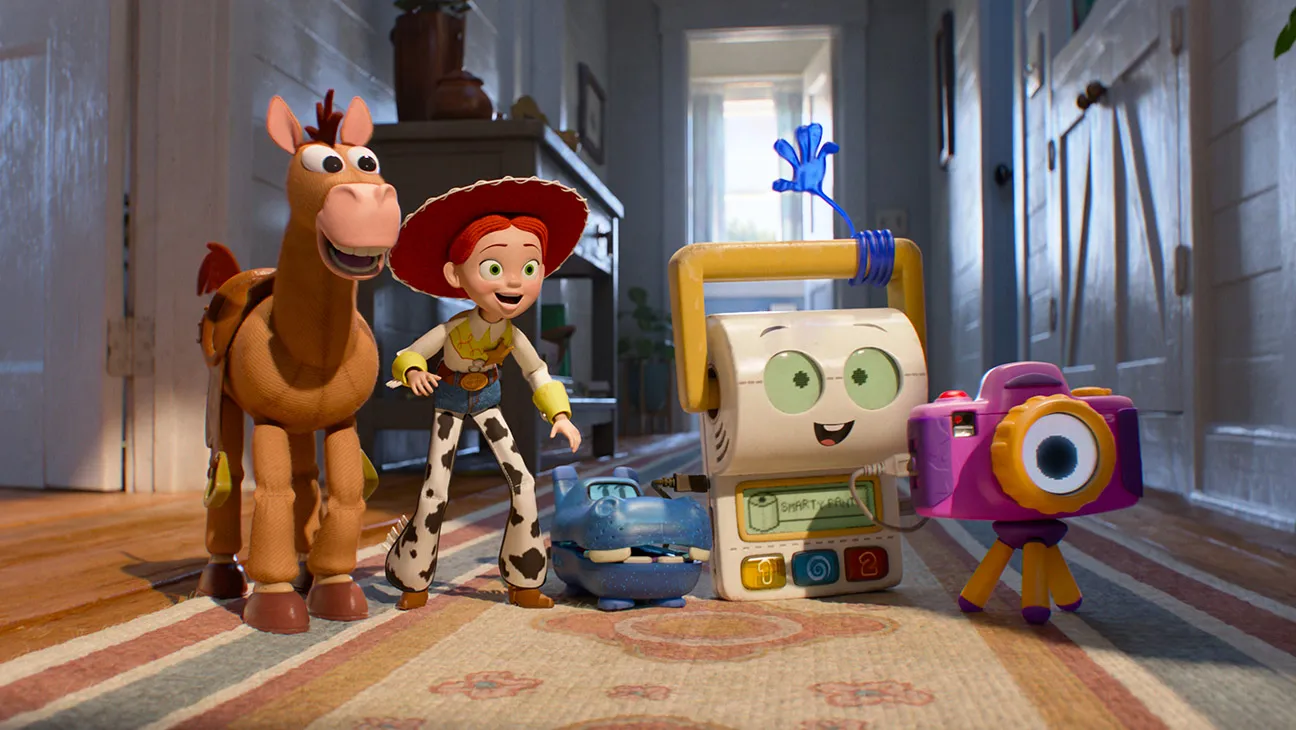
Returning to the Toy Story world, Hale reprised his role as Forky in this week’s Toy Story 5, which opens up with Forky getting married to Karen Beverly, a knife/toy voiced by Melissa Villaseñor. The main themes of the film concern Bonnie getting her first piece of tech, a tablet named Lilypad (Greta Lee), and her small army of toys who start to feel irrelevant, with Jessie (Joan Cusack) leading the charge to get them back in Bonnie’s good graces.
I had the chance to speak with Hale recently about the tech-heavy themes of Toy Story 5, as well as the keys to bringing Forky to life and how he’s grown since the last film. We also touch a little on two very funny scenes from Office Romance featuring some of his finest non-verbal comedy. He was an absolute delight to talk with, and he began our Zoom interview by noticing my sizable Blu-ray collection in my office background. Enjoy our conversation…
Tony Hale: Hey, Steven. Good lord, your collection is so good. It's so good.
I’ll admit, I do like doing these interviews, because everyone always comments on it.
Oh my gosh. Do you see one of those antique picker places, and just get excited because you don’t know what you're gonna find?
I don’t really do that, but some of the record stores around here have pretty good Blu-ray collections.
So good.
Sorry you couldn't be here in Chicago, but it just started raining outside, so I think you made the right call. I believe this is your third outing with Pixar now. What do you see as the key differences about the way they tell stories and the way they develop characters?
Yeah. The magic that’s over there is hard to encapsulate, because every time…when people ask me what are my top five favorite films, Inside Out is always up there. When I first saw Inside Out, I was so blown away by how they orchestrated the emotional life, and did it in such a digestible way, for kids and parents. And so there’s just something about taking simple truths, doing it in an incredibly creative way. Even complicated things like emotions, but making them very user-friendly and fun, you know? I don’t know how they do it; I don’t know what’s in the water over there, but they’re making it happen.
I've been lucky enough to visit the campus a couple times, and I had to just force my mouth closed and just take it in; it’s amazing
I know, it is!
I know this film is being promoted as sort of a tech-versus-toys thing, but when I watched it, I thought it was about finding a balance. It was about that conversation starter, that discussion starter, about how to incorporate both into a kid’s life and development. How do you think the film presents that balancing act?
Yeah, I’m glad you said that, because I saw it as more like toys meets tech. I think it was Tom Hanks who was saying how—to your point—they’re not bashing technology. Technology is here to stay, it’s not going away. But nothing’s gonna replace human connection. Nothing is gonna replace true connection. And as long as we keep that balance, which is tough, says me as a dad of a 20 year-old, that’s tricky, because the technology can go awry, and it can get the front seat a little too much. But you just always have to keep an eye on it and always keep connection, real connection, as the priority.
The film opens with Forky getting married. Tell me about Forky as a married man. What’s different about him?
He definitely works fast, because he was introduced in Toy Story 4 and found someone at the end of Toy Story 4. There’s a line in this one that I love, when he goes, “I love her, but this is gonna be hard.” I love the simple truth of that. I mean, I love my wife, and yet when two people from different histories come together…We’ve been married 23 years, you go through stuff, you know? And it is tough, but it’s worth it. So he’s always saying the truth, he’s asking questions, he’s curious, and that, to me, is half the battle, always being curious with your partner.
Well, being curious is kind of his thing. Since we didn’t talk for the last film, what I was gonna ask you is about the key to cracking the character of Forky for you. He is a guy that asks the most questions. But he also is a guy that lives like an outlier, because he literally has to yell at people not to call him trash. How many of us can identify with that, honestly? But he questions things all the time. Was that part of cracking that code to getting Forky as a character?
Yeah, totally. It was a very collaborative thing. You know, Josh Cooley directed Toy Story 4, so it was about going back and forth with him. Because he does have this openness to him, one of the big messages, because he loved trash. He didn't see it as a bad thing, he was like, it’s comfortable. But you look at the bigger picture of it: everybody has that part of them that they think is kind of trash, and he likes the trash. And it took Woody to say, “Hey. I know you like trash, but you’re meant to love and to be loved,” and Forky didn't know that, there was no shame attached to it, he just didn’t know. And so, there was just a real childlike essence to him that we always tried to keep alive, just shamelessly asking those questions.
Speaking of directors, it's crazy to me that Andrew Stanton is back at the helm of a Pixar movie. I've been lucky enough to interview him for a couple things over the years. But the guy was one of the first animators they hired there, he’s got two Oscars. Tell me what’s unique about the way he handles actors and storytelling.
Yeah. His career and the journey he’s been on is so impressive, and having the opportunity to have worked with him in the booth…because I’m sure you already know this, but we only get pages of the script; we don’t ever see a full script. And so, as a character, it wasn’t until I saw the movie this past week that I really knew what was going on in the film. So, having him guide, not only speaking out all the other characters, but knowing what he exactly needs to make it seamless in the final cut. So, the amount of balls that he’s having to juggle is just wild, both him and Kenna Harris, who is the co-director, is just baffling. And somehow, that grid is in his head. He’s got it figured out.
Speaking of being in the booth—I always wonder this of someone in an animated film—how physical do you get in the booth? Do you break a sweat? I hear about people running out of breath while they’re doing this.
I get so physical. This is how you know: multiple times, I have to be told, “Tony, you have to get closer to the mic.”
You’re flailing?
I’m flailing, I’m all over the room, and they’re like, “Tony, this is a voice-over booth.” The whole reason is, that has to be communicated into the mic, and I just have to be reminded of that constantly, because it’s so fun, but I pretty much give the same performance I do in front of a camera, I’m just doing in front of the mic.
Well, that’s what I’m wondering, because Forky’s only moving parts, really, are his arms, so do you limit your movement while you’re doing the voice
Oh, that’s good, I should. I love his little popsicle feet, just kind of trying to keep up. But he is limited, but those pipe cleaner arms are just all over the place. So I think that’s his expression, and his sweet little face. So he has a lot to express.
I also know that when you’re recording your voice, a lot of times Pixar will film you doing that. Have you ever caught any of your gestures or expressions from your recording session in the final film?
That’s a good question. Yeah, yeah, yeah. I mean, they always do that kind of fun stuff. Now I want to go on a mission, to look at all the recordings to see what they caught, because I’m very expressive with my hands, and Forky’s pretty expressive with his arms, so there’s gotta be something.
Since you did only get your pages for the recording, and you don’t even really know the whole story until you see the final film, what were some of the surprises you noticed the first time you watched it?
Well, definitely that he’s going to his nuptials, that he’s getting married, that they’re getting serious. The frankness is always a nice surprise. That’s what I just love. I love when he’s like, “It means that you're bald, Woody.” Or like when he’s saying, there’s that lizard, and somebody asked, “Well, what happened? He’s been around a while.” And then Forky has to be the one who says, “Okay, the first one died, and so this is the second one.” He’s just constantly stating the facts, but he does it unashamedly. I can’t get enough of that.
The first Toy Story film is over 30 years old. And I think you could safely say that a couple generations’ worth of people have grown up on these movies. And one of the things I liked about this film is, we are acknowledging that the toys are showing signs of aging, too—some of the older ones are. How do these films stay so relevant over decades?
I believe that Pixar’s just constantly watching the culture. Look at this one: you look at the landscape of technology. But doing another one, they wouldn’t go this hard into it if there wasn’t a story to tell. And there’s obviously such a story to tell of analog toys dealing with technology and how to navigate that, and how to talk about that with your kids and balance that. That is a prime story to tell, and they knew it.
Did you have a favorite Toy Story character before you joined the fray?
Let me think. It’s hard to…Woody is such a father, his voice alone is just so comforting. Definitely, just hearing Woody say, “Hey, man,” it was just so dear. I always liked the Potato Heads, though. I always liked Mr. and Mrs. Potato Head. I actually met the voice of Mr. Potato Head Tuesday night at the premiere, which was absolutely thrilling. I grew up with that voice.
I know in most cases with animated films that you don’t ever see any of the other people when you record, even people you share scenes with. So really, the only time you get to see these people is at premieres and press days.
Press, yeah. With Mr. Potato Head, because I just moved to New York when Toy Story came out, so I was 25, and his voice has been a part of my life for, good lord, 30 years. And so, I got to meet him there, and I didn’t meet Joan Cusack until during press this past week, and I’ve been a fan of hers forever. So I turn into a big fanboy.
I think I interviewed her for the film that character was introduced in. Was it 2? But that’s wild that you didn’t get to meet her until this week. And I love that this film is so Jesse-focused.
And it should be. It’s so her story. This story is so powerful. And also, and this isn’t a spoiler, but you see the generations of her existence as Jesse.
They actually deepen the character in this film, which, at this point, you almost think isn't possible. Without saying anything specific about the ending, where we leave the toys at the end of this film, this struggle isn’t over. I don’t mean to make it sound doom and gloom, but they’ve struck a balance to a certain degree, but kids get screens at younger and younger ages The toys are going to have to struggle to stay relevant. What do you think about the way this leaves things?
The thing that warms my heart about Toy Story, why it does have its longevity, is, yes, they’re toys, but you also see this ensemble stick together. You see this ensemble rooting for each other, having each other’s back, supporting each other. That’s why I'm coming back, because it’s like I’m coming back to that family. So I want that family to stick together. I remember ensembles I grew up with, like the Muppets. I loved going back to see that family, that ensemble, just laughing together and being together; it’s always a joy.
I want to ask you real quick about something else you’re in right now that I almost didn’t get to see, because it was not really on my radar. But a friend of mine said, :”Have you seen this Office Romance movie?" I knew about it, but I hadn’t really planned on watching it, but then he said, “You should watch this thing, it’s so funny.” I give Brett Goldstein and his writing partner all the credit, because it’s so well written.
It really is.
You have two of the best scenes in the movie, and we can’t even talk about one of them, but you know it’s the one where you and Brett are debating a word and the relevance of a particular word.
Yes!
Then the other one is the stuff over the credits where people are coming to you and registering their relationships with the company. You have this gift, and I’m wondering if this is something you have cultivated over the years, or if it’s part of your improv training, where you have a different response every time someone says the same thing to you over and over. Tell me about the training that goes into giving that filmmaker a different version of that every time.
Amazing. Who knows? I think I probably got practice by doing Gary, because Gary wasn't allowed to speak. Selena never let him speak. So he pretty much had a whole nonverbal performance. So I think that definitely was a good training ground. I also grew up loving Beaker from the Muppets, who would just, like “Beep beep beep.” He just said one thing, and it made me laugh so hard by just his sounds. I was a fan of Bob Newhart and Tim Conway, who never pushed the comedy. Bob Newhart would literally stand there in tension and dart his eyes, and it was funny. Because you just knew he was so circumstantially under such pressure. And he just didn’t have to wink at the audience, and I loved it.
Yeah, you’re in agony during those scenes, it's amazing. You could take that scene with you and Brett and make it a short film and put it out. It’s so good.
Thanks.
The other thing I wanted to ask you about was the next thing you have coming out, which is The Wrong Girls, which comes out at the end of the summer. Kristen Stewart and Alia Shawkat—you two are back together. Can you say anything about that?
This is the challenge with press, is I forget, because I shot it a year ago, and I mean, it’s…first of all, this is the second time I've been able to reunite with Alia, because we did Being the Ricardos together, and she's a dear, and it was so fun to be in this. But, I know that it’s pretty out there, and it was very fun to do. I kind of play a little bit of a jerk, which is always nice to play. Yeah, but it’s definitely chaotic. Dylan Meyer directed it, and it’s always great when these directors are so cool, and they just give you the playtime to improv and stuff. That’s always a gift.
Thank you so much. I’m glad we got to talk even after your trip got cancelled.
Me too.
But get to Chicago soon, if you can.
Yes, definitely. Thanks for taking the time, man.
If you enjoyed this post, please consider supporting Third Coast Review’s arts and culture coverage by making a donation. Choose the amount that works best for you, and know it goes directly to support our writers and contributors.
