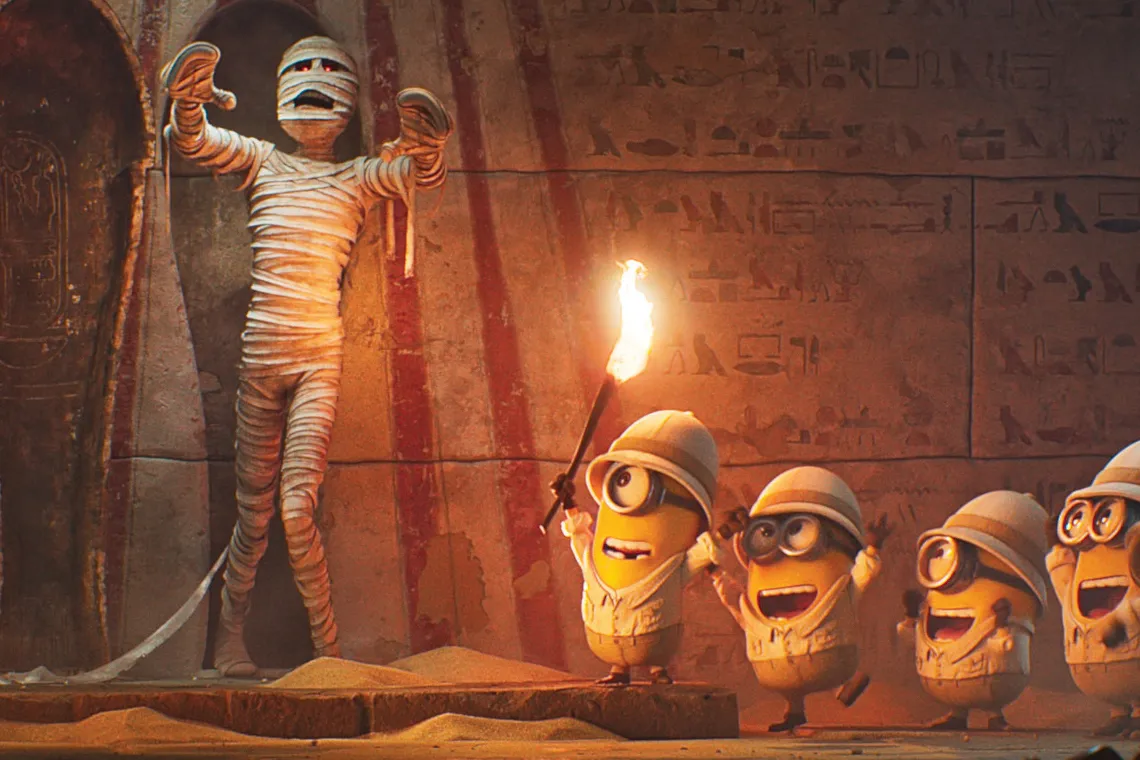

It was apparent even in 2010, when the first Despicable Me film was released, that the Minions were always going to be the best part of this odd little universe where bad guys actually declared themselves bad guys (instead of politicians?) and the world made some amount of sense. They were fascinating creatures not because of the way they looked (admittedly, they are so easily marketable) but because even though they were billed as characters always looking to serve a villain (such as the ever-insufferable Gru), they actually had ambition, creativity, and better comic timing than anyone else in the franchise who were telling actual, written jokes. All they had to do was speak their weird little combination of English, French, Spanish, and gibberish, and audiences howled with laughter.
The proof comes out this week, with the release of the seventh film (with four Despicable Me movies, and now three Minions ones), Minions and Monsters, a welcome left turn from co-creator and director (and voice of all Minion characters) Peter Coffin, who sat out the last Minions movie but did direct the first three Despicable Me films and the original Minions. Leaving the world of Gru behind, this chapter features a slew of new characters and even a time shift, taking us back to the era in film history when silent films transitioned into talkies. According to this bit of alternative fiction, Minions were a key part of this change and rubbed shoulders (do Minions have shoulders?), with some of legends of motion pictures, including silent icons like Chaplin, Keaton, and Lloyd.
All of which begs the question: who is the movie made for exactly? Even the most intelligent kids (and perhaps some of the parents) won’t get a lot of the classic cinema references, many of which flash by our eyes as the Minions race through active movie sets. Seeing one of the little yellow dudes getting pulled into the gear works in Chaplin’s Modern Times is kind of wonderful, and I’m sure some people will recognize it as such, but many won’t. My biggest hope is that the film inspires parents of children who love this movie to show them the source material; there are certainly many to choose from.
The films opens with tour guide Olivia (Allison Janney) telling a group of tourists about the Minions contribution to film history. While once again looking for an evil master to serve, the wandering through the film set of a silent Western being directed by a director named Max (Christoph Waltz). He thinks his shot is ruined, but when he shows the footage to the brothers who run the studio (both voiced by Jeff Bridges), they love it and think the Minions are stars, and it’s in this moment that these Minion-themed movie finally reveal the core appeal of their central characters: they are silent-film stars, who get to talk a little bit but never enough to distract us from their inherent cuteness and charm.
The main characters here are James and Henry, a perfect, classic screen pairing if ever there was one. But by the time they are gearing up to make their first film, sound has entered the picture, and within this framework, we get references to seemingly dozens more classic film, from Citizen Kane to Casablanca—basically, if it’s in black-and-white, it’s fair game. But since Minions can’t exactly embrace the talkies, they come up with another sure-fire way to make a hit movie—monsters! To help make their big screen monster movie, they use a spell book to summon a tiny, squeaky, tentacled little dude called Goomi (Trey Parker). He’s too adorable to be a big scary monster, but luckily he has a direct line to the type of threat to humanity that James needs to make a credible monster movie.
Meanwhile, another minion named Dick leads a group of Minions still in search for a new boss, and they run into the neurotic alien robot Dort (clearly a reference to The Day the Earth Stood Still’s robot character Gort and voice by Jesse Eisenberg). And while Dort came to Earth looking to take over the dump, he starts to feel feelings for the human Debbit (Zoey Deutch), a suffragette who is impressed with Dort’s feminist leanings. As much as the back half of Minions & Monsters suffers compared to the hyperactive front half, I was charmed by this weird, questionable relationship, due in large part of Eisenberg turning his recognizable jittery persona into a very funny robot character.
Back to James and Henry’s movie, Goomi eventually summons a ginormous, orange, multi-eyed, gelatinous creature (not unlike the one in The Blob, with with hundreds of eyes) for their villain role, and almost immediately reveals his true plan for world domination. Admittedly, when the scale reaches global proportions, Minions & Monsters lost a bit of steam and seemed like something more aimed at younger audiences with access to their parents wallets to buy them the merch inspired by all of these weird little creatures. But in the moments where director Coffin takes a real look at how Minions were put on this earth to serve and put in the movies to entertain, we get a sense of what he’s trying to say with these movies.
I love the idea that Minions have been a part of the cinematic art form since it’s earliest incarnation, and this might be the first time I can fully endorse a film featuring the little goggle-eyed bastards. And if that doesn’t inspire you to check this one out, there’ a George Lucas (voiced by actual George Lucas) cameo that’s pretty hilarious.
The film is now playing in theaters.
If you enjoyed this post, please consider supporting Third Coast Review’s arts and culture coverage by making a donation. Choose the amount that works best for you, and know it goes directly to support our writers and contributors.
