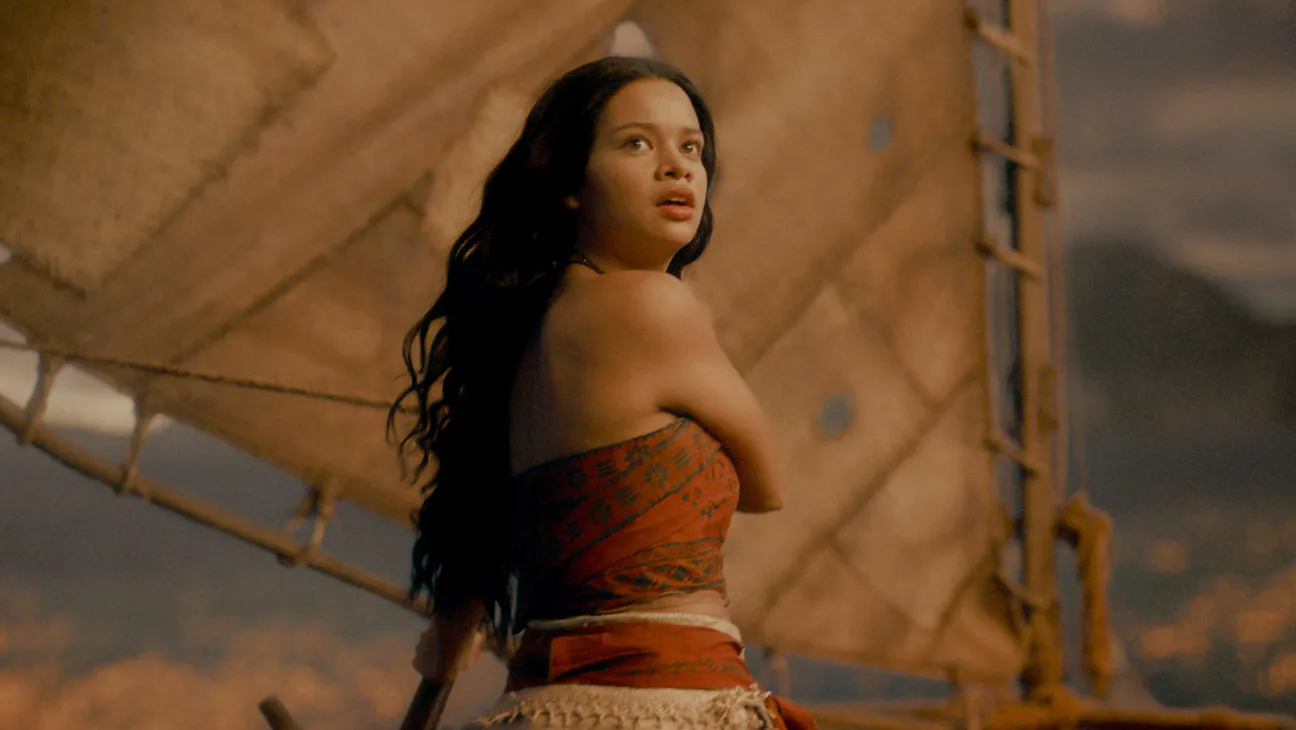

Live-action remakes of beloved animated films are a mixed bag at best and totally unnecessary in every case. That doesn’t mean that a few of them aren’t good, but without exception, there is a certain magic lost when you take the endless possibilities of animation and make them (or attempt to make them) photorealistic. The original Moana (which is only 10 years old, making this the shortest turnaround time from animated to live-action version) was one of Disney Animation’s most vibrant, colorful, and culturally relevant works in ages, and it opened up the world of the Pacific Islands in a spectacular fashion. Aided with a handful of songs co-written by Lin-Manuel Miranda and a voice performance from the bottomless energy cell known as Dwayne Johnson (as the demigod Maui), Moana turned out to be something special and singular.
With this go-around, Moana isn’t so much a reimagining as it is a retelling of the exact same adventure story of a young chieftain’s daughter (newcomer Catherine Lagaʻaia), living her whole life on the island of Motunui, never allowed to go into the inviting water that surrounds her home. Even the fishermen who take boats out to fish never go beyond the reef surrounding the island. Moana’s father (John Tui) tells stories of rough seas beyond the reef and terrible perils that await anyone who goes beyond. But her wise (albeit, slightly loopy) Gramma Tala (Rena Owen) shares Moana’s passion for the ocean, a passion that binds them even after Gramma dies early in the film. Even the ocean itself coaxes Moana to travel, offering up a precious stone that acts as the heart of the island, which Maui stole ages ago and then lost in the ocean.
Eventually Moana and her wonky-eyed pet rooster named Heihei do set sail, find Maui, and have their own personal odyssey through trials, including an encounter with a greedy, deceitful crab (voiced by Jemaine Clement, also a returning voice from the animated film) and a final test against a lava monster that is actually so wonderfully conceived and rendered, it might almost be too scary for little kids.
Normally in these live-action remakes, casting the people who did the original voice in the animated version doesn’t happen. But it’s understandable that director Thomas Kail (Hamilton, the filmed version) and his team would want Johnson back as Maui, whose body is like a walking storybook, covered in ever-moving tattoos, like its own animated film, telling us tales from his past, commenting on his present condition, and providing Maui advice and even criticism when required—more often than not, the tattoos side with Moana and push Maui to be more of the hero he used to be.
Moana moves between surreal fantasy, traditional Polynesian mythology, pure slapstick, and an uplifting story about a young girl so tapped into her people’s ways and traditions that she’s able to draw strength and courage from such knowledge. Maui’s motivations are more about seeking redemption for a misdeed committed long ago. But something about this live-action version feels more like a series of life lessons than an actual story.
It’s great that we have a film whose characters value life, positive energy and deeds, and are determined to rid their corner of the world of all destructive forces. That message feels good to hear right now, but it also grounds the movie to such as degree that it stops feeling like escape and feels more like you’re being forced to see the world we live in through fantastical eyes. Watching Moana isn’t a completely joyless experience, but its darker moments brought me down, and its lighter scenes didn’t restore me the way they should. This is about as good as these live-action remakes get, and it’s still somehow lacking. Let’s face it, reality sucks.
The film is now playing in theaters.
If you enjoyed this post, please consider supporting Third Coast Review’s arts and culture coverage by making a donation. Choose the amount that works best for you, and know it goes directly to support our writers and contributors.
