
Depending on the times and the filmmakers, Homer’s foundational story The Odyssey has meant many things to many creative adaptors. Just two years ago, a version of the mythic action epic was made called The Return, with Ralph Fiennes as the Greek king Odysseus and Juliette Binoche as his long-suffering wife Penelope, waiting 20-some years for his return from the Trojan Wars. In this telling, director Uberto Pasolini emphasized the crumbling family dynamic, with Penelope raging against her absent, war-hero husband, and their son, Telemachus, angry at both parents for allowing him to grow up in a palace full of sleazy suitors, all eager to wed Penelope and seize the throne of Ithaca.
Some of those elements are present in writer-director Christopher Nolan’s telling of The Odyssey as well, but with emphasis given to something even more substantial than interpersonal relationships. Nolan tackles the very price and value of war itself, and comes to the determination that senseless warfare angers and saddens the gods themselves. And he doesn’t just see the price of war as the deaths of both soldiers and civilians; he sees nearly as much damage done to those who survive and must deal with the consequences and guilt of those who died around them. Making his heaviest emotional work since Dunkirk (also a film that deals less directly with the cost of war), Nolan begins The Odyssey by asking himself, “What would keep a man from returning to the family he loves and staying away for 20 years?” And the answer has something to do with Odysseus (played with sincere depth by Matt Damon) wanting to get his head on straight before he felt it was right for a homecoming.
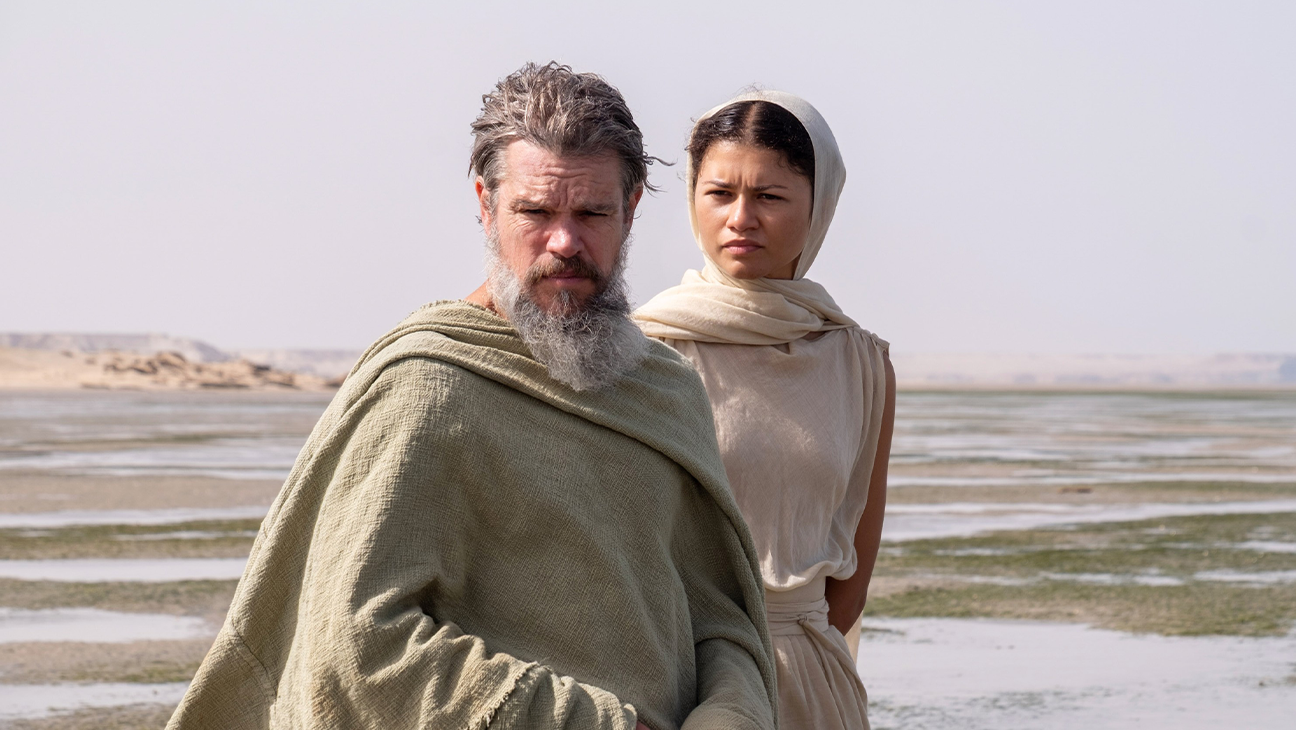
Sure, there were mythical barriers as well, such as a Cyclops, sirens, nymphs, witches, and furious gods, but through regular conversations with and guidance from the goddess Athena (Zendaya), it’s clear that our hero is burdened with a staggering amount of regret and shame. Haunted by duel visions of a soldier (Elliot Page) he effectively sacrificed so that the Trojan Horse deception would work, and the complete leveling of Troy and all of its inhabitants, Odysseus does attempt to get home with his most loyal men, after separating from Agamemnon (Benny Safdie), the commander of the Achaeans during the Trojan War. But his boats go astray, thus beginning a years-long journey that spark a thousand other similar stories.
The story of Polyphemus, a giant Cyclops (Bill Irwin) and son of Poseidon, is the first of many encounters with the mythological unknown, and it’s a terrifying sequence in which men are eaten by the creature who simply wants to tend his flock of sheep and live peacefully alone in a cave. But when Odysseus takes things too far and kills him, the crew is convinced that the bad weather they encounter in the immediate aftermath is the result of their leader angering Poseidon. While showing us certain monsters, demigods, and the aforementioned nymphs (in the form of Charlize Theron’s Calypso), witches (Samantha Morton’s unholy Circe, who is not kind to Odysseus’ starving men), and sirens, Nolan leaves open the possibility that these beings are somehow rooting in the real world, but he never shows us full-fledged gods doing godly deeds, and I’m thinking that’s probably for the best because it keeps the film grounded in a form of reality that still feels like it’s simply a bygone era rather than a full fantasy world.
Back in Ithaca, Penelope’s primary suitor is Antinous (a nasty Robert Pattinson), who plots to kill Telemachus and take what he believes is his in this kingdom. But Telemachus decides to go looking for Odysseus and heads out into the world, including a trip to Sparta, where he meets Agamemnon’s brother, Menelaus (Jon Bernthal), married to the beautiful Helen (Lupita Nyong’o), whose abduction started the Trojan War in the first place.
There are dozens of characters, and Nolan wisely casts familiar faces to play most of them, if for no other reason than to keep everyone straight. There are a lot of face-covering beards and helmets on display here, so throwing in overqualified actors to play smaller parts works to the film’s advantage. One of my favorite performances belongs to Odysseus’s loyal servant, the blind Eumaeus (John Leguizamo), who looks after his master’s family even after going blind in his old age. His earnest compassion radiates off of the screen, and it’s a worthy reminder how good an actor Leguizamo has always been when he dials back his energy but not his passion.
Look around the perimeter of the screen of The Odyssey and you’ll also catch glimpses of performers like Mia Goth, Corey Hawkins, James Remar, Himesh Patel (as Odysseus's second-in-command), and even hip-hop artist Travis Scott as a bard who tells the story of the Trojan War through oral poetry. But even with all of these actors, hundreds of extras, stunning sets and locations, and epic-level action, all shot around the world using newly developed IMAX film technology, the film’s true power always comes back to an insurmountable level of hurt, borne of war. I don’t mean to make The Odyssey feel like a bummer, but quite often, that’s what it comes down to. And Nolan, who has not been especially great in capturing real emotion on screen, lets his outstanding cast do that work for him, making us feel the weight of their pain in the process.
With breathtaking cinematography by Oscar-winner Hoyte van Hoytema and a rousing, pounding score by Ludwig Göransson (three Oscars in his trophy case), The Odyssey is a big movie that feels intimate because it’s such an achingly personal story. Editor Jennifer Lame (one Oscar) makes a film whose scope should be difficult to follow because it moves around in time, to different periods of Odysseus’s life, easy to track and a pleasure to watch unfold. The film’s nearly three-hour running time flies by thanks to impeccable pacing and dozens of great performances. I don’t consider myself a particular enthusiast for The Odyssey as a text or the period in history it’s (fictionally) meant to be set in, and I was drawn in and scooped up by all of these elements working so beautifully together, resulting in one of the year’s best film so far.
The film is now playing in theaters, including 70mm IMAX and 70mm presentations in a small number of local theaters, including the Music Box Theatre.
If you enjoyed this post, please consider supporting Third Coast Review’s arts and culture coverage by making a donation. Choose the amount that works best for you, and know it goes directly to support our writers and contributors.
