Also seen on CultureCombine.com.
As much as video games have tightened up as safe, corporate products over the years, it’s still awesome to see developers taking chances and swinging for the fences. Aether & Iron wouldn’t be possible if every release came from a rigid corporate structure. It’s an ambitious blend of RPG and visual novel that might occasionally betray its lower production values, but it more than makes up for it with great storytelling and stellar voice acting. There’s also some turn-based vehicular tactics thrown in for good measure, though it never quite blends seamlessly with the narrative.

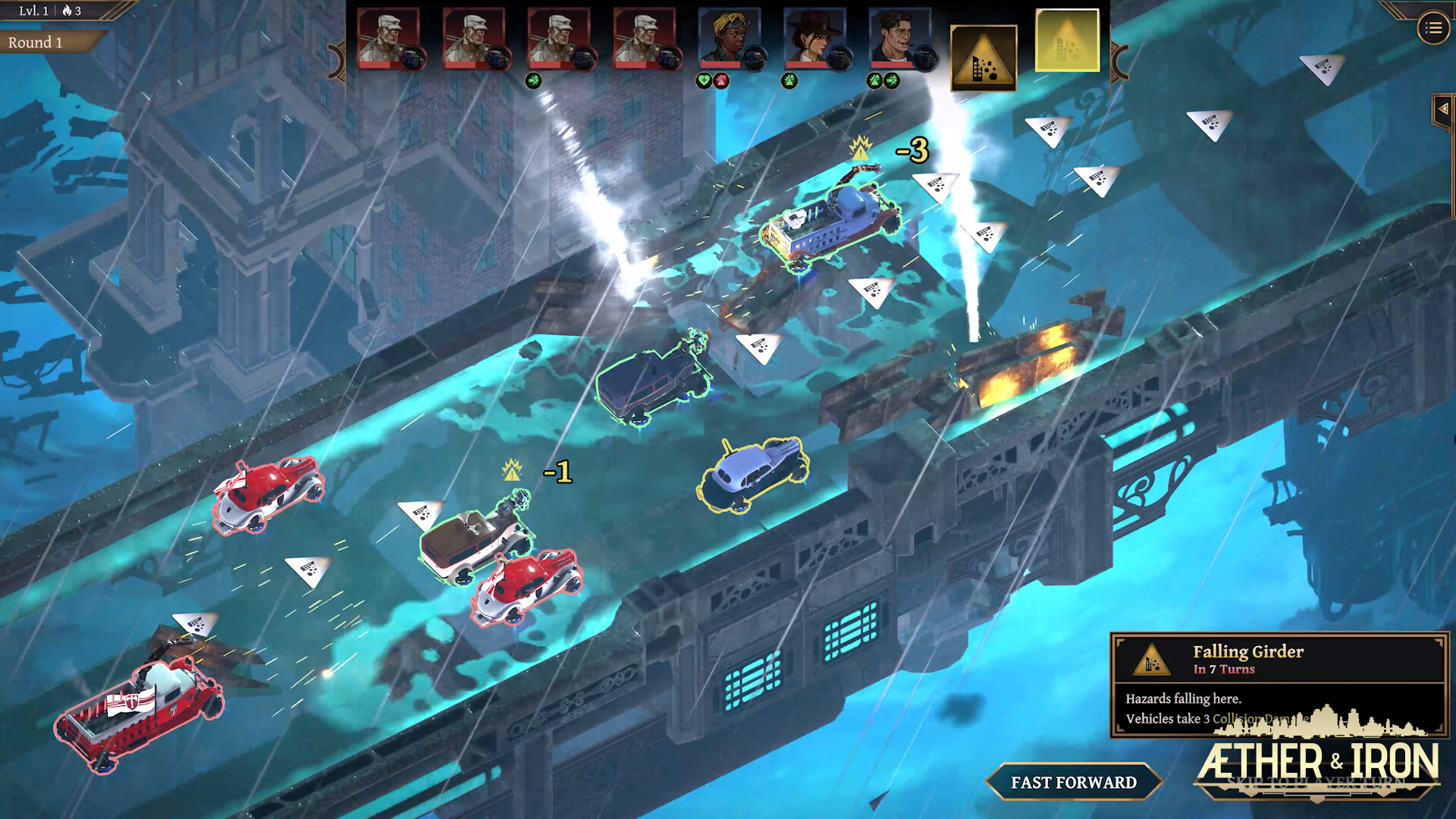
One of the things that initially pulled me into this Aether-filled, alternate retro-future New York was the promise of car combat. Not in a frantic Twisted Metal style, but a tactical, turn-based experience built around the concept of the Hollywood car chase. Okay, fine—I was completely won over by the promise of a hardboiled, noir "decopunk" reality, but the car combat was definitely a major hook.

At its core, Aether & Iron bills itself as a turn-based tactics role-playing game, but functionally, it plays much more like a narrative-heavy visual novel punctuated by skill checks and combat encounters to spice things up. This isn’t a bad thing at all. Going into it expecting a story-first experience is the best way to approach it.
The setting itself—a retro-futuristic city kept afloat by flying machines—is practically another character. It leans heavily into 1930s noir tropes, right down to the societal divide between the Lowers and the Uppers. It’s a tale as old as time: the rich ignore the world's problems even when the sky is literally falling around them. In this universe, the accumulation of so much Aether is causing massive environmental disruptions, threatening to drop the floating metropolis right out of the sky. (As an aside for the geography buffs: the developers inexplicably put the Statue of Liberty on Ellis Island, which is a notable ‘Mandela Effect.’ Clearly in this universe it was on Ellis Island after all.)

The catalyst for the plot is a job to escort Nellie, a scientist from the Uppers who is as sheltered from the city's grim realities as you are steeped in them. You play as Gia, a smuggler who handles the game's varied cast—ranging from doctors and movie stars to the lowest dregs of society—with a cynical, world-weary moral ambiguity. The dialogue can occasionally verge into hammy territory, but it fits perfectly with the pulp-noir theme. The voice work across the board is great, and the developers clearly know it, letting the cast carry the emotional weight of the story.
The gameplay loop largely consists of bouncing back and forth from objective to objective as you move from one point of the world map to another, sometimes hindered by random encounters. Missions range from simple protection gigs to a full-blown, multi-step casino heist.

Because Gia is a smuggler, you constantly have to consider random stops. If you have contraband out in the open, it’ll get confiscated—or worse, result in a messy run-in with the local authorities. You can modify your car to hide illicit goods, or keep them in the open to add some spice to your travels.
However, despite my hours in Aether & Iron, I found myself constantly waiting for the world to finally open up and offer me more agency. Sadly, it never really does. Sure, you can make a few decisions about what to tackle first, but you’re mostly being led by the nose through the narrative. If you’re okay with a linear ride, you'll be happy. But after the game teases a wide-open world with beautifully drawn overworld maps, it's disappointing to see them reduced to a few quickly driven streets that just shuffle you from point A to point B.
The RPG mechanics also stumble. The skill trees govern both your conversational and combat abilities, but the skills you need to navigate the story aren’t necessarily the ones you want during the tactical combat sections. This dynamic severely hamstrung my original character build–thankfully there are items that allow you to respect characters. To add more disappointment, the different companions you recruit share the exact same skill tree as Gia, just in truncated forms. While this makes it easy to build a synergistic team, it entirely removes the thrill of discovering what a new character brings to your established group.

Then there is the turn-based car combat, which put up a massive roadblock in my progression. After the first few introductory fights, the difficulty curve spikes hard. I repeatedly found myself failing encounters, forcing me to retreat to a shop to grind out new equipment for my car just to survive spontaneous battles, only to rinse and repeat at the next roadblock. If there was some sort of car progression baked smoothly into the narrative, it wouldn’t feel so jarring.
Instead, the combat often feels like a tacked-on nuisance that actively breaks up the pacing of the story.
Mechanically, the battles have bizarre quirks. For instance, it costs more Action Points (AP) to move forward than backward. I frequently found myself moving forward as a defensive maneuver at the start of a fight, only to get stuck in the back row with highly restricted movement while the rest of the battle played out. The encounters aren't entirely horrible—they do give the player a physical way to touch the world beyond clicking dialogue options, and they achieve the developer's goal of creating dynamic vehicular combat—but the execution leaves a lot to be desired.

Another major complaint is the overall technical execution has some rough edges. The menus feel weirdly sticky. Either the hitboxes for the buttons are too small, or they’re just finicky, but I constantly found myself wrestling with the UI, especially when trying to repair vehicles or swap parts in the garage. More dangerously, the save/load menu is laid out in a way that makes accidental deletion terrifyingly easy. I accidentally wiped my entire campaign while trying to delete a single file. (Luckily, I was just testing out save scumming a dice roll, so I was able to save my progress and continue.)
Aether & Iron is a game of incredible atmosphere and so-so car combat.You can tell it’s a game that has a lot of heart–from the voice actors giving it their all to the art setting the stage. But it never fully came together for me in a package that felt cohesive. But I enjoyed my time with Aether and Iron and would love to spend more time in this world.
Did you enjoy this post? Please consider supporting Third Coast Review’s arts and culture coverage by making a donation. Choose the amount that works best for you, and know how much we appreciate your support!
