In the interest of transparency, I want to disclose I met the author Taylor Thornburg at an open mic and wrote this review after speaking with him. Later I attended a couple of Thornburg’s writer’s workshops, and we plan to collaborate on his speaking series for Quimby’s Bookstore.

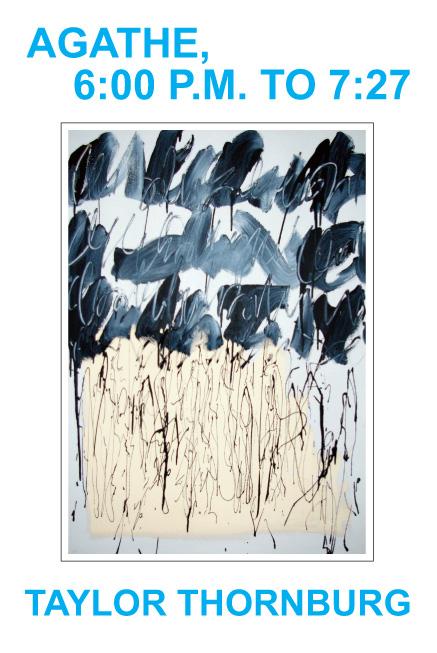
Agathe 6:00 p.m. to 7:27, Taylor Thornburg’s debut novel, released by Lost Telegram Press last September, begins with a typewriter-font letter addressed to the titular Agathe. In it her partner, Michael, a famous author, says he “woke up and saw that had completely outgrown relationship.” With little explanation why and no explanation where, he packed some things and moved out of their home, leaving Agathe, who we meet in her kitchen moments after reading the letter, confused and devastated.
The debut somewhat resembles a romantic mystery novel. We’re introduced to a romance between Michael and Agathe, and we're tethered to Agathe while she ponders the mystery of his disappearance. However, Thornburg isn’t interested in genres and may disappoint readers looking for the accoutrements of either a mystery or romance. Rather than. an investigation, Agathe 6:00 p.m. to 7:27 is a flashback book wherein the reader rides shotgun as our protagonist reviews her memories of Michael, searching for an explanation.
The novel succeeds with Agathe, a woman easily recognizable and sympathetic. She’s the sort of hipster girl who possesses obvious creative talent but is too demure to fulfill her potential. Agathe’s self-doubt and class anxiety, explored in flashbacks, are real human struggles with which readers can relate.
During a wedding flashback Agathe learns Michael might be cheating. She suspects everyone, “The woman was every woman at the wedding. She was slim and pudgy and redheaded and nimble and solid and everything that Agathe was not, namely rich. They were all rich.”
She’s an endearing liberal arts underdog, the sort of character Greta Gerwig would play in a Noah Baumbach film. In fact, the book, focused on the habits and desires of over-educated 30-somethings, reads like a film by Baumbach, who, same as Thornburg, takes influence from the French New Wave.
Similar to Baumbach’s movies, Thornburg’s story is character driven. There’s a cast of classmates weaving in and out of Agathe’s memories, each of them cleverly drawn by the author, who has a talent for revealing personality through gesture.
For example, when Thornburg describes Agathe’s loyal but boring college boyfriend, “Ulrich walked very straight. Agathe leaned into him at an angle. When they started dating, she thought him cold until she realized that when he held her hand, he held tightly and never let go.”
Beautiful, character-building descriptions and dialogue are peppered throughout the book, all in service to a very particular atmosphere. Midway, it becomes apparent Agathe 6:00 p.m. to 7:27 exists in a slightly more romantic reality than this one. Characters reflect people from real life, sure, but they interact with heightened melodrama and earnestness. It’s a balancing act, realism and romance, though Thornburg makes it look natural.
The finest prose, however, arrives when the novel dips into fantasy. Agathe sometimes visits an imaginary dreamscape where she travels between memories. In a notable chapter, Agathe imagines Maria, Michael’s potential mistress, in the dreamscape with her. She stumbles around her memories trying to offer them to Maria in exchange for Michael’s heart.
When she imagines the two in her childhood bedroom, “I had a childhood too. I had a secret place that belonged to me. I got scared here. I played games here . . . Weren’t you a little girl once too? Isn’t this reason enough to let me go? To let Michael go?”
This Christmas Carol-esque memory tour is fascinating, abstract, and reads as the most unique part of the book. Jumps into fantasy let Thornburg explore creative settings, which serve as an exciting break from the nondescript kitchens, offices, and bars where most of the novel takes place. He should consider more fantasy elements in future projects.
The only glaring problem in the book, in a word, is Michael. Oh, Michael, Michael, Michael. What should we do with this guy?
The relationship we discover during flashbacks, and even the writing Michael leaves behind reveals a truly unlikeable male lead. He’s so unlikeable, in fact, it’s difficult to square why Agathe cares about him so much.
We learn Michael probably cheated on Agathe, he’s neglectful, he looks through her stuff without permission, and in one odd moment he seems unconcerned when she almost dies in an accident. Now, let’s be clear. This is not a bad-man-makes-book-bad argument. Authors can and should explore difficult people. The issue is not that Michael has negative qualities; it’s that he has no positive ones. So this creates a question, a hole: Why does Agathe love him?
Seriously. Agathe is smart, attractive, she has options. And at every turn Michael is a disappointment and a phony. The novel doesn’t properly address why Agathe overlooks this behavior. Without Thornburg’s guidance we can only guess what she sees in this jerk.
There are other small problems. The book dabbles in cliches. People throw their hands “in the air,” regret comes in “waves,” brows “furrow,” people sweat “profusely.” Authors should cut overused language like this in the drafting process. It’s a minor issue, though, and doesn’t distract from what the novel does well.
Despite a warped male lead, Agathe 6:00 p.m. to 7:27 is a compelling and readable book. Thornburg builds characters who hold our attention, then trails us along their melodramatic yet familiar world. The moments of fantasy were standouts and could’ve been expanded. But, overall, with this book Thornburg has made a strong debut.
I look forward to more.
Agathe 6:00 p.m. to 7:27 is available through Lost Telegraph Press.
Did you enjoy this post? Please consider supporting Third Coast Review’s arts and culture coverage by making a donation. Choose the amount that works best for you, and know how much we appreciate your support!
