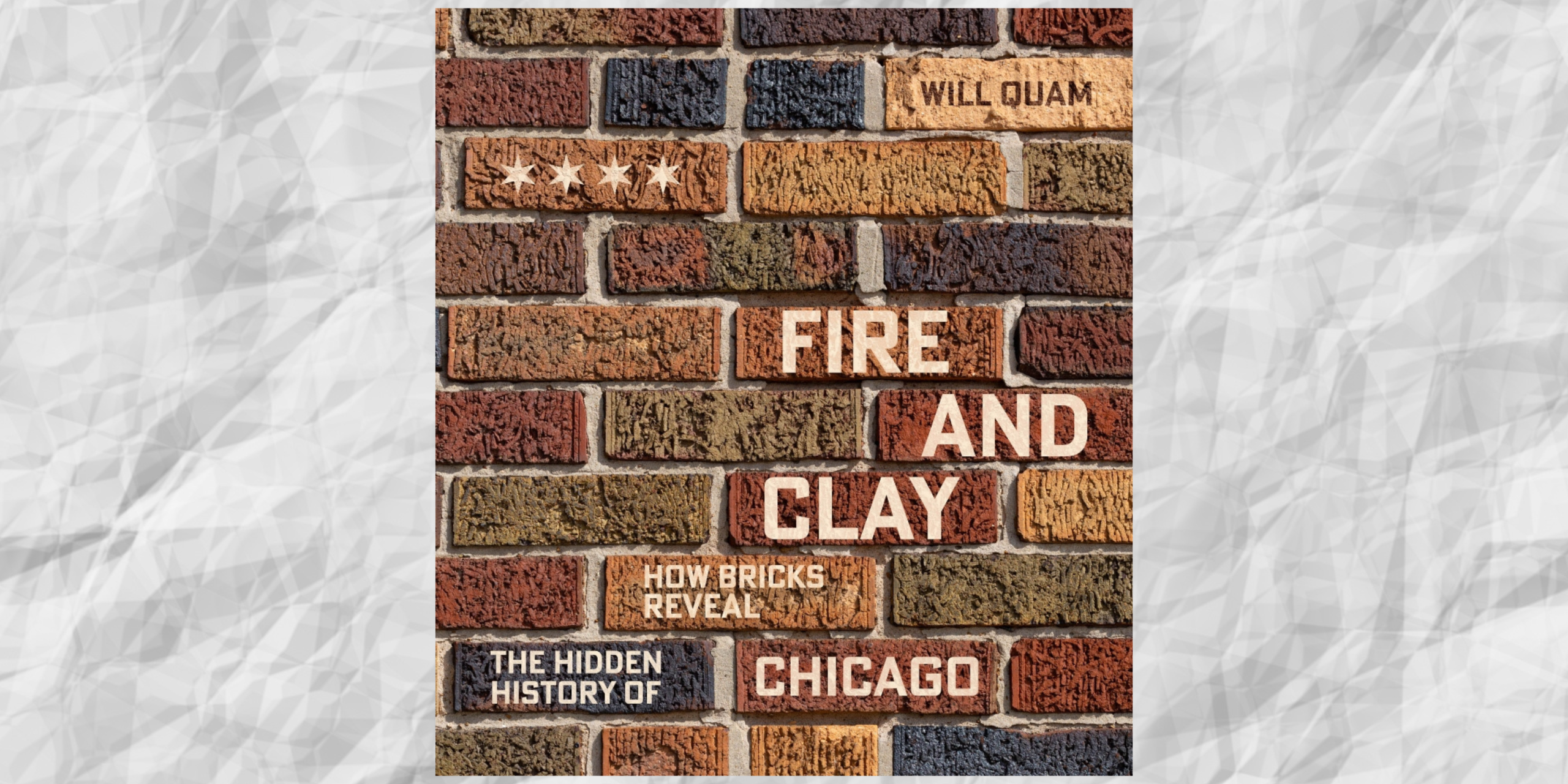

Open Will Quam’s Fire and Clay and you’ll find your notion of Chicago (and its suburbs) transformed. You’ll suddenly notice all the brick buildings and walls and individual rectangles of fired clay that make up our human-made landscape.
Once you lift your eyes from the pages and go for a walk or for a drive, you’ll start to see brick upon brick in block after block—brick factories, brick bungalows, brick stores, brick two-flats and three-flats and larger apartment buildings, and brick schools.
And you’ll see the great variety of bricks; as great as the diversity of Chicago’s people—a variety of colors, finishes, textures, and rhythms in feeling and tone.
The simple, humble brick is ubiquitous in Chicago—one of the most bricked cities in the world. Brick, writes Quam, an architecture historian and brick aficionado, is the oldest human-fabricated building material. An artistic as well as structural substance, brick is used to express ideas, emotions, and beauty.
A brick is a tool. A tool of building, of structure, of safety, of fireproofing. But this book and the buildings of Chicago show that a brick is just as much a tool of expression, expression made possible by human design and labor.
A brick is more than a brick, it is a brushstroke in a painting—each unit a beautiful piece of a more beautiful whole
A brick is more than a brick, it is a brushstroke in a painting—each unit a beautiful piece of a more beautiful whole.
The subtitle of Quam’s book is How Bricks Reveal the Hidden History of Chicago. Here’s one example of what he means: Do you know that Horner Park along the North Branch of the Chicago River was once a claypit? Quam even provides a 1939 map that shows the “Clay Hole” between Montrose Avenue and Irving Park Road, east of California Avenue.
Lane Technical High School at 3400 N. Western Ave. used to be a brickyard. Unsurprisingly, so was the Brickyard shopping mall at 2600 N. Narragansett Ave. Many parts of the region were perfect for brick-making because, as Quam writes, thousands of years ago, the receding Ice Age Lake Chicago left behind a “muddy, clayey lake bed.”
The clay and its location are why Chicago common bricks were able to be produced and sold so cheaply. The raw material was incredibly easy to access, did not need to be modified or worked very much, and was available in massive quantities across the region.
Chicago “Built Mostly of Itself”
In 1912, the Chicago Tribune could declare that the new Chicago of skyscrapers rising along Michigan Avenue was “being built mostly of itself.” The bricks of the loftiest modern buildings were fired from the ancient mud, and the skyline was “simply a pleasingly modified form of clay.”
That was true of the common bricks used inside Chicago structures and along the sides of homes and businesses that didn’t face the street. But, for the front of the buildings, there were special bricks, called face bricks.
Chicago’s common bricks, while cheap to make, were also considered “the ugliest bricks in the entire country” because of the unpredictability of their color. So, Chicago imported all its face bricks, more than anywhere else except maybe New York.
This meant that Chicago builders and architects could be especially sensitive and responsive to trends and changes in brick fashion. They were not beholden to a local face-brick industry…If the red bricks of St. Louis were feeling stale, then they could import deep blues and browns from western Pennsylvania…The options were endless.
As a result, as you walk along a Chicago street in one of the neighborhoods, you’re likely to spot any number of different sorts of face bricks, even on blocks that seem pretty cut and dried.
For instance, Quam notes that, in 1926, in the Brainerd neighborhood on the South Side between 89th and 95th Streets, developer William Whitman quickly erected 72 bungalows along Ada and Elizabeth Streets, ordering his architect to make “a separate design for each.”
Each bungalow was given a different color and texture of face brick than its neighbors’, but these homes were built in a scant four months, so there really wasn’t time to do much else in the way of differentiating design.
In the abstract it doesn’t seem like just changing the color or texture of brick should be enough to break up the monotony of a block of houses with the same plan, but it is.
One surprising fan of the humble brick, Quam points out, was Ludwig Mies van der Rohe who came from a family of stone masons and trained as a mason himself.
While his reputation is rooted in his pioneering steel-and-glass designs, Mies was downright rhapsodic about the brick in his 1938 inaugural address as the head of the architecture department at the Armour Institute of Technology (now the Illinois Institute of Technology):
“The brick is another teacher. How sensible is that small handy shape, so useful for every purpose. What logic in its bonding, what liveliness in the play of patterns. What richness in the simplest wall surface. But what discipline this material imposes.”
Quam’s Fire and Clay is a delightful read for anyone who’s interested in the city and what makes it tick—or, in this case, stand. His photographs are richly detailed and often seem to pop off the page, such as a close-up of a wall of early 1900s green-glazed bricks. The deep, almost mysterious variations of dark green in the bricks, Quam writes, are due to impurities in the clay and the glaze.
Glazed Bricks and Terra-cotta
On the facing page is an image of the Metropolitan Missionary Baptist Church at 2151 W. Washington Blvd. on the city’s West Side, “clad in pearlescent glazed bricks” made by a brick company in Momence, Illinois, near Kankakee.
Not too far away is another glazed-brick standout, Morton School of Excellence, a public elementary school at 431 N. Troy St., built in 1964. Even before the school had been given a name, Quam writes, neighbors were calling it “the Blue Palace because of the brightly colored bricks covering its sides.”
Another sort of brick—it’s made of clay and fired in forms—is terra-cotta, used for large sculpted blocks as a cheap replacement for hand-carved stone. And, eventually, it was used for seemingly everything.
When (Charles Thomas) Davis first wrote his treatise on brick and terra-cotta in 1884, he listed just twenty uses for terra-cotta (things like crown molding, chimney tops, and, oddly enough, baptismal fonts). By the time he updated his book in 1895, he was able to declare that architectural terra-cotta was no longer just a stone substitute; rather “Much of the recent great advance in freedom of design in this country began with the advent of the architectural terra-cotta worker.”
In Fire and Clay, Quam covers seemingly every angle of the brick story, such as the wide range of methods used to make bricks, the growth and death of the brick industry in the Chicago region, and a scary chapter about how most companies doing tuckpointing in the metropolitan area use the wrong kind of mortar, sure to cause problems for the homeowner in the future.
Quam covers seemingly every angle of the brick story, even a scary chapter about how most companies doing tuckpointing use the wrong kind of mortar, sure to cause problems for the homeowner in the future.
He also explains that old Chicago bricks—bricks that have weathered city winters and summers for decades—are now fashionable for many buildings going up in the American South, such as in a gated community in Corpus Christi, Texas, where more than a dozen expensive homes were all built with reclaimed Chicago common brick.
This means that old bricks from old buildings are valuable, and—no surprise—an underground market of brick thieves has developed. Quam quotes a 1985 Los Angeles Times article about how Chicago brick vandals “drive up to a vacant house, clamber in through a broken window, haul in the cable and pass it around an interior wall…Then (they) yank hard with the pickup.”
Some 150 buildings were taken down that way in 1985, up from only 20 a few years earlier. Quam doesn’t know how many buildings are lost annually nowadays, but he notes that guys are still showing up at resellers with loads of old bricks in their trucks—old Chicago bricks.
Fire and Clay: How Bricks Reveal the Hidden History of Chicago is available at bookstores and through the University of Chicago Press website.
