The American Writers Festival, held over the weekend at the American Writers Museum and the Harold Washington Library, was presented by the museum in partnership with the Chicago Public Library. In this third edition of the free festival, more than 90 writers were featured, discussing bestselling novels and memoirs plus screenwriting, poetry, fantasy, horror, podcasting, journalism, children’s books and more.
Day one was held Saturday at the American Writers Museum with one session per hour while day two on Sunday at the Harold Washington Library offered a total of 35 session options during the six time periods. Attendees were able to purchase books onsite and have them signed by the authors.
Day two also included the AWF Block Party held all day Sunday on Plymouth Court behind the library. The block party, held in an outdoor tent, included food, music, activities and information about the work of other festival partners.
Day one had a limited but diverse program that included a play reading and talks on writing about romance, baseball, free speech, thrillers, and cooking. We attended on day one; here are brief reports of the sessions.
Romance: Writing Love Stories
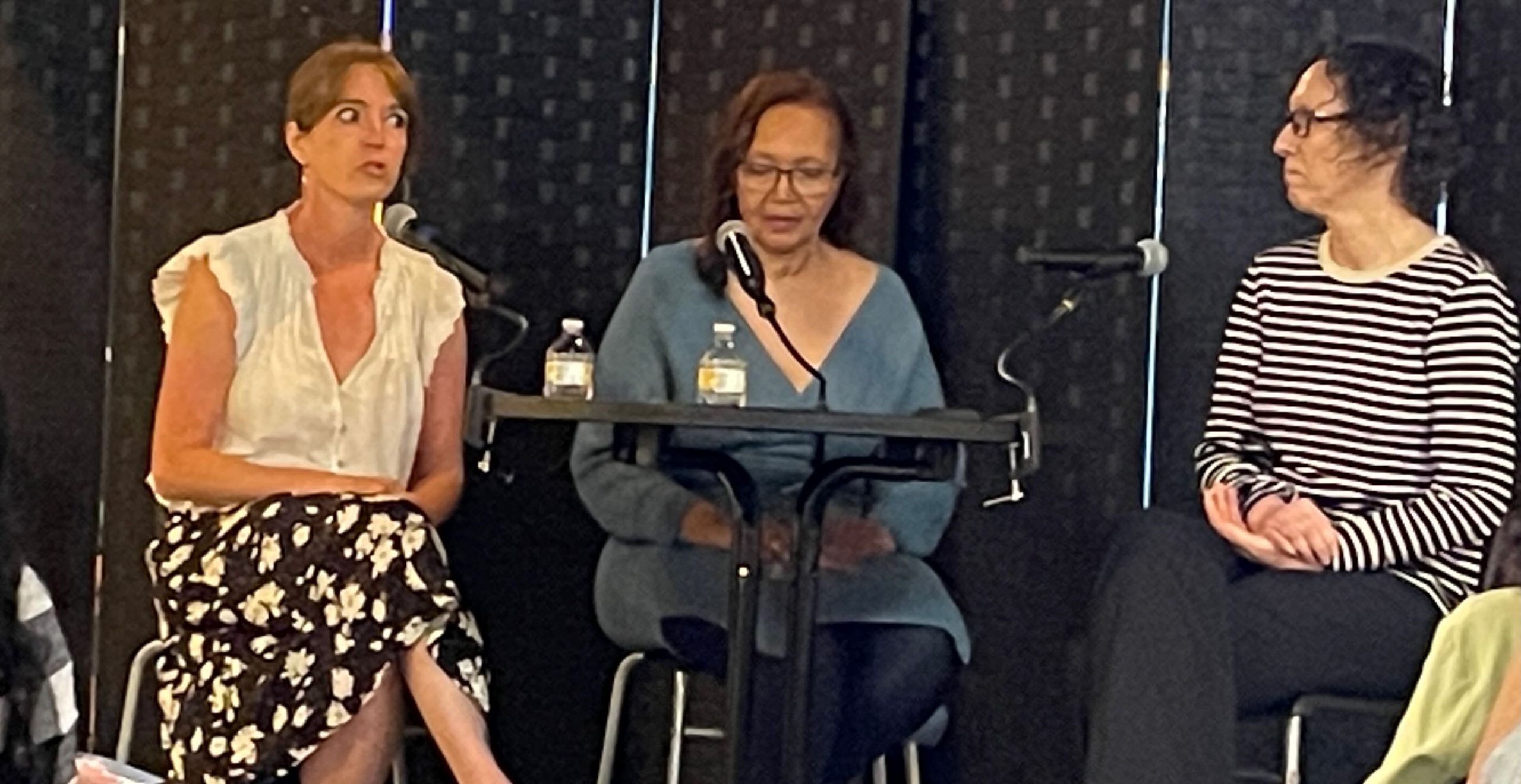
Moderator Pamela Knight (a Chicago romance writer known online as @slackermomthewriter) talked with romance writers Lucy Gilmore and Penny Reid about their approaches to writing. Gilmore writes mysteries and romance fiction (including The Lonely Hearts Book Club) while Reid lives in Seattle and “writes kissing books.”
Knight’s questions brought out interesting comments from both writers, such as the following.
How do you build the world of your book? Reid needs to decide on all details of the setting in advance. Gilmore, on the other hand, assumes a world already built, like a known or fictional city, and begins to write against a general background.
What’s your favorite trope? Gilmore chose “found families” and “enemies to lovers.” Reid likes revenge fiction, where “bad people get what’s coming to them.”
How much research do you do? Both said they like to go to a place and spend some time learning about it and talking to people who might be relevant to their plot or characters. Gilmore noted that she’s writing a book about a librarian and went to two libraries and talked to staff about their work.
Writing Baseball: The First All-Star Game
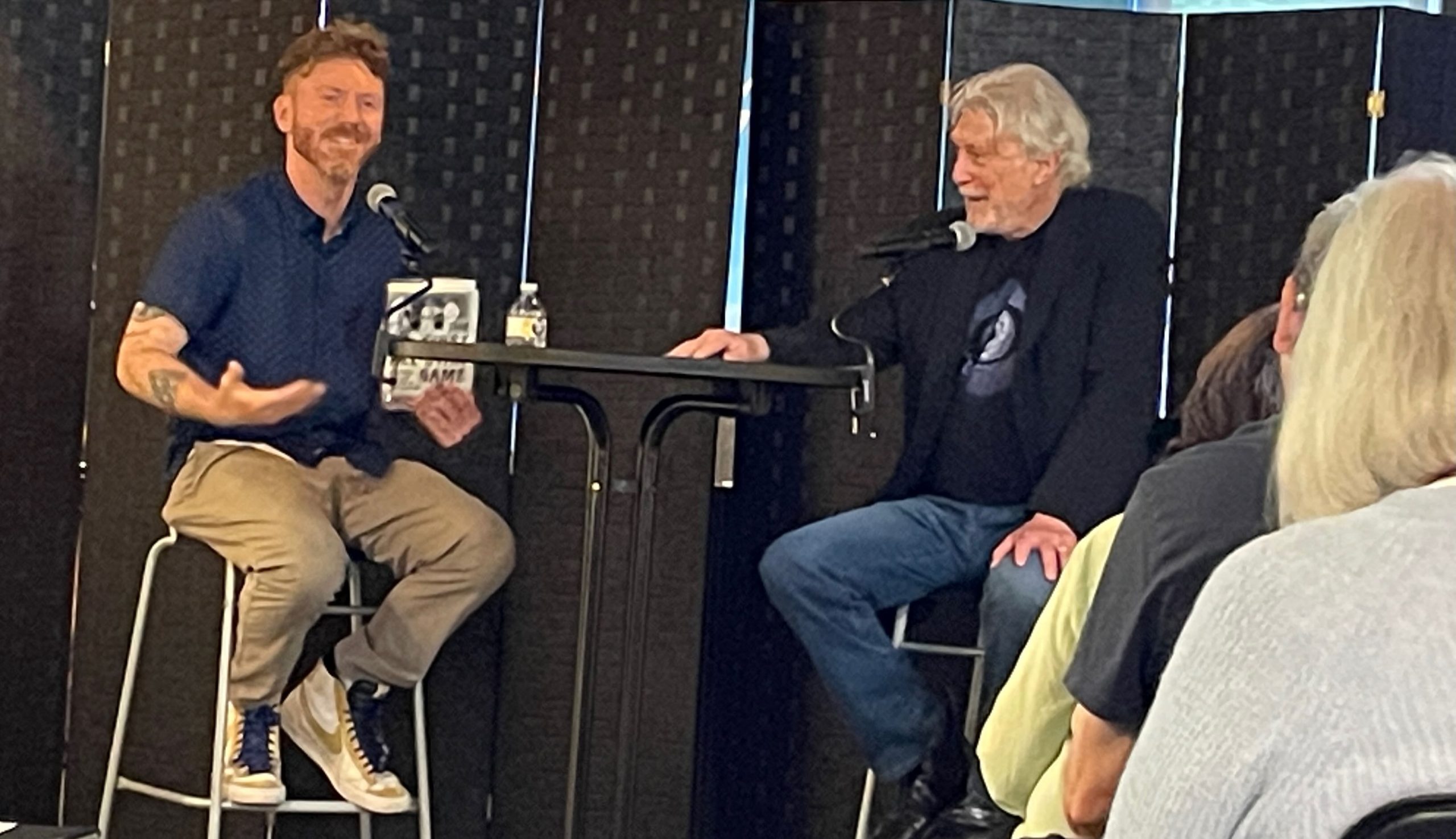
Randall Sullivan, a noted journalist and historian, was interviewed about his new book, The First All-Star Game: Babe Ruth, FDR and America at the Crossroads. The interviewer, Joe Kilgallon, is a Chicago stand-up comedian with a background in sketch comedy and improv. He’s also a baseball fan and former Wrigley Field tour guide. Sullivan’s book is set in 1933 Chicago, where the first All-Star Game was held as a highlight of the 1933 World’s Fair.
The pair discussed the 1933 setting where “Chicago was the center of the world,” Sullivan said. Al Capone and the fame of his crime family as well as the World’s Fair contributed to that, as did the attempted assassination of President Franklin Roosevelt in Miami in February 1933. The shooter missed FDR and killed Chicago Mayor Anton Cermak, who was riding with him.
Baseball was also a big part of the American cultural landscape in that era, before football and basketball became popular. Baseball was really “America’s pastime” and had deep roots in American history, going as far back as the Civil War. Babe Ruth was supremely popular. In fact, attendance at any Yankees game plummeted 30-40 percent on a day when Ruth was unable to play, Sullivan said. And of course, the Babe would be on the American League’s All-Star roster.
In addition, the impact of the Great Depression was huge. People felt that “the country was falling apart and won’t come back,” the author said. The World’s Fair and the All-Star Game were considered to be morale boosters for Chicagoans.
The First All-Star Game, published this month, is available from the publisher or your favorite bookseller.
Free Speech Today
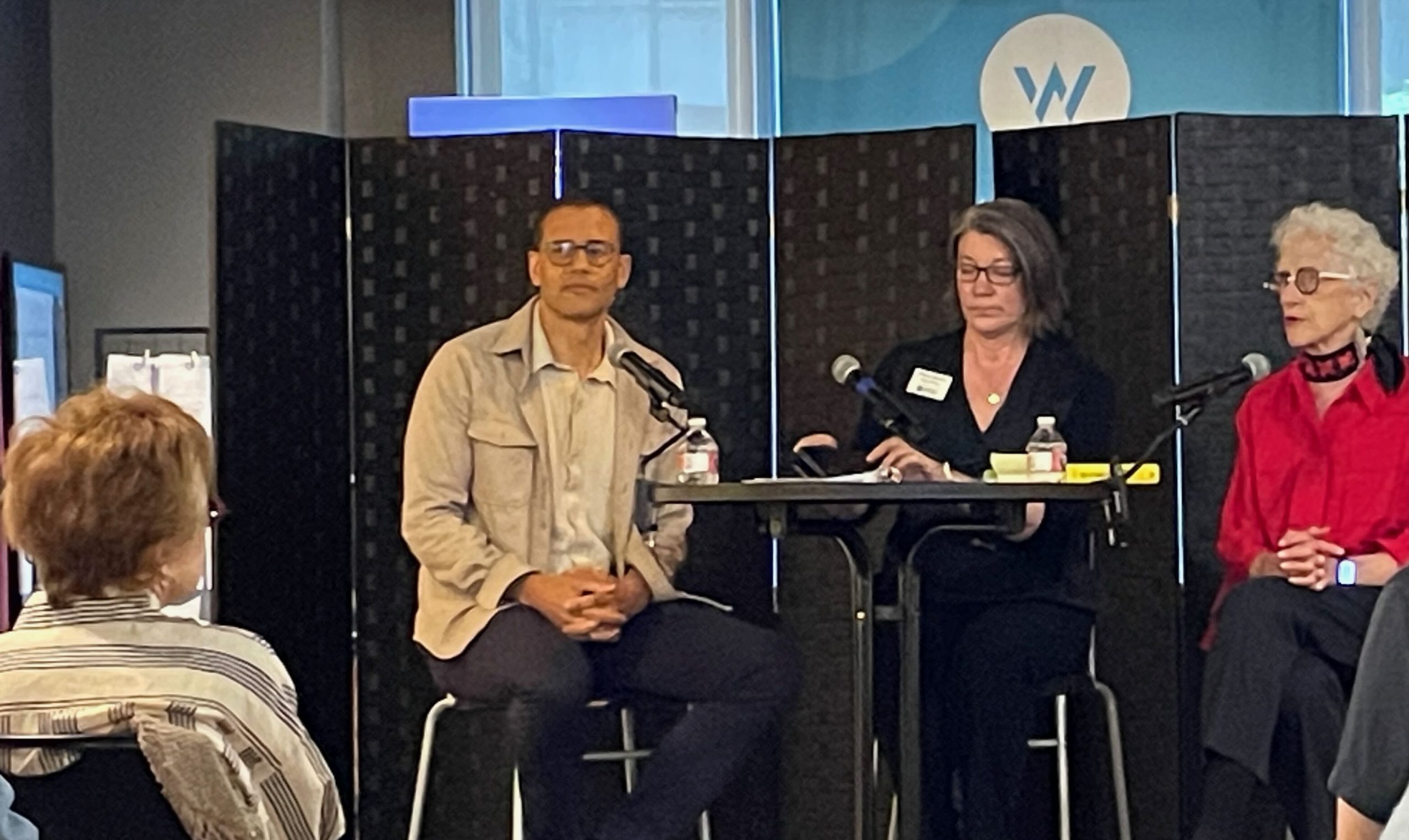
Jacob Mchangama is a research professor at Vanderbilt University and a native of Denmark who came to this country three years ago “because he was attracted by the First Amendment.” His 2022 book, Free Speech: A History from Socrates to Social Media, has just been released in paperback. He is founder and executive director of the Future of Free Speech and the host of the podcast Clear and Present Danger: A History of Free Speech.
Mchangama was joined in conversation about free speech issues by Chicago detective novelist Sara Paretsky, an active participant in social justice and democratic causes. Allison Sansone, AWM director of programs, moderated. Their wide-ranging discussion covered free speech cases from the 20th century protest era to now, and book banning, as well as SLAPP lawsuits, which some states are legislating against. Strategic Lawsuits Against Public Participation are baseless civil lawsuits filed by powerful individuals or corporations to intimidate, silence or financially exhaust critics who speak out on issues of public interest.
Mchangama’s book on free speech is available from the publisher or from your favorite bookseller.
Route 66 Recipes
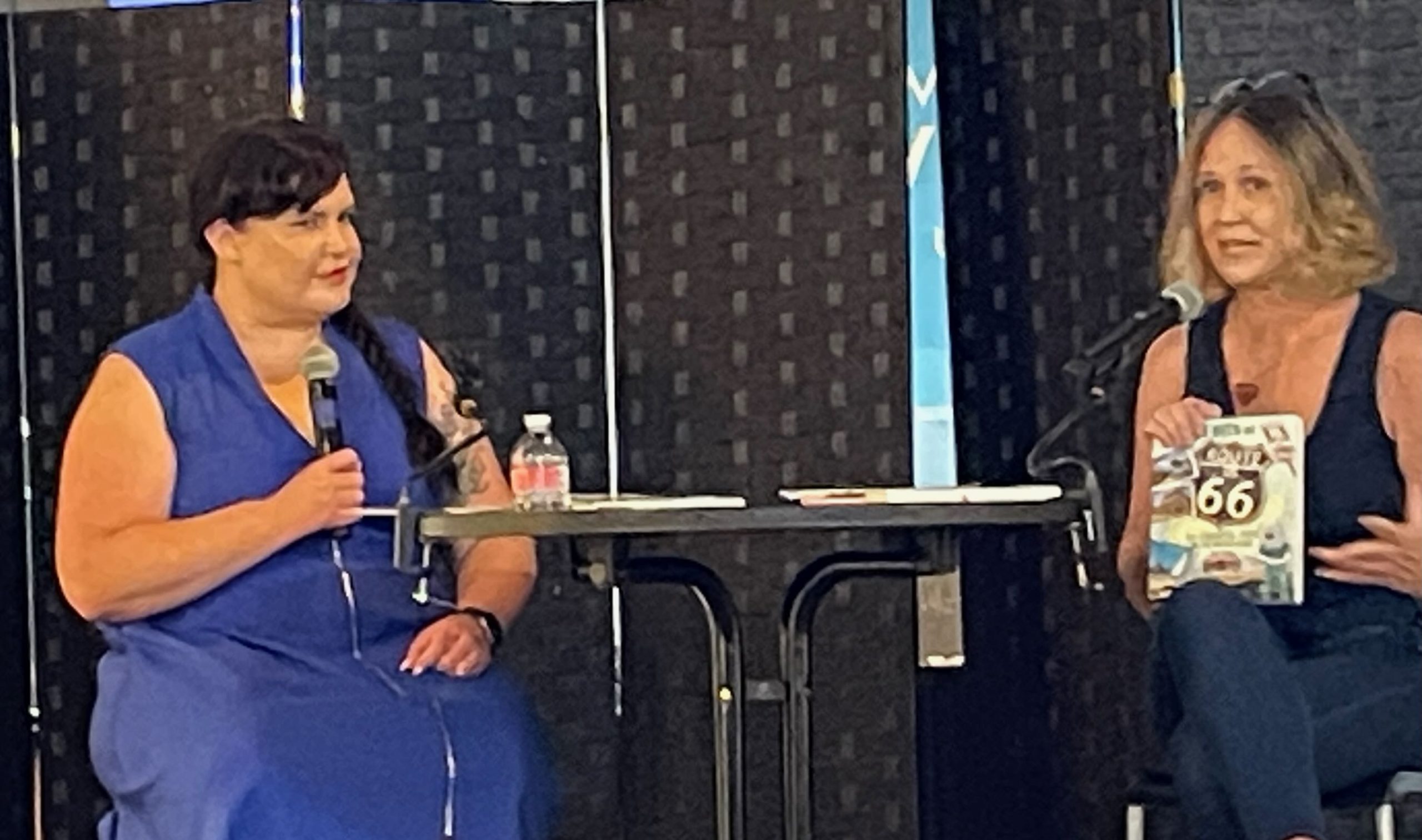
Chicago cookbook author and Route 66 traveler Amy Bizzarri discussed her two books on cooking and eating along the iconic highway with Erica Pelzek Floyd, produce purveyor and founder of Lake Literary Center in Malone, Wisconsin. Bizzarri’s new book is Route 66 Recipes: A Culinary Cruise Along the Mother Road, a followup to her 2018 book, The Best Hits on Route 66: 100 Essential Stops on the Mother Road.
Bizzarri discussed her research approach, which first involved driving Route 66 from Chicago to California and stopping, eating and chatting with café owners along the way. She includes specialized itineraries such as the Gearhead’s Guide to Route 66, The Mother Road for Music Lovers, and Natural Wonders of Route 66. Her new book features recipes for those special foods. You need about two weeks to take a proper Route 66 trip, she said.
Floyd asked if she was able to get the real recipes from the café cooks. Bizzarri said no, instead she researched those recipes and cooked them in her own kitchen until she felt they had reached the perfection of the road food. That is her specialty, she said: Recreating historic recipes in her own kitchen.
When asked what her favorite dish was, Bizzarri hesitated, but said it was the cashew chicken she ate in Springfield, Missouri. The chef who invented it was an Asian-American man who emigrated to the US in the 1960s and invented the dish because he thought it would be acceptable to customers, since Asian food was considered exotic then. His son now runs a tearoom in that location. Your favorite drink, Floyd asked. That would be a Green River phosphate made by a “soda jerk” in Girard, Illinois. Her favorite dessert is root beer bread pudding at a diner in Oklahoma.
Bizzarri’s book, Route 66 Recipes, is available from the publisher or your favorite bookseller.
The “mother road” term for route 66 was coined by John Steinbeck in his landmark 1939 novel on migrants, The Grapes of Wrath. It was a road of flight and refuge for hundreds of thousands in the 1930s who were fleeing poverty in the Midwest and hoping to find a better life in California.
The Last Senior Home in Bronzeville
Playwright Nikki Carpenter presented a live reading of her play with actors reading the roles of residents of the senior center. The 90-minute dramedy uses humor and drama to tell the story of a beloved senior residence that is being purchased by investors and replaced by “luxury condos.” The residents mourn, but most of them fight to keep their center open—to no avail. By the end of the play, the senior center has become a construction zone and the characters are coming to grips with a new reality, including some good news.
Sydney Charles directed the reading, which featured seven characters:
—Toya Daniels (Kristin E. Ellis), the center’s staff member
—Carol “Honey” Jones (Gabrielle Lott-Rogers), a former café owner who still misses her customers at Honey’s Soul Foods
—Joseph “Harlem Joe” Greer (Darren Jones), recently moved back to his Chicago after living in New York
—William “Willie” Johnson (Donn Carl Harper), a former musician
—Barbara Shabazz (Joslyn Jones), a disabled but lively woman
—Dr. Rupe Simms (Robert Cornelius), a former university professor
—Beverly Simms (Linda Bright Clay), his wife, who once wanted to become an actor
A staged reading of Carpenter's play was presented by Definition Theatre in 2025. Carpenter is hopeful that the play will have a full production soon.
Based on a True Story: Thrillers
The final session of the day featured a discussion of two books by their authors. Brian Morra’s book, The Righteous Arrows: A Cold War Spy Thriller, and Joanne Leedom-Ackerman’s book, The Far Side of the Desert. We were not able to attend this session.
Photos by Nancy S Bishop.
Did you enjoy this post? Please consider supporting Third Coast Review’s arts and culture coverage by making a donation. Choose the amount that works best for you, and know how much we appreciate your support!
