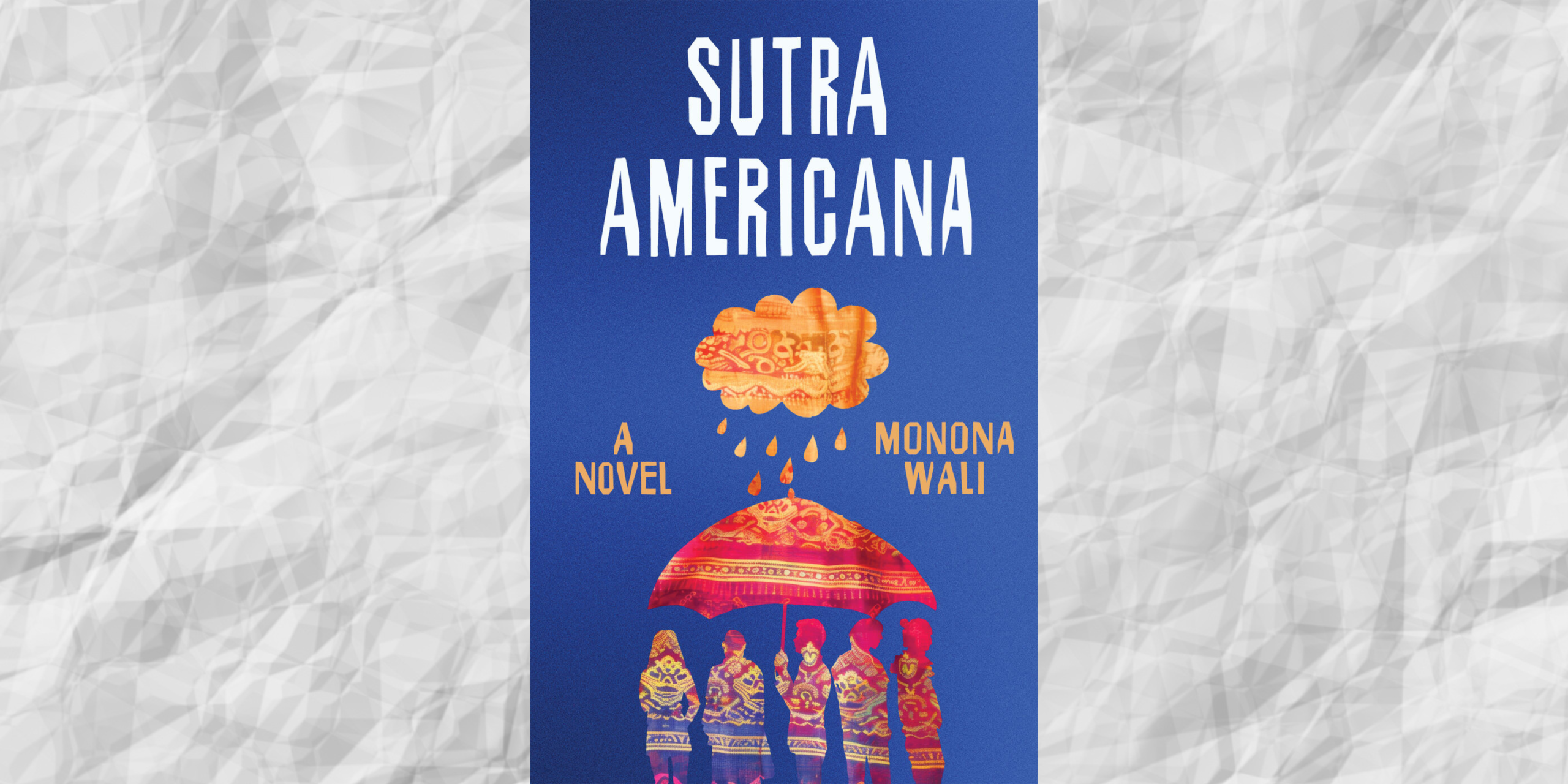
Monona Wali’s new novel, Sutra Americana, is an incredibly written, multigenerational family saga that follows an Indian-American immigrant family through five decades of change, sacrifice, and self-discovery. At its core, this is a story about migration, Not just the physical journey from one country to another—the emotional and cultural journey of figuring out what parts of ourselves we carry with us and what parts we are willing to leave behind.
The novel begins in the 1960s, when S. K. Sharma, a brilliant young astrophysicist, brings his wife, Sushila and three daughters, from India to America to pursue his academic ambitions. Sharma and Sushila’s love story starts as unconventional: they were university sweethearts whose relationship crossed deeply rooted caste boundaries in India. Together, they build a new life in a country full of promised opportunity, one that both fascinates and challenges them. As Sharma pursues his career in cosmology and higher education, he pushes his family to assimilate into American culture—putting away saris, introducing meat into their diet, prioritizing English, and embracing many American social customs.
But assimilation comes at a cost.
What appears from the outside to be a picture-perfect family slowly reveals itself to be far more complicated. Like any family, the Sharmas carry wounds, secrets, and unresolved conflicts. The relationships between husband and wife, parent and child, and sibling and sibling are layered, messy, and deeply human. Wali captures the uncomfortable truths of family life: that the people who love us most can also be the people who hurt us most. Wali challenges the reader with the idea that forgiveness is possibly the hardest form of love.
One of the novel’s most fascinating explorations is the tension between cultural traditions and personal identity. What customs are essential parts of who we are, and what traditions do we abandon in order to feel like we belong? Sutra Americana examines the complicated experience of immigrants who are caught between two worlds trying to honor where they come from while adapting to where they are. Wali asks whether identity is something inherited, created, or maybe something that can exist in between.
Through the lives of Sharma and Sushila’s three daughters, the novel captures the changing landscape of America. As they grow into young women during the height of the Vietnam War, the women’s liberation movement, and even 9/11, they begin to challenge their parents’ expectations and forge identities of their own. Their journeys reflect a generational shift in how people understand independence, love, family, and marriage.
Marriage is one of the novel’s most compelling themes. Wali examines how different cultures and generations understand commitment and devotion. For Sharma and Sushila, marriage is an unbreakable promise—something to protect even through hardship, betrayal, and pain. For their daughters, raised in a changing America, happiness and self-preservation become equally important values. The novel never presents one perspective as completely right or wrong; instead, it explores the difficult truths that exist between them.
Ultimately, Sutra Americana is a beautiful case study in identity. Who are we when we are pulled between multiple versions of ourselves? Does where we come from define us? Does the life we build define us? Or are we allowed to exist as a collection of contradictions?
This quick, 245-page, deeply personal read is emotionally resonant. While the novel follows an Indian-American family, its questions about belonging, forgiveness, and the desire to be understood are universal.
And for Chicago readers, there is an added joy: much of the story takes place in Hyde Park and the city’s academic landscape. To me, reading about familiar places makes the experience feel even more intimate. Add this book to your October reading list! Find a park bench in Hyde Park and reflect on the decades of love, heartbreak, and resilience that make up a human life.
Sutra Americana is available at bookstores and through the University of Wisconsin Press website.
