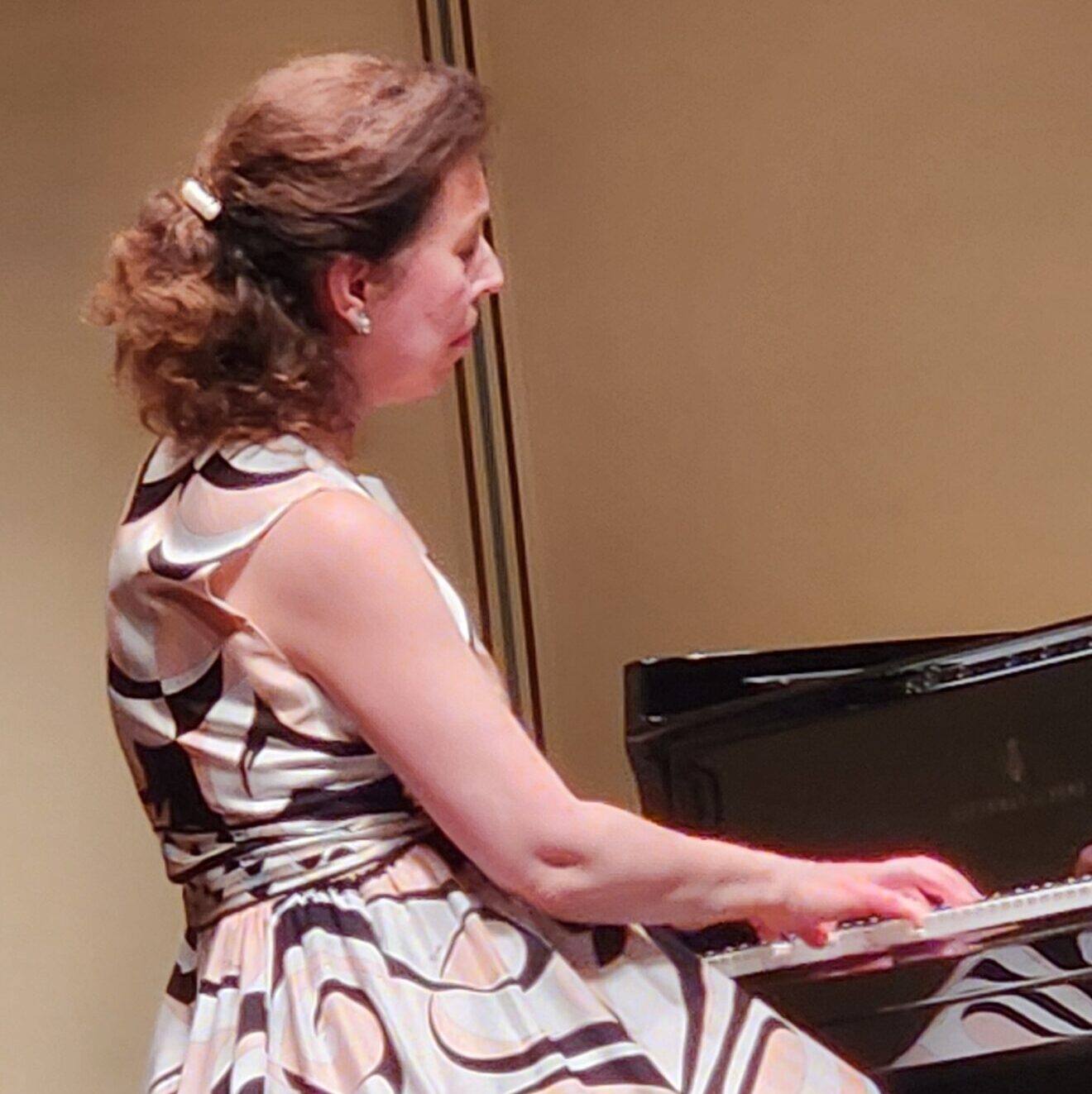

Angela Hewitt gave a riveting performance of one of the most intense pieces of music ever written for keyboard. At Ravinia’s Martin Theater on Wednesday evening, she was playing a Steinway piano. When Johann Sebastian Bach wrote the Goldberg Variations in the second quarter of the 18th century, he was writing for a harpsichord, as the recently invented forte-piano was not widely available.
Many harpsichords have two keyboards that allow each hand to play different parts on the same instrument at once. Bach specified that both keyboards were to be used in several of the variations. In an excellent explanation of the Goldberg Variations before starting, Hewitt described the challenges of merging two keyboards into one on a piano and the dramatic moves a performer must go through as their hands merge, cross, and get in the way of one another.
She explained that it starts and ends with the same Aria, which is in G-Major. In between there are 30 variations organized into sections of three, with each section ending with a canon. The piece is also divided into two. The first half ends with Variation 15, which, she noted, itself has a fascinating ending. With the hands moving in separate directions, the left hand plays the last note while the right hand is hanging above the keyboard. When ending the Variation on Wednesday evening, she paused and pointed her right index finger toward the audience before breaking into the Overture that starts the second half.
Variation 15 is the first of three Variations in g-minor. Hewitt discussed the other variations in g-minor, the last of which, Variation 25 is especially intense. She considers it the hardest part of the Variations to play. On Wednesday her facial expressions and body movement conveyed her intensity. She reassured the audience that Bach typically follows such sadness with happiness, and her performance fully brought this out.
While there were a couple of missed notes, Hewitt’s playing was excellent throughout. She accurately reproduced trills and other ornamentation, arpeggios, scales, and chords, and carefully allowed each voice in the counterpoint to be heard, whether there were two, three, or four voices. In the Fourth Variation, she very adeptly played melodies with the right hand, with the left offering quieter back-up support, which can’t be done on a harpsichord.
Hewitt also demonstrated masterful technique dealing with the two keyboards fused into one. In the Fifth Variation, one hand played a rapid-fire melody, while the other jumped over the other with single, longer notes. In the Fourteenth Variation, a quick three-note melodic motif is passed back and forth between the hands. While ascending and descending the keyboard, Hewitt’s hands seemed to bounce up and down. In other Variations, lengthy scales cross each other in very close contact.
As the piece winds up, the Variations increase in intensity. Variation 29 starts with powerful chords broken up with quick melodies. Hewitt captured this contrast very nicely. She was also very effective with the final Variation, Quodlibet, which incorporates popular tunes.
At the end of the final Aria, Hewitt held her hands a couple inches above the keyboard for several seconds before rising to a thunderous ovation. In doing so, she allowed the gravity of the performance to sink in.
This was an amazing experience. As someone who has only recently become acquainted with Bach’s Goldberg Variations, I was very appreciative of Angela Hewitt’s detailed explanation of this masterpiece. Combined with excellent playing, she created the right ethos for a riveting performance of the only work on the program. The event started at 7:30, and she finished the second Aria right around 9:00. I can think no other piece of music for solo keyboard that lasts over 75 minutes, and Hewitt managed to make every second compelling.
Ravinia has assembled a wonderful schedule of excellent concerts this summer. Tonight, Counting Crows with the Gaslight Anthem are in the pavilion, where Taj Mahal and Keb’ Mo’ will be performing tomorrow night. Friday, June 13, 7pm, and Saturday, June 14, 7:30pm. For more information, click here.
Tomorrow afternoon, Elena Moon Park & Friends will perform at the carousel a program that will appeal to children and adults. Saturday, June 14, 1:30pm. For more information, click here.
Classical music returns next Saturday afternoon, when Tony Siqi Yun performs what many believe to be the greatest piano sonata ever written, Beethoven’s Appasionata. Saturday, June 21, 1:30pm. For more information, click here.
Did you enjoy this post? Please consider supporting Third Coast Review’s arts and culture coverage by making a donation. Choose the amount that works best for you, and know how much we appreciate your support!
