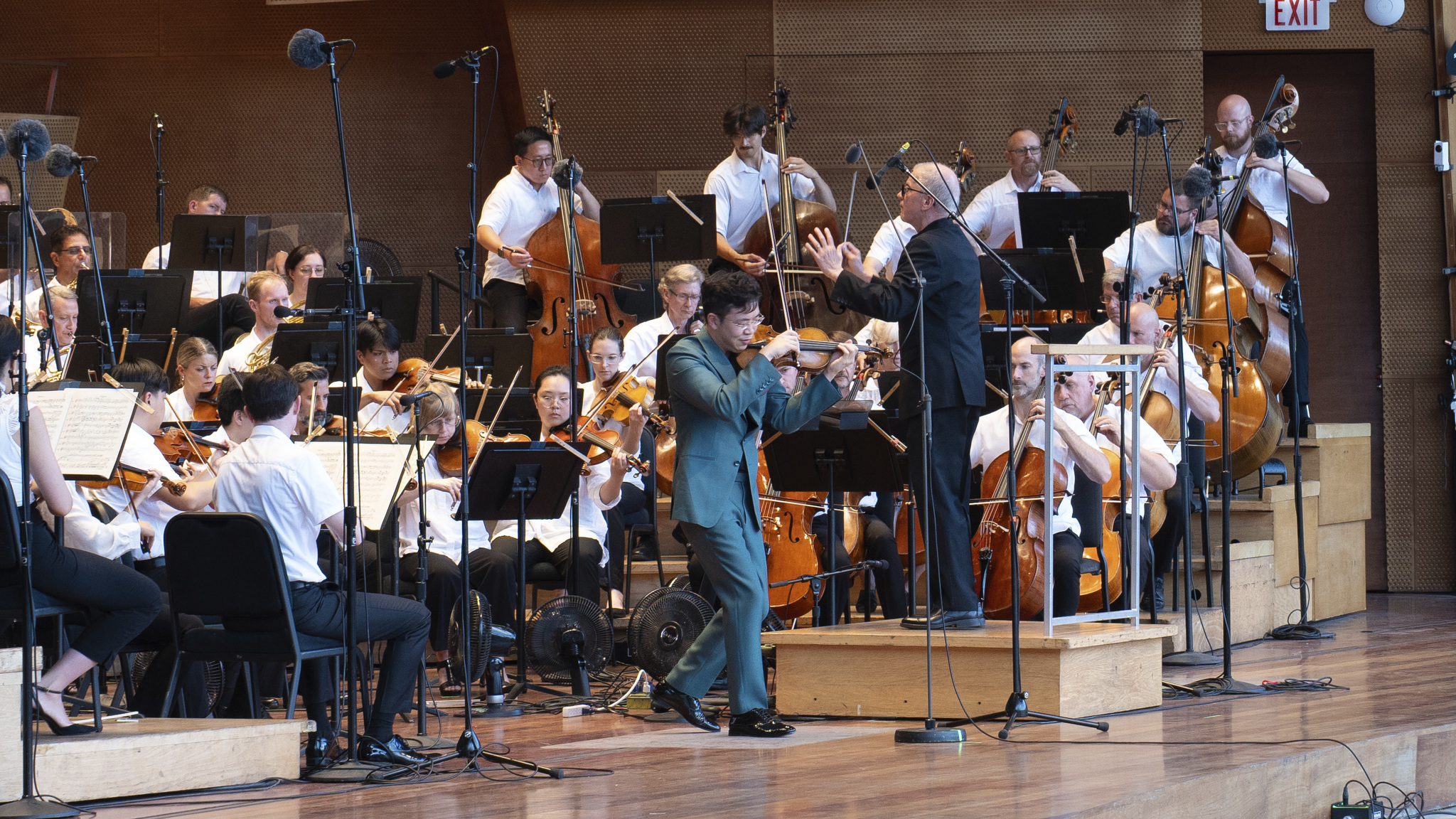

The Grant Park Orchestra gave another lovely concert on another lovely evening at the Jay Pritzker Pavilion at Millennium Park on Wednesday. This time, however, it was led by Osmo Vänskä and featured violinist Paul Huang, who gave an excellent performance of Scottish Fantasy by Max Bruch. While humid, the weather was not overly hot, and the ambient noise around Grant Park was fairly quiet, with only a couple of jarring interruptions.
Originally from Finland, Vänskä was the music director of the Minnesota Orchestra for 19 years. While there in 2019, he conducted the world premiere of Transitions by Henry Dorn, the first work on the program Wednesday evening. The composer was present, and he provided an inspiring explanation of his mother’s struggles with cancer in the last month of her life, when she was hospitalized. He also discussed how writing this piece helped him with his grieving process.
In Transitions he set to music the sounds that surrounded her in the hospital, including the rising of ventilators, rolling hospital equipment, and fingers tapping on computers or pads. He cleverly used instruments to mimic these sounds with the woodwinds and horns swirling with a frenetic pace while percussion sounded.
Halfway through, the sounds in a quiet hospital are memorialized by a piano over which a high pitch sounded from a bowed vibraphone key. Sadness from the horns could be heard. Soon, a string octet set the sad tones as the horns and brass lamented. The ending was almost triumphant, with overriding tinges of sadness. The Grant Park Orchestra captured these sounds well, and the audience appreciation was large and thoroughly warranted.
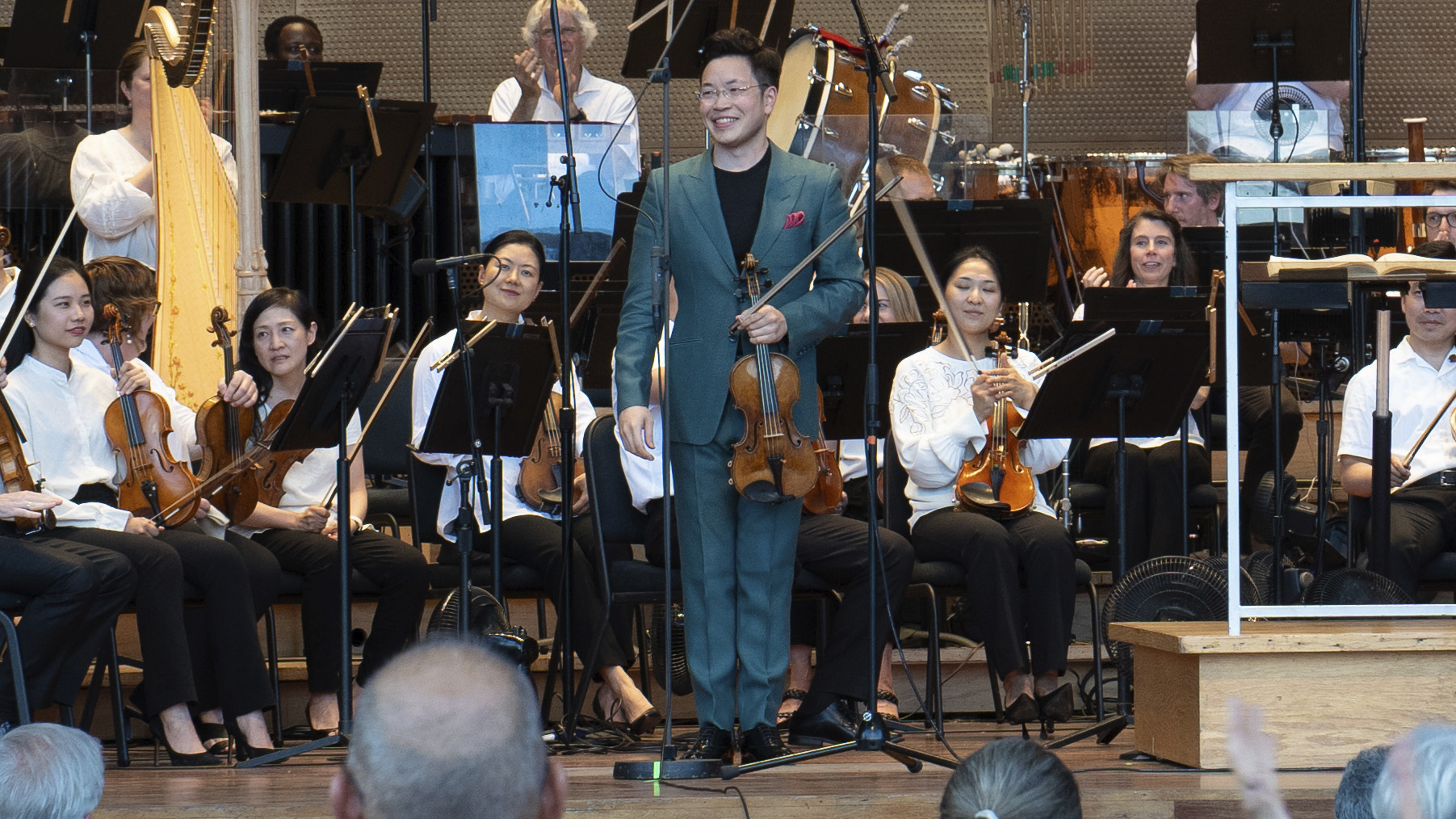
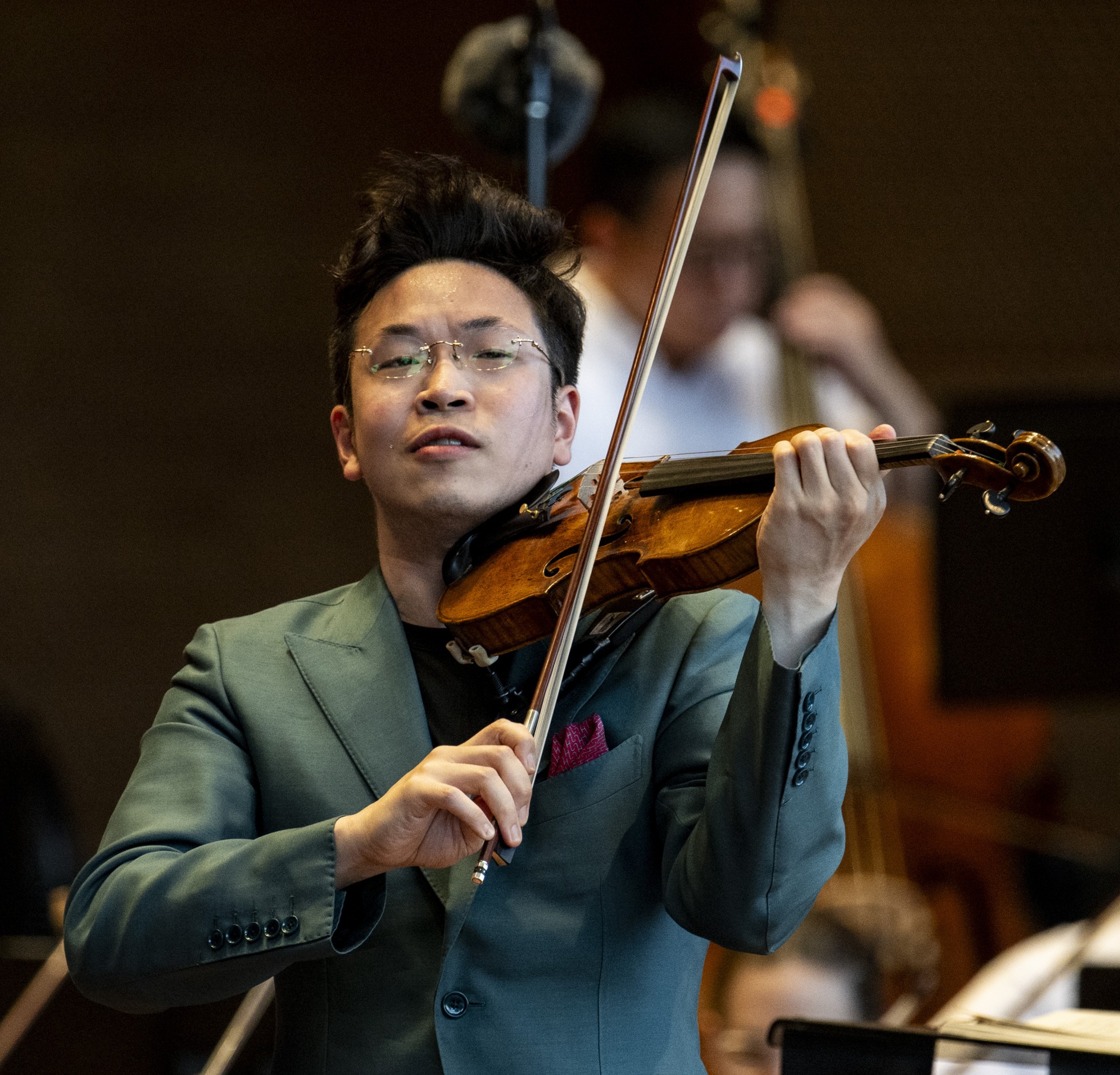
Following a quick set change, a stoic Paul Huang entered the stage for the charming Scottish Fantasy. It opens quietly with a somber brass chorale starting the Introduction: Grave and Adagio Cantabile. Huang soon overlaid his warm tone and clearly articulated melodic passages. The orchestra filled in very nicely after the initial solo, and in the transition to Adagio cantabile, Huang offered very passionate playing with lots of clear, double stops. He consistently displayed highly polished technique.
My favorite part of this piece is the second movement Scherzo, and the violins marched right in, with winds and brass adding syncopated notes. Huang’s rapid fingering and bowing precisely hit the notes. The third movement Andante Sostenuto should have allowed Huang to show deep feelings, but It’s always hard to hear the music when a bad case of sirenitis breaks out in the Loop. The finale certainly allowed this, especially the cadenza at the end.
In response to a standing ovation, Huang offered an energetic encore, Fritz Kreisler's Scherzo. It showed, yet again, that his technique is well honed.
Following intermission, Osmo Vänskä led the Grant Park Orchestra with an enjoyable performance of the first Beethoven symphony I ever got to know well, Symphony No. 6 in F-Major, op. 68, Pastoral. This symphony is replete with many innovations. It is the first symphony to follow a program, starting with the name Beethoven gave it, Pastoral, and it sets to music his love of the countryside. It is also the first symphony in five movements, and he gave descriptive titles to each of the movements.
Hearing this work is always a pleasure, and, except for a couple of instances when the woodwinds were a bit hard to hear, Vänskä’s restrained conducting style led the orchestra well. With a baton in his right hand, he kept his arms pretty close to his waist. There were many times when his left hand kept the time and directed the players, while the baton stayed at his side. His body got very animated when the music called for it, and, during climaxes his arms and hands would shoot to the ceiling.
There are certain things I listen for to identify a great performance. First is the tempo of the opening movement, “Awakening of cheerful feelings on arrival in the countryside.” Vänskä took it faster than I like, but it still worked well. He also honored Beethoven’s repeat. One thing I listen for is the phrasing of the violins in the secondary theme. In the exposition, violin phrases end with longer notes. In the recap, they are very short. In this performance the violins did it well both times.
Beethoven gave a lot of important parts to the woodwinds in the Pastoral Symphony. In the second movement, “Scene by the brook,” the muted violins create the ultimate bucolic feel, while the woodwinds and horns trade solos. Most famously, at the end, Beethoven uses a flute to mimic a nightingale, an oboe to mimic a quail, and a clarinet to mimic a cuckoo. In outdoor performances, I always hope real birds actually respond, but they didn’t on Wednesday.
The third movement is a dance, “Merry gathering of country folk,” which gets interrupted by the greatest thunderstorm ever set to music. Thunder in the distances is sounded by rapid notes played quietly by cellos and basses, and, upon arrival, by the timpani. Lightening is sound by quick violin strokes. This performance passed my test. Very enjoyable.
Tonight, Christopher Bell will be conducting Grant Park Orchestra’s annual Independence Day Salute. It will also feature Josh Jones, marimba, and Imara Miles, mezzo-soprano. Jay Pritzker Pavillion, 6:30 pm. For more information, click here.
On Wednesday, Nicole Paiement will be conducting the Grant Park Orchestra and cellist Inbal Segev in a program that includes Bedřich Smetana’s The Moldau, Mark Adamo’s Last Year, and Claude Debussy’s La Mer. Jay Pritzker Pavilion, Wednesday, July 9, 6:30 pm. For more information, click here.
If you enjoyed this post, please consider supporting Third Coast Review’s arts and culture coverage by making a donation. Choose the amount that works best for you, and know how much we appreciate your support!
