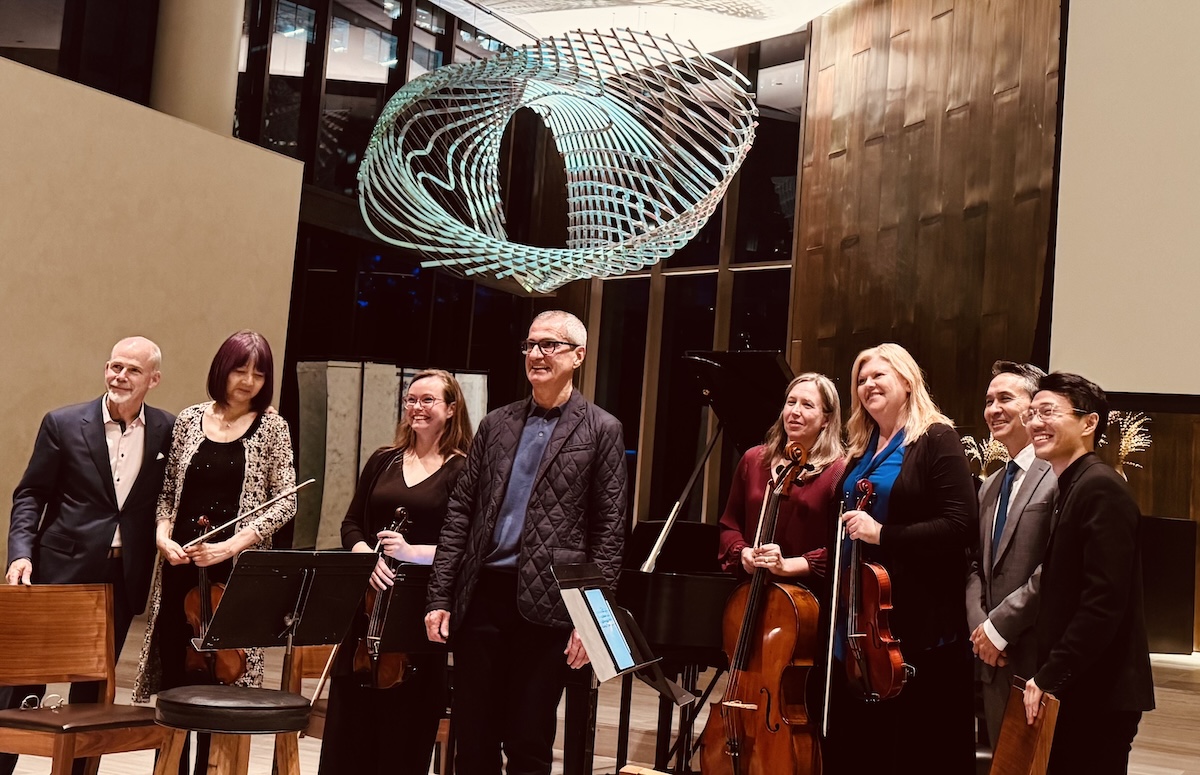

The stunning Buchanan Chapel at Fourth Presbyterian Church was the scene of an incredible immersive experience in new music on Tuesday evening. In a program entitled Viaggio Profondo: An Homage to Gustavo Leone, members of the Fulcrum Point New Music Project performed the music of this Argentine-born, Chicago-based artist. They also performed music by Carolina Heredia and Tomas Gueglio. This concert was part of the Ear Taxi Festival.
Located on the Magnificent Mile, Buchanan Chapel provides an awesome setting. Suspended from the ceiling is a kinetic, color-changing sculpture called Quaternion by Alyson Shotz. It creates a focal point and reflective accents throughout the space. The music, art, and atmosphere melded beautifully for this exceptional performance.
The program opened with Viaggio Profundo, a film by Paul Hettel, with whom Leone worked for nearly thirty years at Columbia College, where Leone is the Music Department Chair and Hettel, now Professor Emeritus, was a Professor of the School of Film and Television. The film and music share a symbiosis in their vision and themes, focusing on all living creatures being heard and celebrated. Bird calls, other creatures, music, and frequencies were layered in with the land and seascapes. It was an excellent introduction to the evening of beauty that aroused the senses and emotions.
The first three pieces were titled Viaggio Profondo: Homage to Gustavo Leone. The music was dramatic and, in some sections, Hitchcockian. The first ensemble included Rita Seko (violin), James Kang (viola), Paula Kosower (cello), Kuang Hao Huang (piano), and Stephen Burns (Conductor and trumpet). In addition to playing, Burns is the Founder and Artistic Director of Fulcrum Point New Music Project. The title piece, "Viaggio Profondo," is what most reminded me of Alfred Hitchcock's North by Northwest (1959) when Cary Grant and Janet Leigh find themselves directly on the monument at Mount Rushmore. The martelé or hammer bowing was interspersed with the lower register of piano as rumbling counter percussion. The experience was as visual in my mind's eye as it was aural. I was riveted.
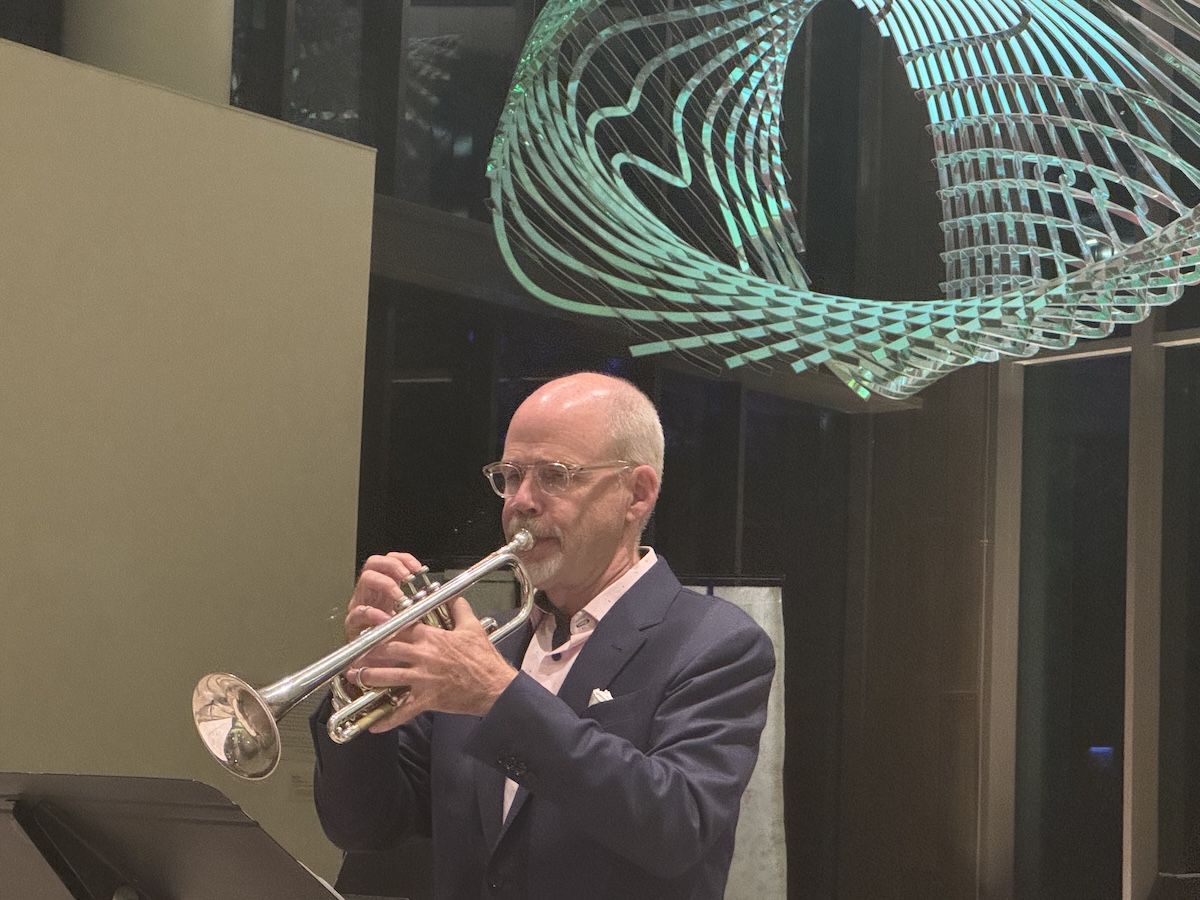
The Leone set included wordplay in the titles that helped convey subjective meaning and enjoyment of the music. The second piece, "Oscuro Chiaro," reverses chiaroscuro to create the opposite effect, where light and dark colors emerge in the music, unlike a painting technique. It could be considered a distortion, but not with the excellent musicianship of the ensemble. The varied colors of the notes emerged from tangled polyphony, creating structure and a different visual for me as my eyes scanned the chapel. I don't presume that the chapel with the Shotz sculpture was deliberate, but it added to the hypnotic visual of that particular piece.
The third piece, titled "Corsón," was solo in three parts on trumpet for Burns. It was mentioned that there were several influences on the piece as a whole, including Miles Davis, and that the title Corsón means "horn sound". I detected some pinches of Davis's definitive Bitches Brew (1969), as well as Sketches of Spain (1960). The composition was a living score that swirled, blared, and soothed. Burns's playing was impeccable, and it was great to hear a song meant mainly for the trumpet rather than as part of a larger composition.
Next was a composition by Carolina Heredia called Déjate Caer Mixed Media (2012). Violinist Rika Seko played solo against a recorded soundtrack and video of abstract images and shifting colors. Some of the imagery resembled fireworks and other Rorschach patterns, with hues of color woven in and turning like a kaleidoscope. The music could be described in the same way, with mixed tempos, delicate passages, and sharper interjections. Déjate Caer is literally translated as falling into it, which is appropriate for how the music came together.
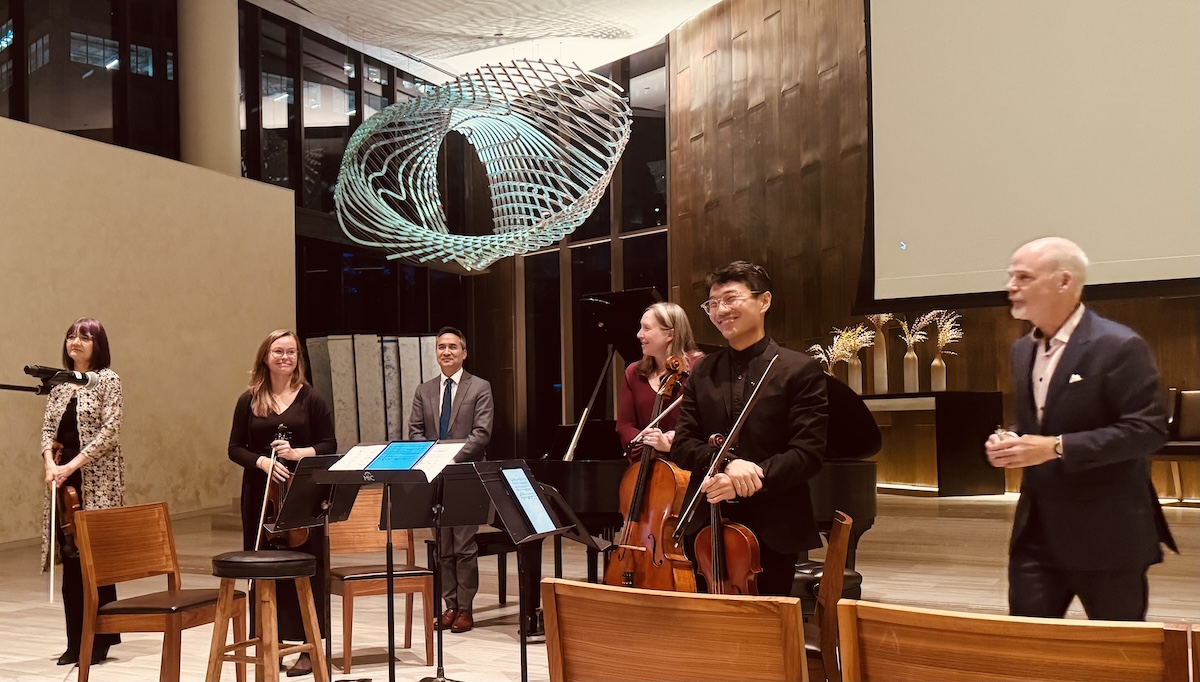
The group then played Decals II by Tomás Gueglio. Burns presented a different way of looking at decals as more of a cumulative experience. He described a friend decorating his daughter's bedroom with decals, creating a cohesive look by mixing them. Decals II had two subtitle pieces: "Passacaglia" and "Bourdons." Passacaglia is a baroque musical form from 17th-century Spain. A variation is repeated over another theme, similar to a fugue but not as intricate. I thought of it as a metaphor for using decals as decor- repeating them until a pattern forms. Bourdon is translated as melancholy bells or a staff carried by a pilgrim. Gueglio is also Argentinian and plays guitar like Leone. I did not find Bourdons to be somber but rather an addition of layers and more colors of sound. It was more suspense than sorrow, which can feel like a release once a mystery is solved. Heredia and Gueglio were perfect additions in an homage to Leone.
The final piece of the evening was Leone's String Quartet No. 4. Seko, with Amanda Beaune (violin), Claudia Lasareff-Mironoff (viola), and Paula Kosower (cello), played the final composition of the evening. Leone introduced it himself, describing it as a journey up a mountain in Colombia to look out over Bogotá, which is a high-altitude valley. That sounds like a contradiction, but the ascent in the music sounds like a strenuous but pleasurable journey, knowing what lies ahead. At the top is a view of the Bogotá valley, a teeming metropolis blended with green spaces and beautiful architecture. The descent is a mix of allegro and more melodic adagio, as if slowing to savor what you saw on the way up with a different perspective. It is a lovely composition with Leone's signature dramatic violins mixing choppy and hard bowing with smooth and melodic simultaneously.
Viaggio Profondo-an Homage to Gustavo Leone was part of the Ear Taxi Accent performances, showcasing Chicagoland-based performers and contemporary works of music. It is an opportunity to delve into the multifaceted music scene in our magnificent city. The Ear Taxi Festival does more than scratch the surface of creativity and genius; it provides an accessible way to discover the cultural depths of Chicago. Some of these composers will be spoken of in the same canon as Mozart, Bach, and Shostakovich in the future, and we are fortunate to be here in this moment of birth and emergence.
The Ear Taxi Festival continues with upcoming Accent performances from Mark Nagy's Station Four at Elastic Arts on Diversey on October 23, Alarm Will Sound on Friday, October 24, at the Logan Center in Hyde Park, and Saturday, October 25, the DePaul Faculty Artist Series: Composers Christopher Jones and Osnat Netzer, at the Holtschneider Performance Center on the Lincoln Park DePaul campus. For even more concerts and details, please visit eartaxifestival.com.
Did you enjoy this post? Please consider supporting Third Coast Review’s arts and culture coverage by making a donation. Please choose the amount that works best for you, and know how much we appreciate your support!
