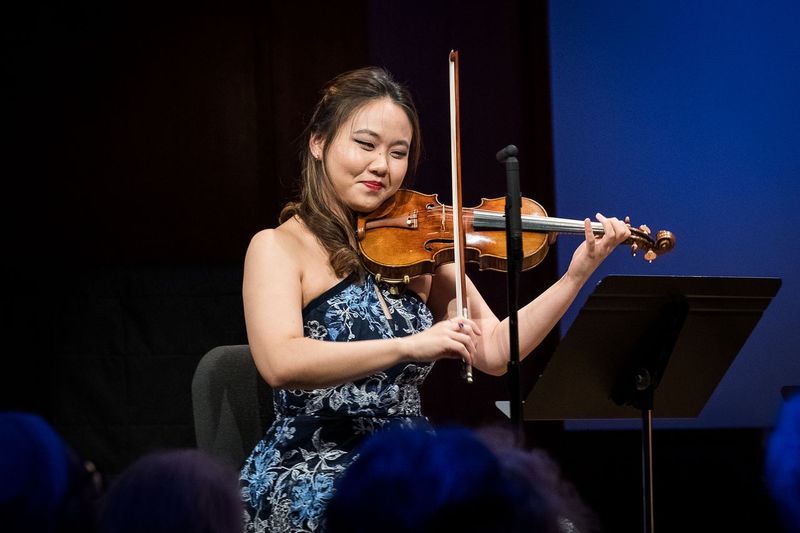

The Chamber Music Society of Lincoln Center gave a surprising and charming performance of string quintets at Harris Theater on Wednesday night. It was surprising because they performed several rarely heard quintets from several centuries, even something little known by Ludwig van Beethoven. It was charming because they played one of the best pieces of chamber music written by the king of charm, Wolfgang Amadeus Mozart.
One of the most common chamber musical arrangements is a string quartet formed by two violins, one viola, and one cello. There is a large repertoire of music for string quartets and many professional ensembles exist to perform them, including a few near Chicago. Occasionally, composers add a second viola, or, less frequently, a second cello, to write for a quintet. With few established ensembles specializing in string quintets, the repertoire does not get played very often. When it does get played, the focus is typically on a handful of quintets by top composers like Mozart, Schubert, and Brahms.

With a large collection of talented musicians performing on tour and in New York, the Chamber Music Society of Lincoln Center is in a great position to perform string quintets. On Wednesday, CMS brought in violinists Stella Chen and Alexander Sitkovetsky, violists Paul Neubauer and Matthew Lipman, who is a Chicago native, and cellist Jonathan Swensen. While the concert concluded with one of Mozart’s amazing contributions to the repertoire, the first half featured music I had never had the opportunity to hear previously.
This included a brief, five-voice fugue that Beethoven wrote late in his career in 1817 and was published posthumously as Op. 137. While in the major key of D, the start of this fugue bears some resemblance to the Scherzo of the 9th Symphony in d-minor. Starting with Stella Chen as first violin and descending through the remaining instruments, they played with conviction.
One interesting feature of this performance was that the violins and violas switched chairs during the concert. Alexander Sitkovetsky was first violinist in the opening work in four movements, Phantasy Quintet by Ralph Vaughan Williams from 1912. Violist Paul Neubauer started the Prelude with a slow, mournful solo on viola, which, after some ensemble harmonies, was taken up by Sitkovetsky. This was the first of many occasions when the players created a lovely aural palette, a feeling that continued after cellist Jonathan Swensen sped things up for the Scherzo. As the work progressed through shifting tempos and movements, the sound was lush, even when strings were muted, which removes overtones.
Following the Beethoven, violists Lipman and Neubauer played two short pieces from 1920, Two Duos for Two Violas in G-major by York Bowen. As Lipman described, this fun work shifts back and forth from a duet to a duel, starting with lots of doubled stopped chords and ending with tight fingering on the finger board. Their ensemble sound was so clean, it felt as if it all came from a single instrument.
The last piece on the program before intermission was a lengthy work from 2010 by Brett Dean, Epitaphs for Two Violins, Two Violas, and Cello. With a fascinating mixture of musical tones and rhythmic sounds bowed and plucked, this work has five sections devoted to the memories of people who had impacted him.
Each movement had a very different feel. The second Epitaph, “Walk a little way with me … in memory of Lyndal Holt” had rapid passages of movement while the third Epitaph, “Der Philosph… in memory of Jan Diesselhorst” had lots of long, slow notes form interesting chords. Into the mix were several solo and duo opportunities for the players. Throughout, the blend was wonderful as was the remarkable cohesion between the players. Mutes were also attached at various times.
After intermission, we got Mozart’s String Quintet in C-major, K.515. In a discussion before the performance, several of the players suggested that this is Mozart’s finest piece of chamber music. At this level of perfection, it is all a matter of taste. But this work certainly is highly characteristic of Mozart’s ability to craft delicate melodies and weave them into tonal fabrics of the greatest possible finesse.
Notwithstanding a couple of missed notes, the performance certainly measured up from the opening dialogue between Swenson on cello and Chen on first violin, while the others backed up with rapid chords. Throughout this work, Mozart pairs up instruments, as the others provide harmonies. The finale was very lively, and the performers were obviously having a good time. Their ensemble interaction was tight and the phrasing crisp. A very enjoyable performance.
Chamber Music Society of Lincoln returns to Harris Theater for Bach’s Brandenburg Concertos, Thursday, December 4, 2025. 7:30 pm. For more info, click here.
