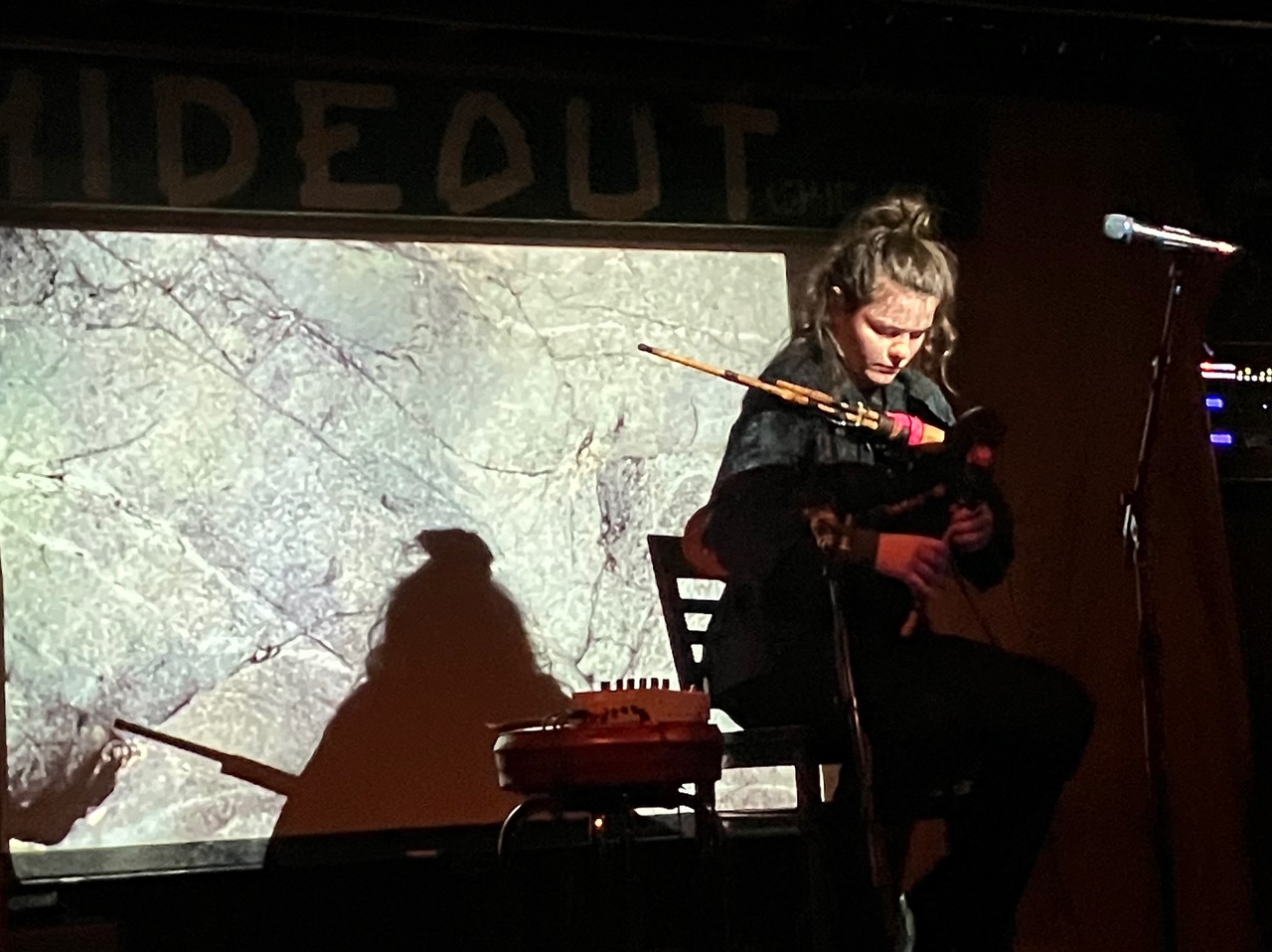
Two middle-aged men were waiting for the doors to open. “How did you find out about her?” we asked. One of them said he read an article in the New Yorker. Then we asked a 20-something young man the same thing. “I don’t know,” he offered. He couldn’t remember exactly when he first heard her music but whenever it was, he was immediately smitten by it so much so that he traveled from his native Ohio to see the show on a Sunday night at the Hideout.
They, and plenty others, had come to hear the Scottish piper Brìghde Chaimbeul too. Chaimbeul is a master on the bellows-blown Scottish small pipes, similar but different from the Irish Uilleann pipes and much softer than the more familiar Great Highland pipes. Unlike the often-daunting Highland pipes, the small pipes have a warm and accessible tone. They’re friendlier.
People came here with intention so when she sauntered onto the small stage of the Hideout, dressed all in black, the crowd applauded in appreciation and anticipation. They also knew they were about to hear something special, something different. After all, it isn’t every day that a native Gaelic speaker from the Isle of Skye and a master on the Scottish small pipes plays a Chicago club. In fact, Chicago was the last stop on Chaimbeul’s two-month international tour to promote her wondrous new album, Sunwise. The tour has been so successful that, aside from a few t-shirts, all of her merch was sold out.
Chaimbeul not only plays the pipes, but she also sings and tells stories. Whether old tunes or original compositions, the compositions she plays and the songs she sings or the words she speaks all have a haunting quality about them. (The sources for most of the traditional tunes come from the archives of the School of Scottish Studies, in Edinburgh.) Additionally, the recurring sound of the drones creates a hypnotic, trance-like rhythm—a constant drone like a heartbeat.
Chaimbeul sits alone on a tall chair, her demeanor serious but not somber. It’s all about the music. She is not a showman but rather a musician who prefers the music speak for itself. With the constant murmur of the drones as background, she looks down towards her pipes as if to ask what is this wondrous instrument that I’m playing? Her eyes remain closed. The audience is enthralled: quiet, engrossed, receptive, lost in the music as much as she is.
Repetition is an important part of the sound of Chaimbeul’s music and hypnotic repetition was a common theme at the show. (The Chicago-based composer and visual artist Anna Johnson opened for Chaimbeul). In Chaimbeul’s use of repetition, some may hear echoes of Steve Reich and Philip Glass, both of which are among her influences. It is partly the repetitious nature of the music that pulls people in. It’s full-immersion music. Sometimes she sings, alternating with the pipes, then lets her skilled fingers do the rest.
At one moment, Gaelic words are displayed on a screen behind her in white text against a black background as she translates them into English, articulating each phrase clearly and calmly. We hear the sound of kindling fire, adding to the atmosphere. Sometimes the Gaelic words were reflected onto her, the white print of the text covering her face entirely, creating an otherworldly effect.
Towards the end of her set, she introduces the shimmering “Duan” (“Song” or “Poem”), an original pipe tune inspired by an old Hebridean custom on Hogmanay (New Year). As she explained, the villagers would go from house to house, reciting a traditional Gaelic rhyme (a New Year’s blessing) that was used to accompany a disorderly procession—it is New Year’s after all--that went three times sunwise around each house in the village, around the children, and around the women of the house. The tune starts slowly before gaining power and speed. On the Sunwise recording, the Gaelic rhyme is spoken by Chaimbeul’s father, Aonghas Phadraig Chaimbeul (Angus Peter Campbell), an acclaimed Scots Gaelic poet, novelist, journalist, broadcaster, and actor, but here Brìdghe reads it herself.
Her tune, “Bog an Lochan” (“Muddy Bog”), is a mesmerizing toe tapper, fast and rhythmic, and a fine way to end her short but powerful set. “Thank you,” she says. “Thank you so much. I’ve come to my last tune. Thank you so much for coming. It’s such a pleasure to be back here in Chicago.” And with that, she takes a bow and disappears from the stage.
Primal and joyous, rapturous and evocative, Chaimbeul creates music that is the modern equivalent of sharing songs and telling stories sitting around the fire, watching the embers burn as the night falls into darkness.
