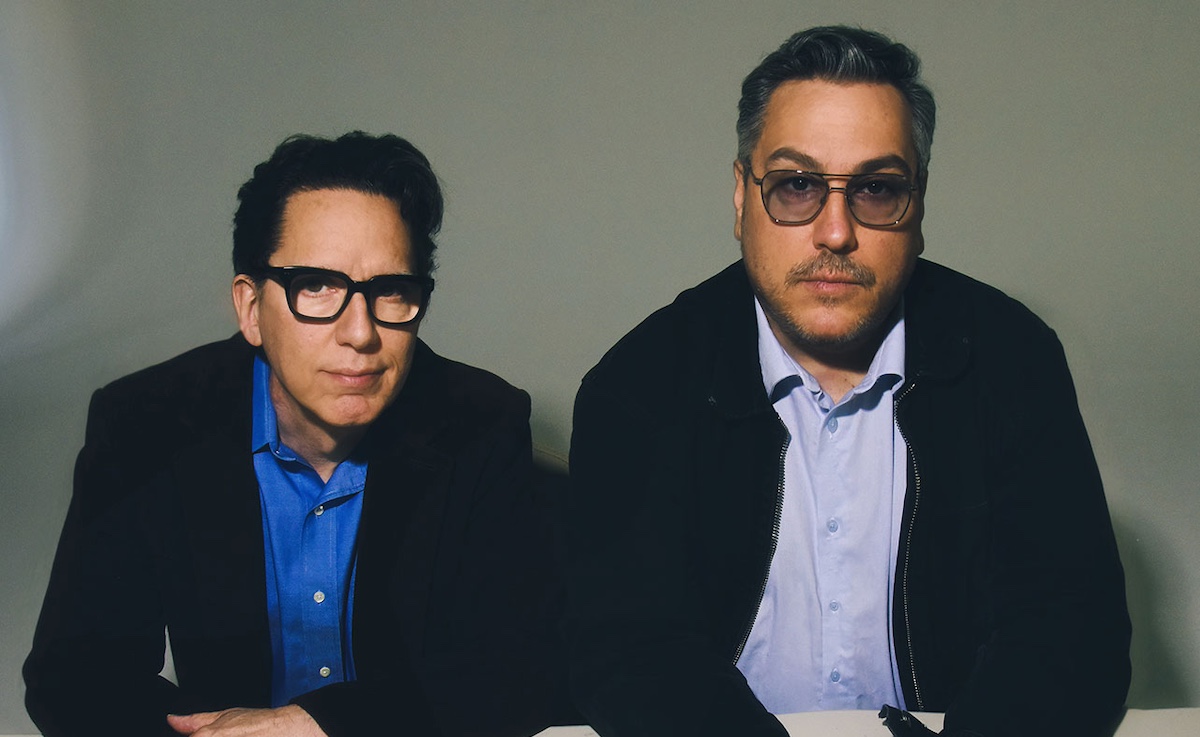
It’s understandably rare for bands to have a career spanning over four decades, and the few that do even more understandably tend to slow down after all that time. But not They Might Be Giants, who are celebrating the 40th anniversary of their debut album with the Bigger Show Tour as an eight-piece lineup performing 38 shows across 16 cities. Each night of the tour spotlights one of the band’s 24 albums, along with a changing selection of highlights from throughout their career and their new album, The World is to Dig.
The band is hitting Chicago’s Vic Theatre with a trio of shows this weekend. We spoke with guitarist John Flansburgh about what fans should expect, the importance of practicing karaoke songs, and a scary incident at one of their earliest Chicago shows.
You’ve got three shows coming up in Chicago this weekend. What should audiences expect?
They'll be fun shows. Two of them are sold out—I don't know how close the third one is to selling out, but I suspect it'll go, especially since, now that we're doing different shows, we get a lot of recidivism, as they say in the system. A lot of people come back after seeing one. That was sort of our experience in Indianapolis.
The multiple setlists are definitely an incentive to go to each show.
We did three shows in Indianapolis, and all the shows are quite distinct from each other. I don't know how many songs we did, something like 80-something total. But there is some repetition. We play “Birdhouse in Your Soul,” and we usually play “Particle Man.” We play some new songs off of The World is to Dig, which we've never played before, so those are all sort of brand-new. It's a pretty action-packed show. I think if anybody came back, they'd be quite surprised at how different it is.
As you mentioned, “Birdhouse” is kind of the obligatory song you have to do at every show, so let's get the obligatory “Birdhouse in Your Soul” question out of the way. What makes it such a deceptively difficult karaoke song?
Oh, I don't know. I wasn't aware that it was. I mean, there's been this recent hubbub that I think is kind of—it seems very randomly generated, but it shows up on my algorithms on social media that somehow the song has all these key changes in it. I don't know how they're defining key change. I mean, I'm just a simple southern guitarist. But I hear one key change and then it returns to the original key. So to me, it has at best two key changes, but there are all these kind of clickbait things saying, “Hear the song with 18 key changes.” I'm like, I don't know if that's exactly right. But is it hard to sing? I've never personally done it.
On Reddit, people are saying that it's tricky because people think it's easy to sing when it really takes a lot of breath control.
Oh, I don't know. I mean, listen, folks, if you're going to do karaoke, you've got to practice at home. You've got to make sure it's in a good key for you. You've got to have your go-to. You've got to be prepared. It's just that there's no room for amateurs on amateur night.
Let's fast-forward all the way to The World is to Dig. My favorite song so far is “What You Get.” I'm curious, what songs stand out to you and why?
Well, we've been playing “Wu-Tang” a lot and that's been kind of fun. But speaking of hard to sing, I've been saddled with the backing vocals on that, which is a real leather lung kind of affair. And I've had to kind of explore how to sing it properly in a reliable way, which has required a little bit of finessing. But all the songs are fun to play. I think there's going to be a lot.
It's kind of a harbinger of how well-received a record is going to be by how many songs from an album you can kind of get away with playing. This is our 24th album. We've been on the road for essentially 35 years doing shows and touring. The fact that we already have five songs from the album in the show and people aren't groaning is a huge victory.
With such a large discography, how do you narrow down the setlist for the second half of each show? You only have so many slots for such an immense catalog.
Well, I mean, there's nothing good about being in a band for 40 years, except that you have a lot of repertoire to draw on. And I think we do change it up. There is no set second half. I guess there's some songs that have a certain amount of theatricality to them. We have this song that became popular on TikTok called “Stuff is Way” that we do with a camera. It's a duet, and I have a camera offstage that's just on my teeth. And I sing the second voice of the song, just projected on the screen, a la Wizard of Oz. And it's very disturbing.
I guess when you have a song like that, and then you've got a song like “Lie Still, Little Bottle,” where I'm playing a stick on stage that's triggering an explosion sound, I wouldn't put those two songs together, but I would put one of them in the set. You're kind of aware of what the archetype of the song is. If a song is highly theatrical, you kind of treat that as a little bit of hot spice in the middle of things.
There are certain songs that are just very manic. We're doing a song called “Till My Head Falls Off” off of Factory Showroom that's really up-tempo. We wouldn't do that in the same set as a song like “Dig My Grave.” I guess you kind of take one from column A, one from column B. We have certain songs that are educational. We wouldn't put multiple fact-driven songs together. We try to create the most variety that we can, and I think we're very aware of songs of ours that kind of run parallel to each other. It's really just sort of shuffling things around to give the illusion of great depth.
Speaking of the fact-based songs, I noticed that the albums that you did for kids are not on Spotify. Is there a reason for that?
All our stuff is on Spotify—They Might Be Giants (For Kids). Basically, I was listening to a podcaster that I really love, Julie Klausner. And just in passing—and this really blew my head off my shoulders—she was like, “It's really shitty when you're listening to your favorite band and all of a sudden one of their kid songs comes on, like They Might Be Giants.” And I was just like, “Ah!”
I realized maybe there's a way we could actually quarantine them. Because the kid songs are for kids. They're not for adults. I don't think they are as cloying as a Barney song, but I do understand why it would kind of undermine your listening experience. So we really just set up a parallel account and all the kid stuff lands in the “for kids” section.
That’s great to know. I’ve been wanting to revisit those for years.
We put a lot of effort into it. It's a very frothy topic. And it's probably just a measure of how far away you are from your own adolescence, how much it bugs you. Because just speaking as an actually old person, to me, it seems like a very neurotic response. Like, “Ah man, kids music!” But I don't have kids, personally. And I don't ever listen to kids music. It's not some toxic, radioactive thing to me. It was just an interesting challenge for writing. And we really did as few children's shows as we could get away with, and now we don't really do it at all. Those albums endure, and also, very curiously, they generated a whole other younger crowd. We have a huge amount of people who come out to shows, concert-age going people, people in their early 20s, who grew up with those records. And that was how they got into They Might Be Giants. It's as if we had a master plan.
Any special memories from hitting Chicago in the past?
I have one really weird memory. We were talking about this yesterday. We played one show at the Cubby Bear, which was really weird, because half the crowd couldn't see us. It was a huge turnout, and it just filled the place. But the way the room was set up, it was actually kind of a panic, because we were just the band playing around the corner. But we did a lot of shows at Cabaret Metro, and they were really fun. And it really felt like Beatlemania. Very active audience, very screamy, and it was just a blast. And to be perfectly honest, they seemed like really, really big shows. It seemed like a really big deal.
Then I remember going back, like 10 years later, doing some walk-on thing or some radio show or something. I don't know what the circumstance was that we were at Cabaret Metro, but I was on the stage. And it was sort of like going back to your second grade classroom and realizing that they're kid-sized chairs. It's not a big room, and it's not a big stage. It's actually quite a small room and quite a small stage. But it seemed really big at the time when we were there, the first few times we played there.
But we had a very strange incident where someone came into the venue and, underneath their jacket, they clearly had a weapon. Who knows what that meant? I mean, maybe they were just like an off-duty undercover cop who really loved alternative rock music or something. But they were just drinking and enjoying the show. And every five minutes, somebody would realize they were brandishing a firearm. And God bless the crew at the Metro, they actually had a protocol that they had rehearsed. The security people had rehearsed the thing, where over the course of like five minutes, they would slowly surround the person without them realizing it. Like one person would sort of stand behind them and someone would kind of stand in front of them, and other guys would stand to the side. And then on some signal, they just grabbed him and lifted him up and took him and ran him out of the room. And it worked. And he was removed.
Nobody told us what was happening. Nobody in the room, nobody in the audience knew what was happening. And then there was just this enormous kerfuffle that was then over as quickly as it started. And we were all just going like, ‘What the fuck was that?’ But I'm grateful that there are people working in these venues who actually take their job seriously enough. We live in this stupid gun culture where people are acting like, ‘What would we do if we didn't have our guns?’ It's like, ‘Oh, well, we'd live in a much more peaceful place.’ I mean, personally, just as a citizen of New York, I think it would be fantastic if there were no guns in the United States. It would be so much better. But yeah, I was grateful that they had their shit together.
It’s such a relief that Metro had that in place.
It was early days for us. I mean, they could have easily just been some crazy psycho. I mean, they might have had something very nefarious on their mind. I have no idea.
The way you're doing this current tour is you've got multi-night, mini-residencies in every city. What made you decide to approach the tour that way?
It just seemed like a way to have more fun. We get to kind of sleep in a little bit. We get to do some touristy stuff. I'm in Detroit right now, and I got to go to the Henry Ford Museum yesterday, which has Thomas Edison's laboratory in it, which is kind of fascinating. There's a lot of interesting stuff in the way it's set up, although they did completely whitewash Henry Ford's anti-Semitic history.
But it's just more fun. It's more fun to be able to take our time. And to be perfectly honest, I think if we were doing a different show every night in different cities, it wouldn't really make as much sense to us. When you're on tour, you're tempted to just always play the favorites and the greatest hits. And even if you don't want it to, it becomes a little bit repetitive, and then you become vaguely bored with yourself over the course of the month that you're out on the road.
What's happening now is, we're doing a new repertoire every night. It’s like a new show for us. It has first-night excitement every night. And even though it might be kind of imposed on us, the excitement is real. It just makes it much more thrilling to do the show. So it's a way to kind of keep things lively.
After 40+ years, I can imagine that anything you can do to ramp up the excitement is worthwhile.
Absolutely. I feel sorry for people who feel compelled to do it in a more square way.
Any activities planned for while you’re in Chicago?
I suspect I'll be going to the Chicago Music Exchange because they've got a lot of overpriced stuff that I'm interested in buying.
How has your approach to performing changed over the last four decades?
My musical partner, John Linnell, is very casual—he's an extraordinarily talented person who can play with tremendous technical facility without seeming to have to work at it at all. When we started the band, I couldn't really sing and play at the same time. I was really new to music in general. And he was the only person I had as a real example of how to do it, so there was part of me that just thought, ‘Well, I guess part of it's just kind of magic.’ And about 15 or 20 years into it, I realized, if I actually start doing vocal warm-ups and dealing with my voice and taking voice lessons, maybe I could improve—really, seriously improve.
In the last, like, 15, 20 years, I've been really working on my voice and trying to be a better singer. It's very weird to be in the middle of your career and realize that you have a ton more that you could learn because you're already doing it. You're getting all sorts of affirmation that you're okay at it. But I was frustrated by the quality and my level of competence as a singer. I had little pitch problems. I would scoop things. I would sing long notes and fall flat, and all those things really just started to bug me. There's all these resources on YouTube with vocal coaches doing these very in-depth kinds of things that you can just drill yourself on every day. And I spend a little bit of my day every day doing these extremely boring, you know, “Let's work on chromatic runs today.” But it keeps me in a much better shape. And I'm just happy to do the work.
I love that you’re dedicated to improving. A lot of artists at this point in their careers are going through the motions and you can hear the deterioration, so I commend you for that.
Oh yeah. I mean, it's way better to be getting better than to be caught in the undertow of aging. That's the other thing. Listen, I've seen a million bands come and go and a million bands that went come back. And it's interesting to see—you can tell there are people who have really neglected their voices. And that's the thing, you just have to be really conscientious about it. I mean, it's not just like all cigarettes and booze, not that there's anything wrong with that. I'm very happy that I've dedicated at least a little bit of time to my craft.
Speaking of which, They Might Be Giants does such an impeccable job bridging the gap between silliness and musical precision. What’s the key to that?
John and I are pretty picky. I mean, we're pretty uptight about a lot of different things. And I think it's a common trait in creative people, no matter what you're doing. I have friends who are working in comedy, and their internal monologues about what's worthwhile and what's not worthwhile are incredibly focused. They could totally kill in some kind of performance and come out and be like, ‘Ah, they were laughing, but they were laughing the wrong way.’ It's a very common thing.
For us, with recordings, we really want it to hold up to repeated listening. So the idea of letting stuff slide or it just being okay is kind of unacceptable. That was one of the weird things about doing the kids' records. The second we started doing kids' stuff, we were bombarded with so much weird, bad advice. Like, “It's just for kids. You don't have to do that. You should do it at home. Don't do it in the studio. Don't spend money on this.” And we're like, “No, man. You don't think kids can tell if it's a cool recording?” I feel like kids, their radar on that stuff is probably even more finely-tuned than a lot of adults.
We had the song “Cowtown.” It might have been the first song we ever recorded. And it has this effect in it that is in classical music a lot called hocketing, where you have two of the same instrument in a void of the other instrument's notes. So it's going like, bop, bop, bop, bop, bop, bop, back and forth, but it's like a dovetail joint where there's no gap between them. But what's really key to the effect is that the instruments have to be the exact same volume. They have to have the same tone, and that will make it sound like one instrument.
Right now one of the spotlight albums (on this tour) is Lincoln, so we're playing the song “Cowtown” in the show. Stan, our sax player, and John Linnell play the clarinet part at the beginning of the song with this hocketing thing, and it just has to be equal. If it's not equal, it's not gonna work. I mean, hopefully we're just uptight about the stuff that counts and try not to be too uptight about the stuff that doesn't.
There is an aspect to our show that I feel very lucky that now seems very long established that I think is—it's a little bit Johnny Carson. I'm not sure who else works this way, but there's this sort of idea that if something is sort of fucked up or something doesn't work, that's even better than if it did work. I think somebody was comparing it to Catholicism, that by building in forgiveness into our set, if we can't pull something off or if something just crashes, which it does on occasion—like sometimes you go up on the opening lyric of a song (and) you literally have to start over, which is mortifying to me. But the truth is, if you're not too caught up in it, it's just fun. It's more fun for the audience. It's shocking for the audience to see something fall apart. It doesn't bother us. It's not going to bother them. So when we fuck up, we just kind of celebrate it and laugh it out. And it's fine. And I feel very lucky that that's how we ended up dealing with those problems.
I think when we first started, we were working with tape. There were always technical fuck-ups with the tape, and I think that's what kind of let it go. Because if it's a technical problem, there's only so much you can do, and that kind of got the ball rolling on our forgiveness trip.
That’s the beauty of analog recording.
It was good for us, because when we started with the tape, what we realized is, if there was a big technical crash-out with the tape, we needed to keep on going. So we actually kind of figured out how to also work as just an acoustic duo. We hadn't really developed that when we first started doing the show. We were really leaning on the idea that we were essentially a four-piece band, but doing the duo stuff was a whole different trip.
What still surprises you about the band and about the audience after all these years?
I'm not that optimistic a person. I'm pretty cynical. Most of the music I like has a very hard time finding audiences. I really appreciate a lot of more left-field stuff, so I'm very used to things not being celebrated and not being able to continue because doing strange music is often kind of not that loved.
When we started the band, I felt like what we were doing was very laudable because it was so take-it-or-leave-it that it almost had a governor on it as to how popular it could be. And I think at almost every turn, we've had all these lucky breaks over the years. Nothing huge, nothing life-changing. We haven't had the kind of success that a lot of other bands enjoy. Most bands have one huge breakout thing that overshadows everything, and it seems to me like we've had the other kind of career where we've kind of just crawled along and things have gotten incrementally better, which is fine, but maybe it's not typical.
I'm just really grateful that people have been able to discover us, and so many people like it and people keep on coming back. It seems like audiences enjoy our more ambitious impulses. We'll do songs that are very musical or songs that are very weird, and they seem to dig it.
They Might Be Giants performs at The Vic Theatre (3145 N Sheffield Ave) Friday, May 1 through Sunday, May 3 (doors 7pm, shows at 8pm). Tickets (starting at $57) are on sale now.
