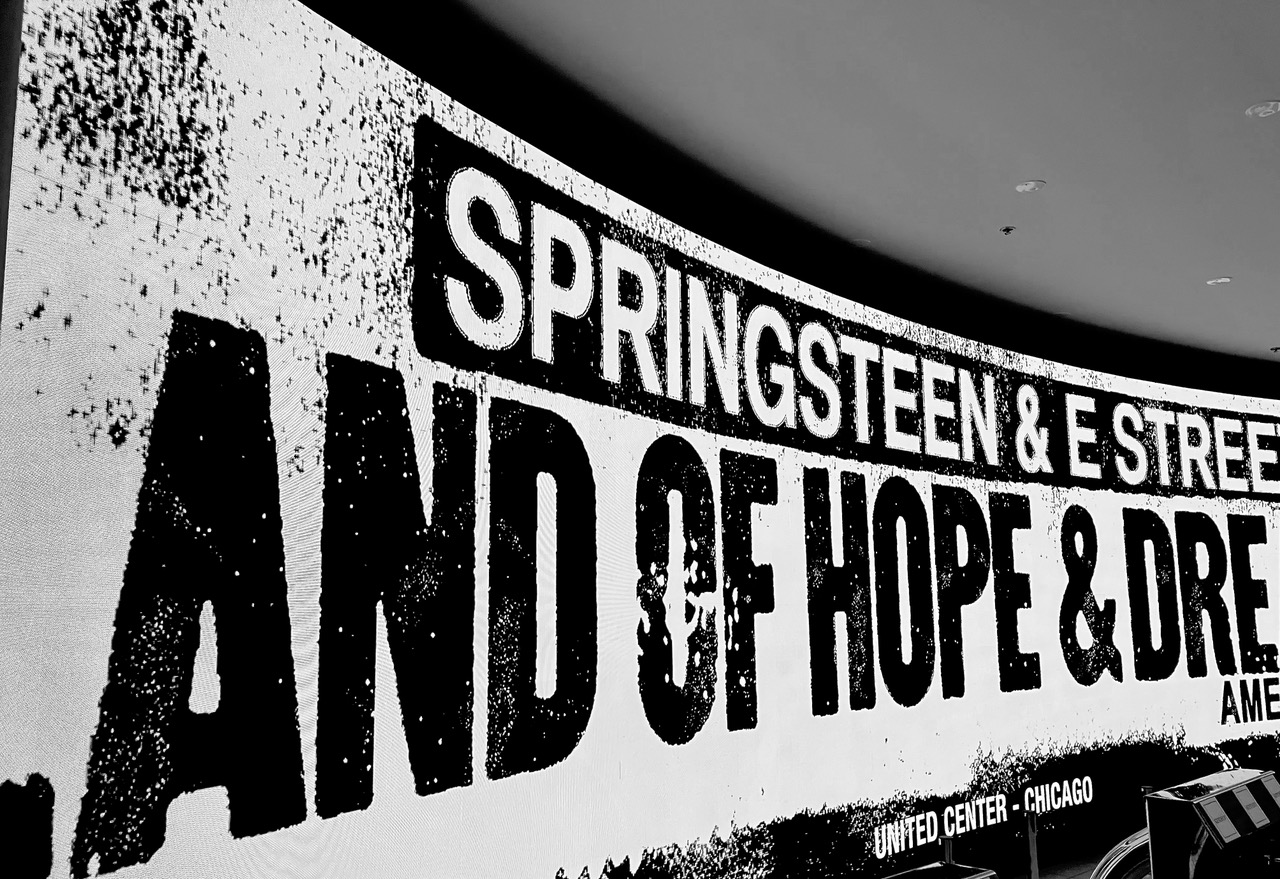
On Wednesday night at the United Center, Bruce Springsteen and the E Street Band came to town as part of their Land of Hope & Dreams/No Kings tour. I have seen Springsteen perform many times over the years—according to memory and rough mathematics, this is my 19th time. I have seen him at muted acoustic shows (The Ghost of Tom Joad tour at the Rosemont Theatre), at a joyful Seeger Sessions show in Tinley Park, and at his wondrous one-man show on Broadway. The Land of Hope and Dreams American Tour, dubbed the No Kings shows, ranks with the best of them.
I first saw Springsteen in November 1978 at McGaw Hall in Evanston, an intense and intensely fun show. At that point, I was aware of him from the recordings that I bought and the reviews in newspapers and magazines. Even though I thought I knew what to expect I was still blown away by the fire and fury of his performance. I saw him a few more times in the 1980s and then nothing until the release of The Rising in 2002, although I always followed his career and purchased his records.
Springsteen is one of the greatest performers in music and what made this latest show special for me wasn’t the perennial crowd-pleasing songs, but rather the thoughtful detail that he brought to the setlist; a combination of some of his most political songs and carefully chosen covers. Indeed, the No Kings tour is the most political of Springsteen’s long career. During their three-hour set and nearly 30 songs, Springsteen and the band performed selections representing the span of his long career, including cuts from Born to Run, Darkness on the Edge of Town, The River, Born in the USA, The Ghost of Tom Joad, The Rising, The Seeger Sessions, Magic, Wrecking Ball, and Letter to You. Wearing his customary uniform of white shirt, black vest, dark tie and jeans, he sang protest songs, anti-war songs, and odes to friendship, camaraderie, and community.
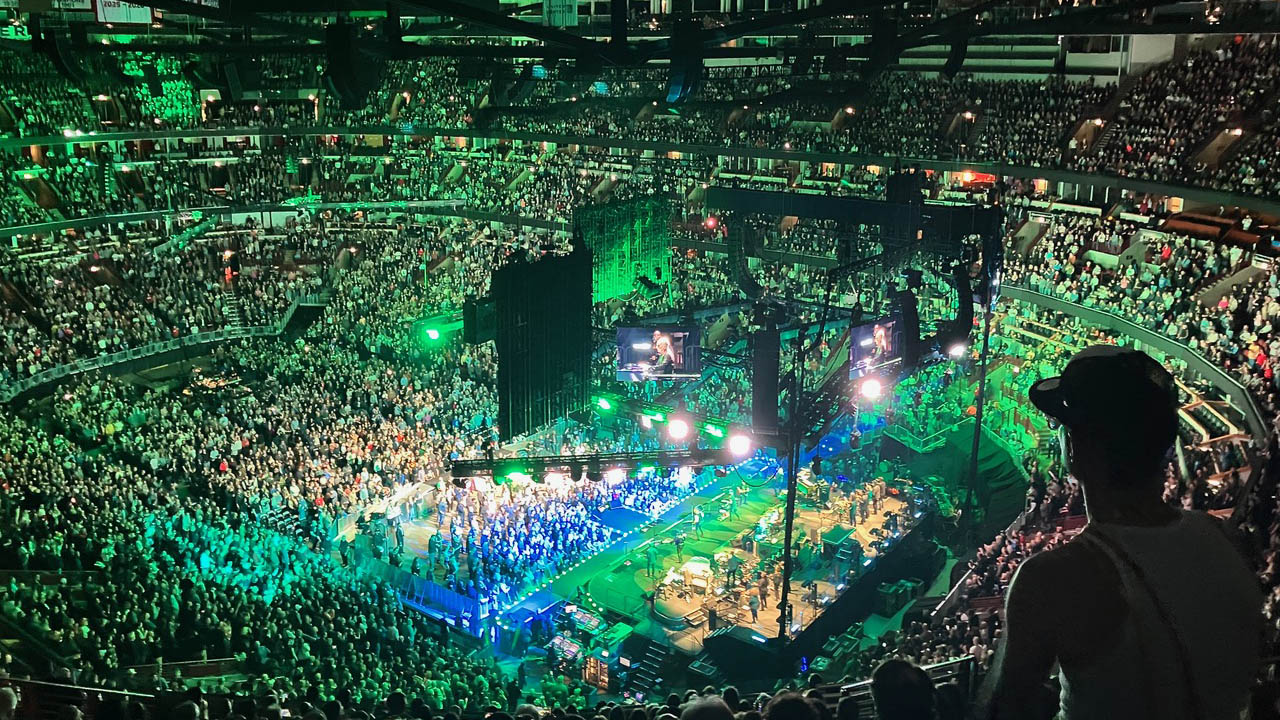
He opened with a cover of Edwin Starr’s “War,” setting the template for the rest of the evening. Springsteen has been performing this protest song about Reagan’s Central America policy since 1985 during the final leg of his Born in the USA tour. “War” segued perfectly into a searing rendition of “Born in the USA” with Springsteen and guest artist, the great Tom Morello, sparring off each other on guitar. Another cover, the Clash’s “Clampdown” from London Calling (“In these days of evil presidentes”) led to Springsteen and Morello sharing vocals. A stomping “Death to My Hometown,” an Irish-tinged protest song about industrial decline caused by modern-day robber barons, got most everyone on their feet.
The order of the songs not only meant something, but it also gave them added weight and a tinge of poignancy. The teenage anthem “No Surrender” led to the very adult concerns of “Darkness on the Edge of Town.” A new song, “Streets of Minneapolis,” about the deaths of Renee Good and Alex Pretti earlier this year by ICE officers, shifted into the resilience of “The Promised Land,” as the narrator vows to keep the faith despite the obstacles placed in front of him. To lighten up the mood a bit, Springsteen turned to that tribute to companionship, “Two Hearts,” singing heart to heart with his musical wingman, Steve Van Zandt, which then led to another search for connection, the restless if upbeat “Hungry Heart.”
Then the mood turned dark again with an absolutely magnificent rendition of “Youngstown,” his bleak and angry, account of industrial decline in the American heartland, followed by an equally powerful “Murder, Inc.”, “American Skin (41 Shots),” about the deadly shooting of an immigrant in New York, took on additional shades of complexity, and timeliness, with Morello on lead guitar. Calling the idealism of a “Long Walk Home” “a prayer for my country,” Springsteen paused for a moment. “Listen,” he said, before singing the song’s final verse about the importance of maintaining values in a changing world. On “House of a Thousand Guitars,” the stadium lights dimmed as he sang solo on guitar and harmonica, a response to dark times and the power to be found in friendship and the balm of creativity where “the music never ends.”
For the next song he sat down and addressed the crowd. “We are making our way through troubled times,” he began before listing a litany of concerns, including the dismantling of USAID, the undermining of NATO, and the incongruous antagonism towards Canada––“What the fuck did they ever do to us?”––the latter line received tumultuous applause.
The gospel-like “My City of Ruins,” where his adopted hometown of Asbury Park acted as a stand in for the entire country, was especially moving. It was followed by a rendition of “Because the Night,” the rock classic he co-wrote with Patti Smith, followed by an especially rousing “Wrecking Ball,” one of the many highlights of the evening.
The rebirth and resurrection imagery of the “The Rising” led to a searing “The Ghost of Tom Joad,” his musical interpretation of John Steinbeck’s The Grapes of Wrath, with Springsteen and a smoking Morello taking turns on vocals and guitars. The show ended on a hopeful note with the invigorating “Badlands” followed by the redemptive and rollicking secular gospel of “Land of Hope and Dreams,” his modern take on Curtis Mayfield’s “People Get Ready.”
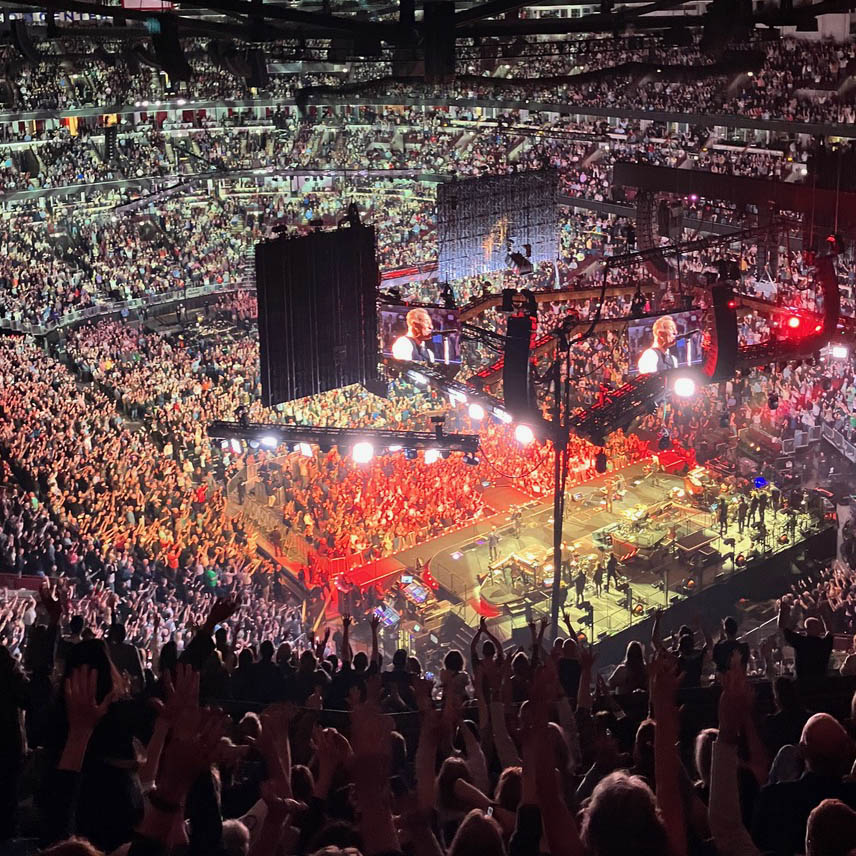
During the encore, Springsteen turned to his Seeger Sessions-era “American Land,” a song in praise of immigrants complete with a faux Irish accent. With the trio of “Born to Run,” “Dancing in the Dark,” and “Tenth Avenue Freeze-out,” the stadium became a place of frenzied joy. During the opening moments of the latter, Springsteen removed his vest and walked among the audience as videos of Clarence Clemons and Danny Federici appeared on the monitors serving as reminders of E Street Band members who have passed on.
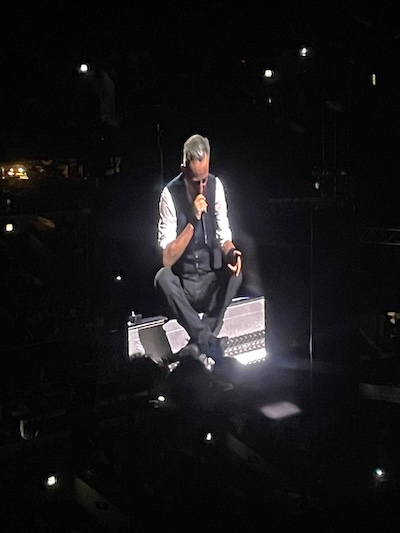
Looking exhausted, and rightly so, but grateful, Springsteen sat down one last time. “Damn Chicago,” he said, responding to the overwhelming applause. “Thank you. Thank you. Thank you.” He talked about the first time he performed in Chicago. It was in 1974, he recalled (actually it was in January 1973) at the old Quiet Knight on Belmont Avenue when he opened for the street corner a cappella band the Persuasions. “I was 24,” he said. “Oh, good lord. Thanks for a lifetime.”
For his final song Springsteen turned to Bob Dylan’s sublime “Chimes of Freedom.” He recorded a live version of it in 1988 to benefit Amnesty International but tonight it felt especially right to hear it in this place, at this time as much for its generosity of spirit as for its empathic appreciation for outcasts, those down on their luck, and “every hung-up person in the whole wide universe.” It gave me goosebumps.
The No Kings show was a seamless, magnificent combination of dark and light. As the crowd left, the unmistakable voice of Woody Guthrie’s “This Land Is Your Land” rang out throughout the stadium.
It was a perfect way to end the evening.
Support arts and culture journalism today. This work doesn't happen without your support. Contribute today and ensure we can continue to share the latest reviews, essays, and previews of the most anticipated arts and culture events across the city.
