Chicago is a UNESCO World Heritage Site for jazz music this week. Concerts, exhibits, and various symposia on the art of jazz across the city led up to International Jazz Day on Thursday, April 30. Through the efforts of music legend Herbie Hancock, vocalist Kurt Elling, and many talented musicians from around the world, the UNESCO designation has come to Chicago. UNESCO is the United Nations Educational, Scientific, and Cultural Organization.
On Wednesday, I was fortunate to see three of my favorite musicians on stage discussing their definitions of jazz and how they composed music for film. The Chicago Cultural Center hosted Jazz, Film, and the Improvisational Architecture of Storytelling in the Claudia Cassidy Theater.
I was in my element in that beautiful landmark building, where people have been inspired and imbued with a sense of pride for Chicago's excellence in the arts. The afternoon was hosted by Sandra Evers-Manly, a film producer and advocate for Black artists on and off-screen in the film industry. Advocacy is literally in her bloodline as a first cousin of American civil rights leader Medgar Evers. She introduced Kris Bowers, Marcus Miller, and Herbie Hancock to the stage. Terence Blanchard was supposed to be on the dais, but was held up in Poland due to flight delays. Blanchard has a long-running partnership with director Spike Lee and composed for Da 5 Bloods (2020) and Lee's elegy for New Orleans after Katrina, When the Levees Broke (2006). All of these musicians have produced some of the finest music in America and the world.
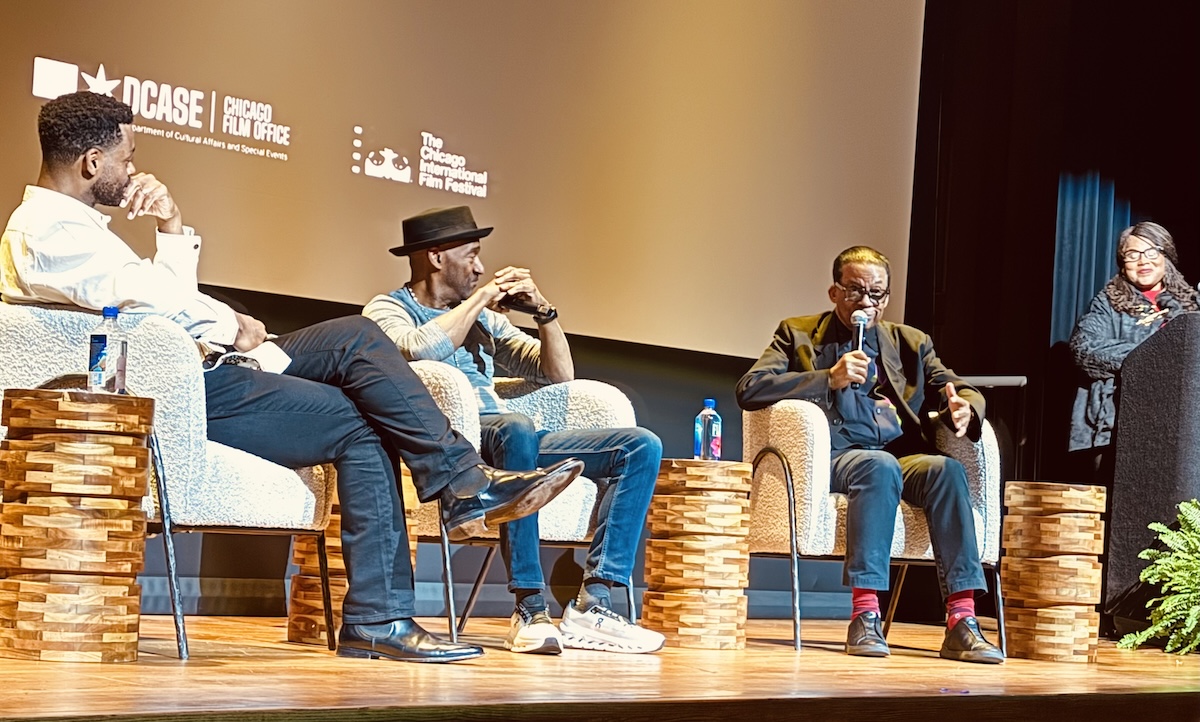
Kris Bowers composed the soundtrack for Green Book (2018), The Color Purple (2023), and King Richard (2021). He credits his parents' insistence on his learning the piano. His father looked at the parents of Tiger Woods and the Williams sisters and wanted that kind of excellence for young Kris. When asked how he came up with music for films, he recalled using piano playing to work out his anger or sadness as a teenager. He uses the same method of emotional connection when he composes for the big screen. Bowers won an Academy Award for producing The Last Repair Shop (2023), a short documentary about a musical instrument repair shop for public school kids.
Marcus Miller is a bassist and composer who wrote one of the most famous bass licks in R&B history. He produced Luther Vandross's first solo album, Never Too Much (1981), and Miller hit the famous note that starts the album's title track. Miller composed soundtracks for Low Down Dirty Shame (1994), Guess Who (2005), and Boomerang (1992). When Evers-Manly asked whether he had chosen film scoring or if it chose him, he answered that he was thrown into the pool by Boomerang director Reginald Hudlin.
Herbie Hancock is a product of Chicago's South Side and wrote the iconic "Watermelon Man," based on the fruit vendors who used to roll through the cobblestone alleys of Englewood, calling out, "Watermelon Man." Hancock's synesthetic approach to music is but one of the things that make him such a great composer. He described composing the soundtrack for Michelangelo Antonioni's Blow Up (1966). European countries have always loved jazz and welcomed Black expatriate artists, writers and musicians. Antonioni loved jazz, and Hancock described sneaking off to Canada and then to New York to find the right musicians to play. Joe Henderson, Jimmy Smith, Freddie Hubbard, Phil Woods, and Joe Newman were the crew for that groundbreaking film.
Bowers and Miller both described listening to their wives' feelings about what they write. Both of them go to the piano in the living room of their homes to play so their wives can hear and express their feelings about the music. Evers-Manly asked if they had music in mind to work out on the piano, or if inspiration came from when they touched the keys. All of them said that it was different every time they sat down to play. Improvisation is at the root of jazz, a building block that enables each musician to create a unique sound from a canonical song. It is the same if they wrote a song or if it was written in the days when Chicago, as Hancock describes it, became the spiritual birthplace of jazz.
One of my favorite movies is Bertrand Tavernier's Round Midnight (1986). It is based on the lives of jazz greats Lester Young and Bud Powell and stars saxophone great Dexter Gordon as Dale Turner. Hancock won an Academy Award for the soundtrack, and he also acted in the film. Round Midnight takes place in Paris and centers around Dale Turner's life as an expatriate musician who struggles with addiction and parental responsibilities. The film was cast with American musicians who had been welcomed and treated well in France, whereas they had been treated horribly in America. Hancock explained that Gordon had lived the life he was portraying. He had substance abuse problems and was an expatriate in Paris and Copenhagen in the 1950s, during a third wave in post-WWII musicians and artists. Gordon was nominated for a Best Actor award for his portrayal of Dale Turner.
There are other challenges to composing a soundtrack. Hancock and Miller described the technical challenges of working on film. The musician has to balance their music with the work of the Foley technicians, who create sound effects, and the sound editors who mix the dialogue. It is always intriguing to hear about what goes on behind the scenes of film and television. I had the pleasure of learning about the artistic and technical sides of composing for film and television from three composers with firsthand knowledge. I was that kid who always read the credits of every movie or television show that I watched. I still stay at the theater until the last credits roll.
Bowers, Miller, and Hancock played the next day at the UNESCO International Jazz Day with a glittering roster of musical talent. Buddy Guy, Dee Alexander, Kurt Elling, and members of the AACM, the American Association of Creative Musicians, and others at the Lyric Opera House for a three-hour extravaganza. You can watch the full concert recording on this video.
Did you enjoy this post? Please consider supporting Third Coast Review’s arts and culture coverage by making a donation. Choose the amount that works best for you, and know how much we appreciate your support!
