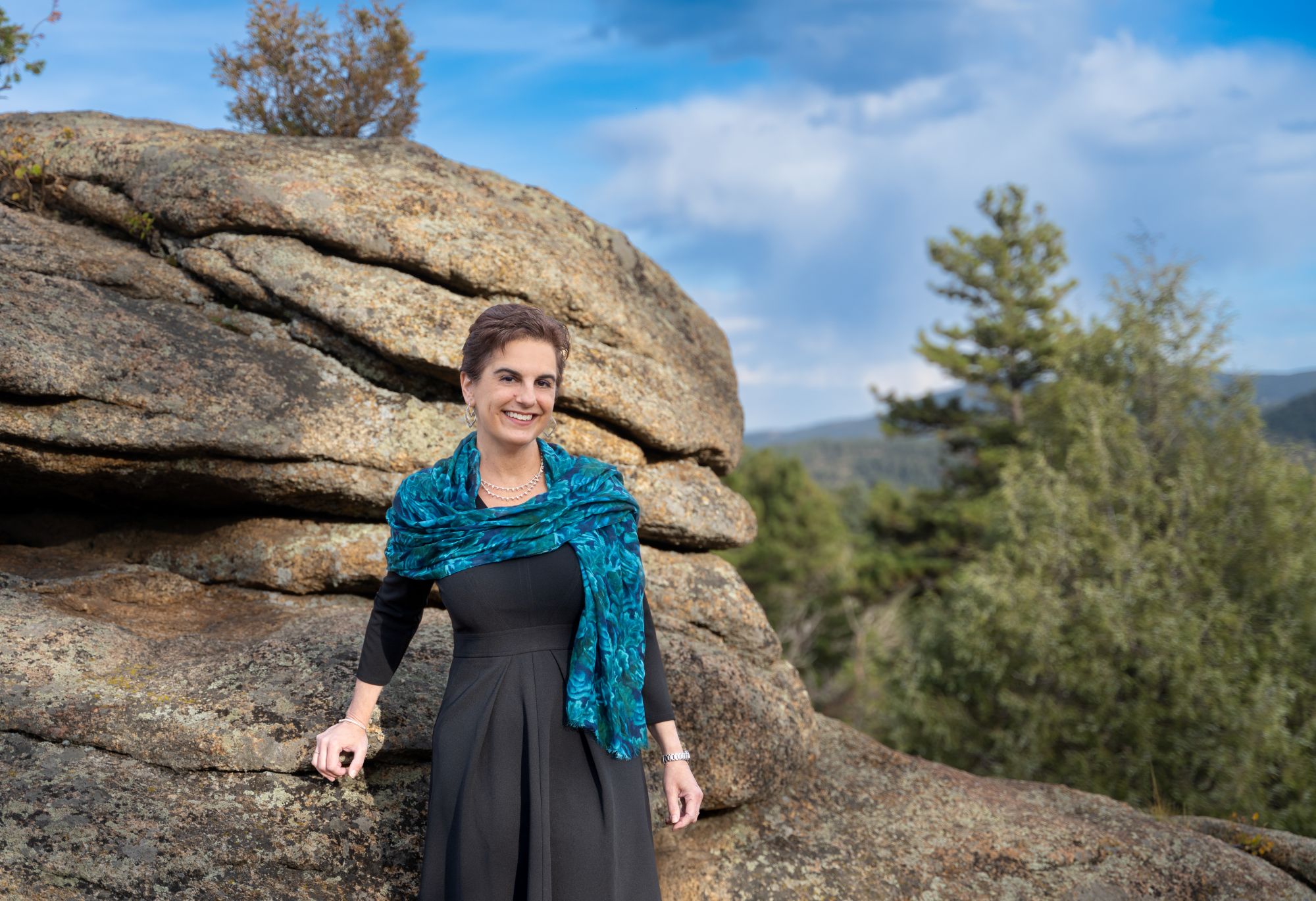
Some people are just born to do something surprising. They start out life in an everyday, normal way. Then, out of nowhere, a lightbulb or a spark goes off and their purpose in life is magically revealed. They become transformed into something completely different and unexpected.
Chicago-based composer Stacy Garrop had one of those magical experiences. She grew up in a couple of different cities in California’s East Bay. Like so many of us, she was having a typical musical high school experience. She played the piano and sang in choirs. She started playing orchestra bells in the marching band, but, due to their weight, she switched to saxophone, an instrument that has played a big role in her compositions. She wasn’t a child prodigy, wowing audiences with Rachmaninoff at the age of 10. She was just living a typical high school existence.
In a lengthy interview, she recalled that, when she was a sophomore in high school, she was taking a class in music theory. Her teacher, Jay Lehmann, said, “Go home and write some music.”
That a high school was offering a class on music theory is astonishing in itself. “Can you believe it?” she laughed. “It was an AP music theory class. This was back in 1986.”
Then she shared about what happened next: “Once I wrote that first piece, I literally couldn't shut off my brain. I just started writing piece after piece. It's like a light bulb turned on in a room I'd never seen before. And then I didn't know where the off switch was.”
“Literally,” she exclaimed, “if he had not said those words and given that assignment, we would not be on this phone call right now.”
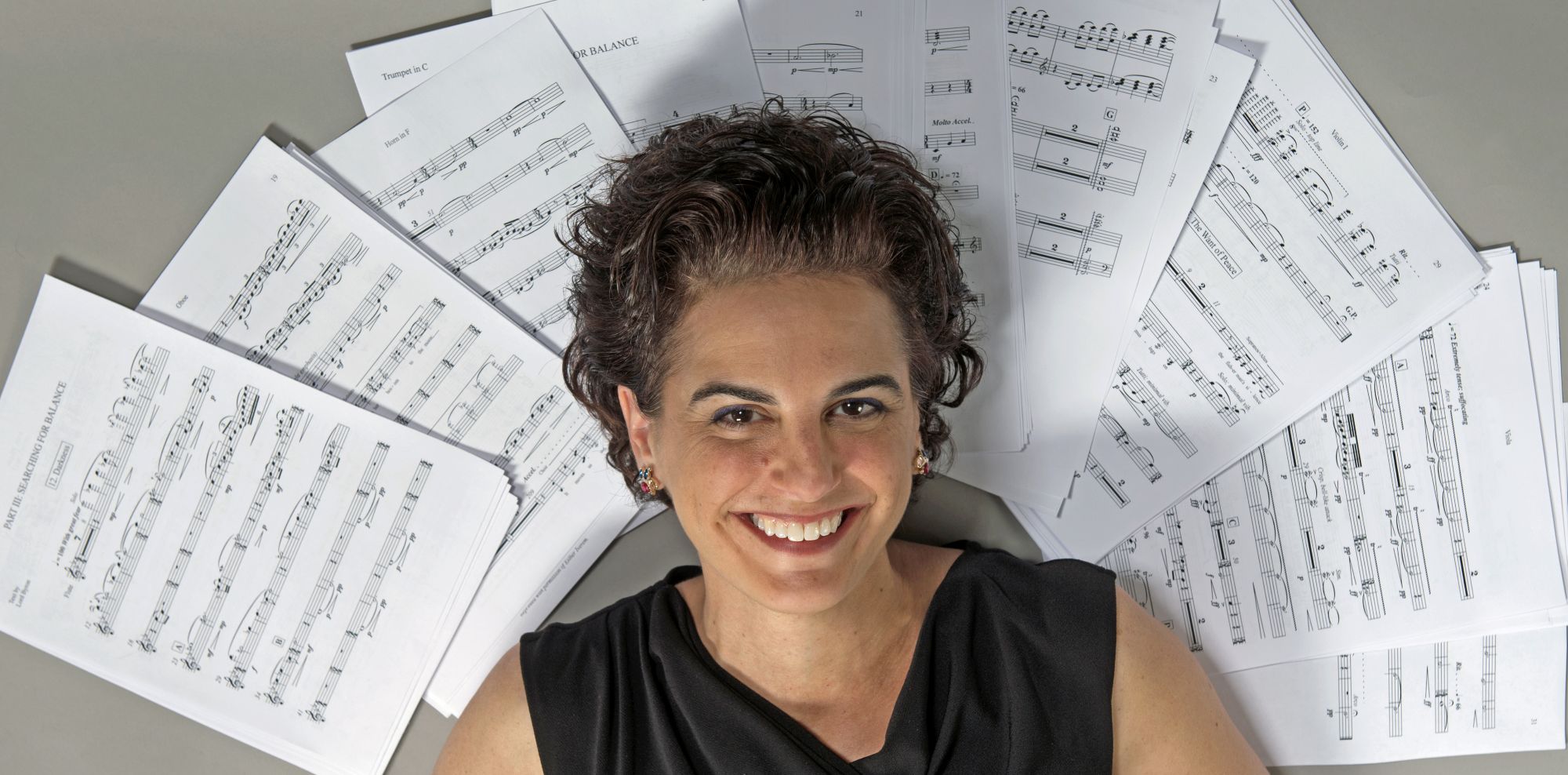
She kept composing, composing, and composing. Then, “a friend of the family connected me to a Bay Area composer, H. David Hogan, who started by handing me stacks of CDs in our lessons and, saying, OK, here's Boulez through Beethoven, everybody he could think of,” she recalled. “Go home and listen to it and then come back for the next lesson. And he would hand me another stack of CDs. So, he helped to acquaint me with a wide range of composers and musical styles as fast as he could.”
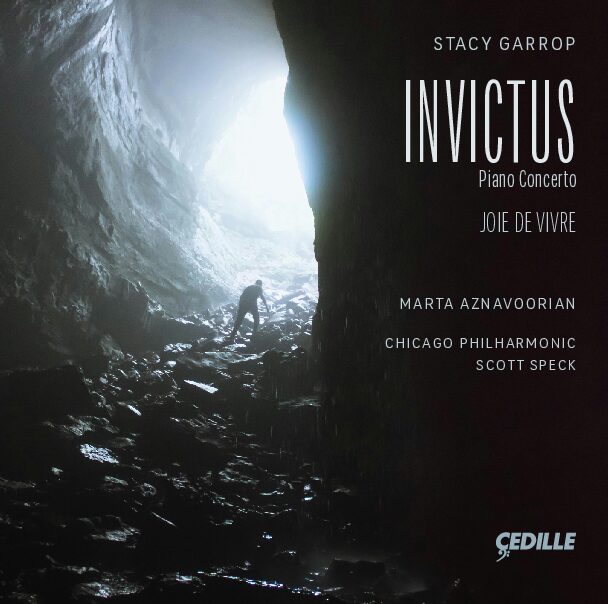
The rest, as they say, has been extraordinary. Not being a performer, she doesn’t write for herself. Instead, it’s all commissions. One recent commission was from Chicago pianist Marta Aznavoorian and the American Composers Forum to write a piano concerto. She decided to base it on the poem Invictus by William Ernest Henley. With Scott Speck conducting Chicago Philharmonic, Aznavoorian premiered this concerto during the Ear Taxi Festival at the Harris Theater last fall. Chicago’s Cedille Records has released a recording made at the time. The digital-only release also includes Aznavoorian performing Joie de vivre, a new work commissioned by Joanne Bernstein.
She described her compositional process as writing a story. “When I start a piece of music, the very first thing I do is meet with the commissioners and ask what is important to you and your community.” She explained how she looks for something they want to discuss that excites and resonates with her. “Once I understand the story that I'm trying to tell, the aspect that I've chosen from what's important to them and what resonates with me, that's the story that I begin to create music for.”
I noted how her music incorporates both tonal and atonal sounds, effortlessly shifting between the two. “Yes,” she replied, “I think in terms of atonal versus tonal, but that's secondary. It's the story that's so important. And once I understand the story I'm trying to tell, I create a formal structure, a graph, to graph out that story. And then I decide, then at that point, I start breaking it down into musical terms.”
She pointed to a piece she wrote for the Pittsburgh Symphony Orchestra, Forging Steel. In writing that piece, “I really dug into the steel making process. The first movement is the explosion of all the different elements being tossed together into a furnace, and having it all keep exploding,” she recalled, waving her arms. “So that's extremely dissonant. But by the time it finishes bubbling and everything, it becomes order. The whole movement goes from disorder to order. And the second movement is when the steel is lengthened and then cut or scrolled up. So that's what I mean.”

In Forging Steel, she was faced with the dilemma of going in the wrong direction at first. “Sometimes I need to reverse course and try again. I actually wrote four minutes of music before I realized it's not working, and luckily it was a piano. I always start with a piano reduction for the big works. So, I just scrapped all that and tried it again.” She continued, philosophically, “I think every composer just has to be honest with themselves. And if something isn't working at any stage, the sooner you admit it, the better. But if you don't, it's good to figure it out at some point.”
This is the same approach Garrop used to work with Marta Aznavoorian for Invictus. After lengthy discussions, they settled on the theme of adversity and resilience. She considered stories from Greek mythology, such as Sisyphus pushing the boulder up the hill, but eventually turned to poetry and found Invictus by William Ernest Henley. “He was a writer who, in 1875, was in a hospital having treatments to avoid the amputation of his right leg, which succeeded. His left leg was previously amputated earlier in his life,” she explained. She shared the poem with Marta Aznavoorian, who agreed with the concept.

Garrop acknowledged that this same poem gave great inspiration to Nelson Mandela while he was imprisoned on Robben Island. She also pointed out Prince Harry named the Invictus Games after the same poem. These international games started in 2014 for wounded service members and veterans to inspire recovery and celebrate resilience.
She then described writing the concerto. She commented that “most people only know the last two lines, which are:
I am the master of my fate,
I am the captain of my soul.
Instead, she considered the whole poem and wrote a movement around each of the four lines of the opening stanza:
Out of the night that covers me,
Black as the pit from pole to pole,
I thank whatever gods may be
For my unconquerable soul.
—Invictus, Willian Ernest Henley
When Aznavoorian premiered it with Scott Speck conducting the Chicago Philharmonic last October, it worked magically.
I asked her if she routinely hears music in her head. She quickly replied, “I don't. Because when I'm writing a piece, the music won't shut off. And that is helpful in some ways because it helps me try to solve some of the issues I'm having with it away from my piano and away from my computer. After that, I think I really try not to have too much music going through my head. Otherwise, it's cluttered in there." She laughed. "It's like an artist wanting to have a blank slate of a clean canvas to start from. I try to keep things minimally quiet.”
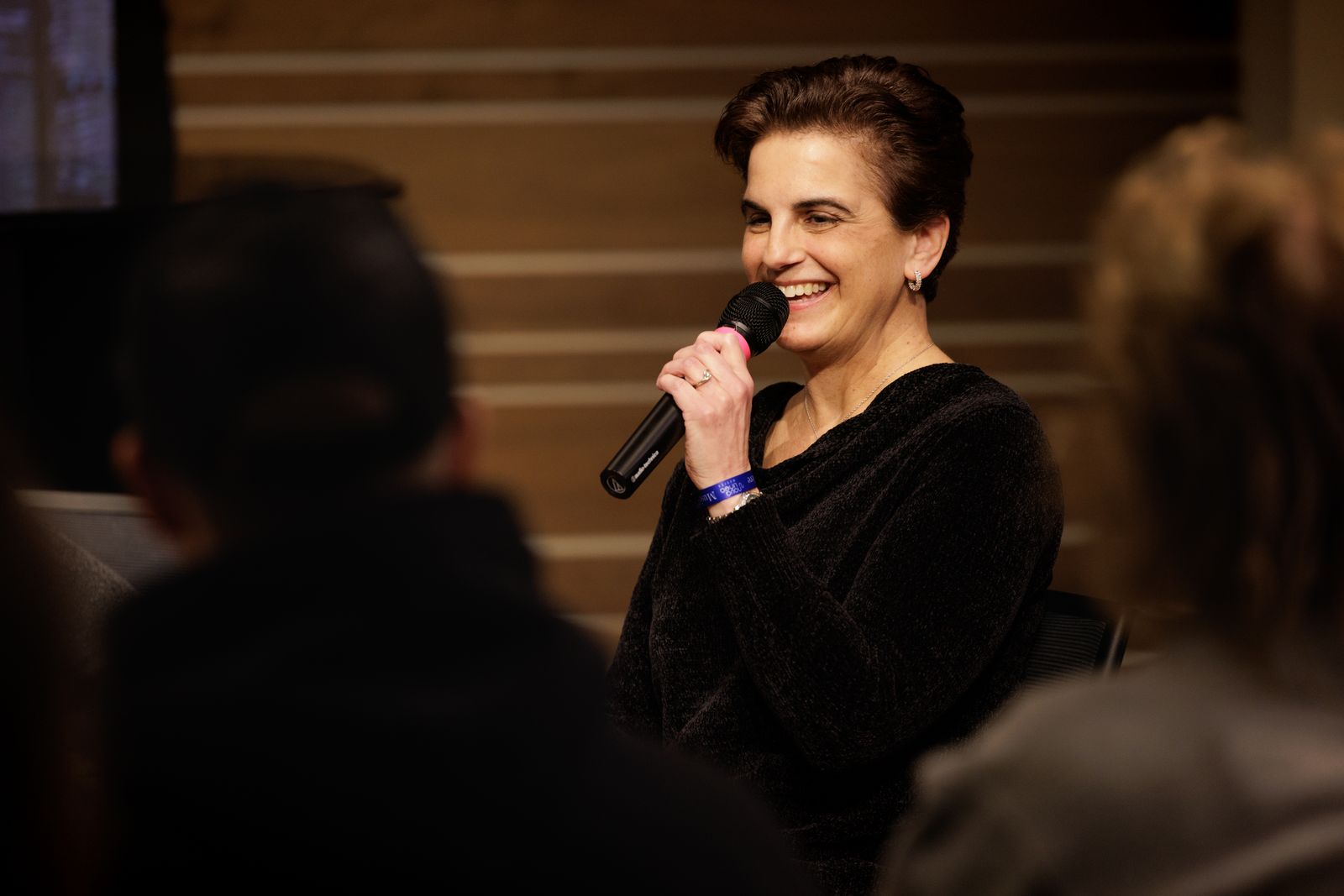
Interestingly, when she listens to music, it’s not usually classical. “One of my approaches to that is I do listen to a lot of pop and rock and folk music. Because they're all short. Form, tension, and relaxation are the most important parameters to me as a composer. If I'm listening to a pop song, I can easily hold on to the form and I can analyze the shape and the chords. It's easy for me to follow. If I were to do that with the symphony, that would take up way too much headspace.” In addition to pop, rock, and folk music, she admits to enjoying K-pop, especially the visual performance of it.
Raised in California, Garrop moved to the Midwest for her education. She earned her bachelor’s degree at the University of Michigan in Ann Arbor in 1992. One of her composition teachers, George Wilson, had an especially big influence on her. He brought her to the Rocky Ridge Music Center, outside of Estes Park, Colorado.
“That just instilled in me this lifelong love of the Rocky Mountain National Park,” she said. “I've gone for now 30 years of my life, basically, over and over again because that's where my heart is buried, and that's where I get inspiration for a lot of works.”
Her time at Michigan briefly overlapped with Michael Dougherty, who, she recalled, “helped me think about orchestra color in a way where nobody at that institution had done so at that point. He said that he didn’t care about the notes, look at the colors. And it was such a breath of fresh air.”
She first moved to Chicago in 1993 and earned her master’s degree at the University of Chicago in 1995. While there, she drew inspiration from Shulamit Ran, who “was a very good role model for me as a female composer.” She noted, “I don't really talk ever about being a female composer, but back in the '80s and '90s there were very, very few women in this field. There still are very few women. As a student trying to work my way up in the system, getting pushback from different people here and there, it was great to see Shulamit succeeding like she was, and to have her kind of take me under her wing to some extent, and see how she went about crafting her career.”
Afterwards, Garrop went to Indiana University in Bloomington for her Ph.D. She moved back to Chicago in 2000 to teach at Roosevelt University’s College of Performing Arts, where she became a tenured professor.
“I love being in this city,” she exclaimed. “It's such a culturally rich and rewarding city here for music and for theater and arts. And I just love the amount of people that support both the arts and music.” She paused and reflected. “I remember back in the '90s when I first was here, we did not have this explosion of groups yet and opportunities for composers. And even in the five years I was away when I came back in 2000, it was evident that this boom was already beginning. And it's been great to see that it never stopped, that we're just still booming.”

She left Roosevelt after 16 years. “I got to a point in my life that there was no way to do the academic job and be a composer at the same time,” she recalled. She has been fortunate that commissions have steadily come her way.
One of my favorite works of hers is an oratorio, Terra Nostra, which is in three parts. It starts with “In the Beginning” from the King James Bible and then incorporates creation myths from India, North America, and Egypt. It describes the rise of humanity and ends with the environmental challenges our world is facing. In doing so, she turns to several big names from the world of poetry, such as Edna St. Vincent Millay, Walt Whitman, Percy Bysshe Shelley, Esther Iverem, Lord Byron, and others.
“The first part is all about the planet being created, everyone's celebrating the animals and the people. The second part is about all the things that humanity has done, which are incredible.” She paused, “But then the piece turns halfway through, and we see the damage is that we are wreaking on our planet. The third part is, the world is getting worse and worse out of balance, how do we possibly get back into balance? The conclusion is that we are from the planet, we're going to return to the planet, we need to be stewards of the planet.”
The idea for the commission for Terra Nostra started with a weekend in residence with Volti, a professional choir in California that runs a weekend workshop for high school students in Occidental, California. While enjoying the redwood forest there, she recalled. “The first day of that three-day trip Robert Geary, who's the conductor of both Volti and the San Francisco Choral Society said, ‘if you were to write an oratorio, what would it be about?’” Over that three-day weekend in the redwood forest, she took in the beauty of the planet. “By day three, right before we left, I sat down with him and already had it outlined.”
It took her a year to come up with the texts, and she searched high and low for the right material. She recalled, “I bought, like, 30 different poetry books, books off of Amazon.com, their used book section.”

The most astonishing poem was another by William Ernest Henley. His “A Song of Speed” from 1903 extolls the virtues of the Mercedes. “That actually came from a book that I had to order from England,” she recalled. “Somebody had produced a book of industrial revolution poetry, and it was the only copy I could find.”
It then took her a year and a half to compose and orchestrate. Part I premiered in November of 2014 and Part II in April of 2015. Parts I, II, and III three all came together in November of 2015.
Performing it is quite a challenge as it requires a full orchestra, vocal quartet, an adult choir, and a children’s choir. “There's so many performers in that piece, and it's like just assembling something,” she paused. “It takes a village. Every time it comes together, I feel like this is my Terra Nostra village, and it just makes me so happy.”
Chicago’s Cedille Records assembled a village around Northwestern University when releasing it in 2024. Stephen Alltop conducted the Northwestern University Symphony Orchestra with soloists soprano Michelle Areyzaga, mezzo-soprano Leah Dexter, tenor Jesse Donner, and baritone David Govertsen. It included the Chicago-based children’s choir, United Voices, and two choirs of Northwestern University students, the Alice Millar Chapel Choir and the Northwestern University Chorale.
Last month, Areyzaga and Dexter were joined in a performance by tenor Samuel Rosner and baritone Peter Wesoloski. The village in question was the City of Elgin, Illinois, where the Elgin Master Chorale and its Director and conductor Andrew Lewis brought in the Elgin Symphony Orchestra, the Elgin Youth Choir, and the Hampshire Middle School Choirs to the Blizzard Theater in the Elgin Community College Arts Center. It was an awesome performance.
Garrop is a big part of Chicago’s enormous contemporary music community and is involved in many music organizations. This includes the Nova Linea Musica Chamber Series, for which she is the Composer in Residence. NLM has been staging performances for two years, mainly at Guarneri Hall in the Loop.
She’s also been involved with Chicago a capella’s Her Voice program, which is a training program for women composers that are emerging. When she talks about “emerging,” she is not referring to composers who are young. She said, “We have people of different ages that are involved with this, which I love.”
“I do a huge amount of writing for saxophones,” she said, “and that has to do with the fact that I went to two major performance schools for saxophone writing—or for saxophonists, which is Michigan and Indiana.” While she wasn’t studying saxophone herself, she was working with saxophonists who came to study with Donald Sinta at Michigan and Eugene Rousseau at Indiana. “Ironically,” she added, “I ended up living near the third major saxophone teacher in the 80s and 90s, who was Frederick Hemke here at Northwestern.”
Once a year, she collaborates with Taimur Sullivan and his Saxophone Ensembles at Northwestern University’s Bienen School of Music, arranging an existing piece for saxophones. On March 2, they premiered a version of Ribbons of Steel, which was originally commissioned by the Grant Park Music Festival last summer in tribute to the Pritzker Pavilion’s Frank Ghery designed structure. This is now available as a saxophone quartet.
When asked which composers inspired her, Garrop focused on form and content. “For form, it's really been people like Brahms and Beethoven. Beethoven breaks the form a lot. That's why I like him. You look at the first symphony and he starts with a dominant chord instead of a tonic. I mean, people were probably like, ‘how dare you’ at that time,” I agreed, and she added, “But that's what makes him so fascinating. He got handed the set of rules and then he's like, okay, I'll choose that one, but I'm going to twist that one.”
Turning to more modern composers, she pointed to Shostakovich. “He's got a very strong handle on form and tension and relaxation, which are the parameters I really care so much about.” She then mentioned George Crumb. “I feel like he's my spirit animal because of the way that he can evoke ambiance and create a sense of timelessness. He's transported the listener into a realm of his own creation and time doesn't matter anymore. That's so special, and I am really into that quality.”
Shifting back to the 19th century, she pointed to Brahms, who, she said, “Stretched form too. But he also was very inventive with instrumentation. So, when you look at these people that are from the past, like before the 20th century, and they were more limited on how people thought of the use of form and instrumentation, it's very interesting to see people like Brahms and Beethoven figure out ways around that.”
In addition to Invictus and Terra Nostra, Cedille Records has released several discs with Garrop’s music. Cedille’s founder and President James Ginsburg and his sister Jane commissioned Garrop to set to music My Dearest Ruth, the final letter their father Martin Ginsburg wrote from his hospital bed to their mother, the late Supreme Court Justice Ruth Bader Ginsburg.
Garrop lifted up the cookbook The Chef Supreme and said, chuckling, “Here's one of my props. Martin Ginsberg was a tax lawyer, but he also was a cook … this book was actually put together by the spouses of the Supreme Court.” In addition to recipes, the book also has anecdotes about the Justices and others. “It's really touching,” she said, “because it gave me an insight really not only on her but on him.” My Dearest Ruth appears on the CD Notorious RBG in Song and is performed by soprano Patrice Michaels and pianist Kuang-Hao Huang.
Several Cedille releases that include Garrop’s work are River of Fire by the Cavatina Duo and Pacifica Quartet, which opens with Romani Songs. In Chicago Clarinet Classics, John Bruce Yeh performs Phoenix Rising for Solo Clarinet. In the Trios from Contemporary Chicago by the Lincoln Trio, a group that includes Marta Aznavoorian on piano, Sanctuary ends the disc. Garrop’s music appears on several other Cedille releases.
So, what does she enjoy for entertainment? “I go to Writers Theatre a lot. I think that straight theater, or even theater with occasional songs thrown in, is just incredible. It helps me think about stories in ways that I don't when I'm looking at music, like orchestral music.”
“I would go to Hadestown or musical theater, but straight theater with some music is really intriguing to me.” She pointed to Hamilton as being really impressive, “But Hadestown for me is really quite, quite beautiful in what it achieved. I think it’s as near-perfect a musical as anyone can think about musicals. Other people will disagree, I'm sure, but for me, Hadestown is just remarkable.”
To get away from Chicago, “the Rocky Mountain National Park is never far from my mind," said Garrop. "It's constant, like, my wedding ring is from Estes Park, Colorado. Usually, some amulet I'm wearing is from Estes Park, and I have pictures around me, and it's always in my thoughts. So, the mountain hiking and exploring of different aspects of life in the mountains is something that really intrigues me.”
Garrop also likes to work with her hands. “I've been doing a lot of Lego lately,” she said, holding up a Lego dinosaur. “That's been really fun to just create something.”
She used to throw pottery. “I made all of my dishes and bowls and cups,” she recalled. “When my husband and I got married, I made the platters that the appetizers were served on.” She sighed. “After a while, you can have too much pottery. So, I had to stop that.”
When asked what she considers to be challenges in contemporary music, Garrop responded, “How can we be relevant to people in today's society, I think is the big question.” I pointed out that that’s also classical music’s big issue, and she nodded in agreement. “Whether this is for pure entertainment, that we're trying to reach out to people, or to help move the needle on some societal issue, or even to challenge the listener intellectually, I think we need to figure out what intrigues them enough to come to the concert hall, and then how do we get them to want to return? What can we do to play a small but important part in their lives?”
Stacy Garrop’s Invictus is now available on Cedille Records.
Support arts and culture journalism today. This work doesn't happen without your support. Contribute today and ensure we can continue to share the latest reviews, essays, and previews of the most anticipated arts and culture events across the city.
