

For their final program of the 2025–26 season, the Rembrandt Chamber Musicians—drawn from the Lyric Opera Orchestra and the Chicago Symphony Orchestra—offered a thoughtful look at how geographic displacement can refine a composer's identity. The concert, performed May 17, was delivered with the poise of musicians who thoroughly understand the mechanics of ensemble playing.
Antonín Dvořák’s “American” String Quartet in F major and Mikhail Glinka’s Grand Sextet in E-flat major do not often appear together, yet both emerged from periods when their composers were living abroad. The link between the two works is less stylistic than biographical. Each reflects a composer working at some distance from home, testing new influences. Glinka wrote his sextet during a four-year stay in Italy, where he absorbed the language of opera. Dvořák composed his quartet in the summer of 1893, in Spillville, Iowa, during a break from his duties in New York. If Dvořák’s piece has come to stand as a touchstone of an emerging American idiom, Glinka’s sextet offers a glimpse of Russian music before nationalism fully took hold.
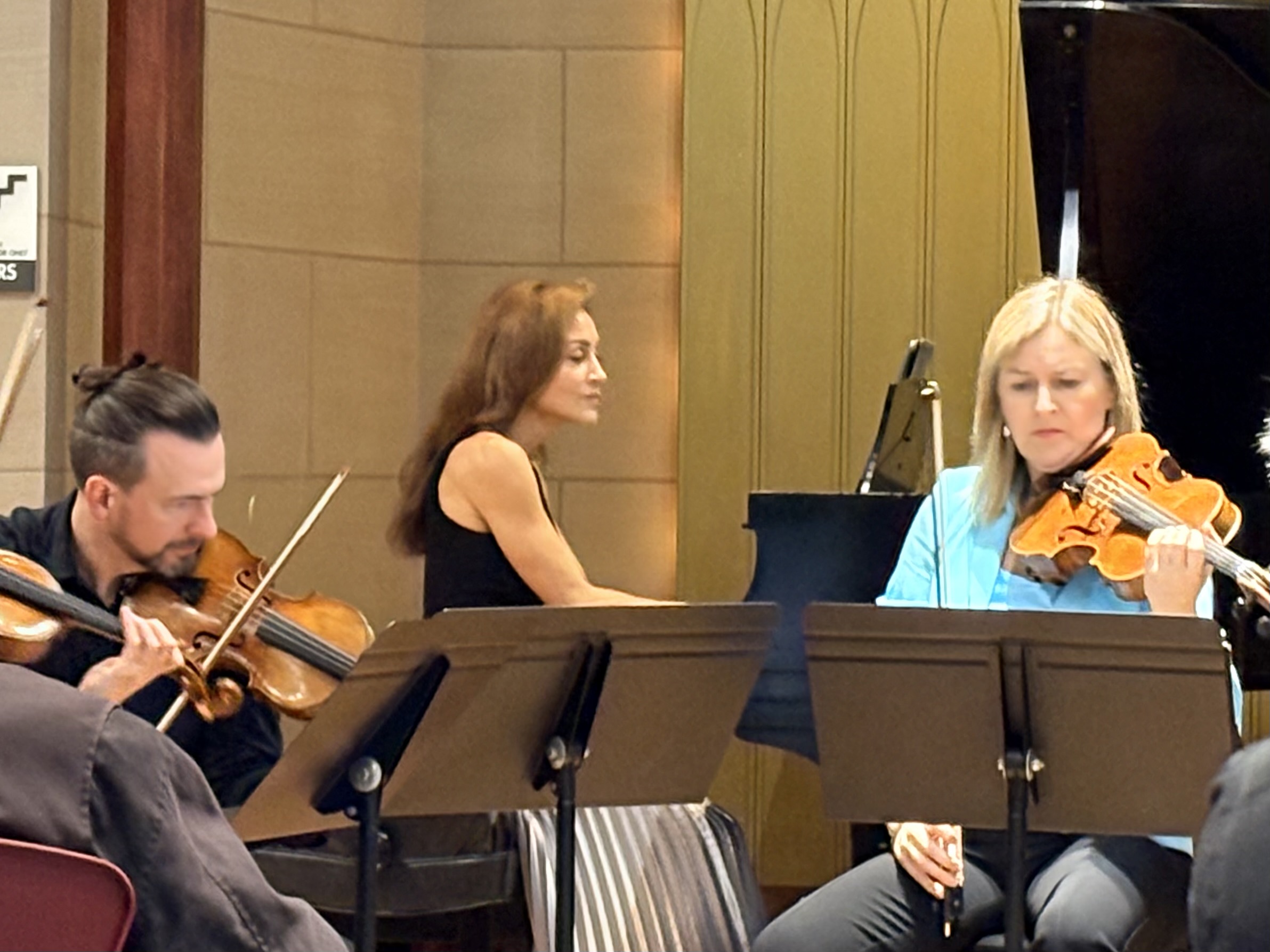
Glinka is often cast as the father of Russian musical nationalism, yet the sextet shows a composer still looking outward. Italian opera is never far from the surface. The slow, second movement unfolds like an aria without words, its lines shaped with an easy lyricism. Elsewhere, the writing favors clarity and charm over weight. The piano part is central, at times brilliant, but rarely domineering. What emerges is a cosmopolitan voice, one that blends Russian inflection with Italianate grace and the sheen of early Romantic virtuosity.
Dvořák’s quartet offers a different perspective on the concept of place. Rather than merely soaking up local flavor during his time in America, he explored the contours of a new national style. Although the “American” Quartet is frequently associated with folk influences, its connection to them is evocative rather than literal, as it contains no direct musical quotes. Through a deliberate economy of gesture, repeated rhythmic motifs, and open intervals, Dvořák crafted a work that feels simultaneously rooted and versatile, as if an American vision were being filtered through a distinctly Czech lens.
The Rembrandt players proved well suited to this repertoire. In the sextet, violinists John MacFarlane and Emily Nebel, violist Carol Cook, and cellist Calum Cook were joined by bassist Andrew Sommer and pianist Marta Aznavoorian. Glinka’s piano writing can easily tip the balance, but Aznavoorian managed it with tact. Her playing was bright and articulate, yet she kept the texture open enough for the strings to register clearly. In the close quarters of the Chicago Temple’s Dixon Chapel, that balance mattered. The ensemble responded with a flexible, responsive approach that brought out the work’s conversational character.
After intermission, the core quartet tackled Dvořák. Their unpretentious approach served the piece well. At times, the performance lacked the ideal rhythmic sharpness needed to fully animate Dvořák’s syncopations. Yet, the musicians approached the music with a generous, alert lyricism that captured the work's open-hearted spirit.
More information about the Rembrandt Chamber Musicians and future performances can be found here.
Support arts and culture journalism today. This work doesn't happen without your support. Contribute today and ensure we can continue to share the latest reviews, essays, and previews of the most anticipated arts and culture events across the city.
