

The Chamber Music Society of Lincoln Center ended their season at the Harris Theater on Wednesday evening with music from “France or France Adjacent,” as violist and Chicago native Matthew Lipman put it in remarks before the concert. The composers in question were Frenchmen Camille Saint-Saëns and Gabriel Fauré and Belgian Henri Vieuxtemps. The program included music from the middle to the late 19th century, and it covered a mix of romantic and modern sounds.
The CMS is a collection of musicians from New York who perform and tour with various ensemble arrangements. For this performance, in addition to Lipman, CMS brought pianist Orion Weiss, violinist Lun Li, and cellist David Requiro. The concert was enjoyable and had all the makings of greatness, but the performance needed something more.
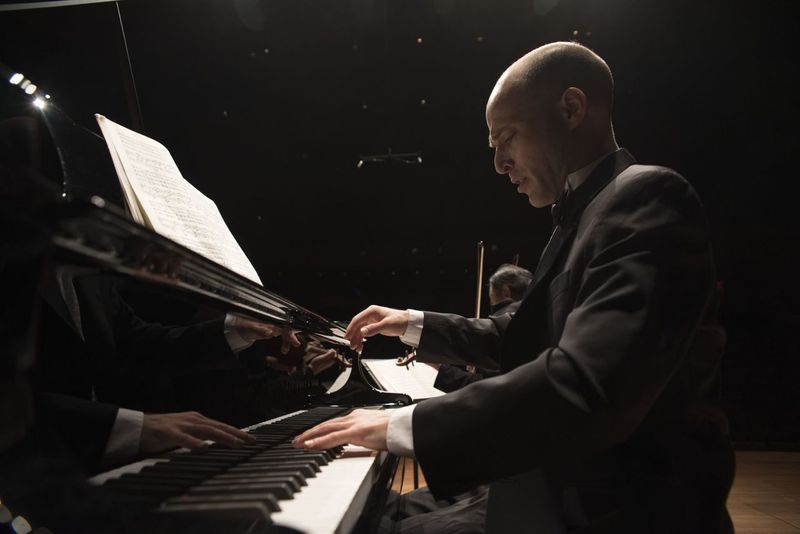
The concert opened with Piano Trio No. 1 if F-major, Op. 18 by Saint-Saëns, a jolly work that reeks with fun and charm. Weiss, Li, and Requiro started things well. Weiss’s hands flowed across the keyboard, while the Requiro sounded the cello and Li quickly followed on violin. The intonation and phrasing were good, as was the ensemble interaction.
While Weiss’s playing was superb throughout, the problem was that the strings were very restrained and sometimes hard to hear. Chamber music like this is most effective when the soprano violin sounds off above the rest and the cello sings below it. Here and in the Fauré, Li and Requiro sounded as if they were muted to the point that, when they actually were muted, it was hard to tell the difference.
These problems went away with Lipman and Weiss performing Vieuxtemps’ Sonata for Viola and Piano in B-flat Major, Op. 36, a work that takes advantage of the fact that a viola is not simply a violin with a lower tuning. Being larger, it produces a sound that is deeper and more soulful than a violin. Right from the beginning, Lipman marvelously reproduced these sounds in the long notes in the Maetoso-Allegro that started the work, and shifted seamlessly into the runs and flourishes that followed.
Weiss continued his excellent playing, which came across as very fluid. Sounds just flowed from his fingers like a fast-moving river, interrupted only with a few rapids. Lipman and Weiss were delightful together.
Lipman said that the second movement, Barcarolla: Andante con moto, brought to mind Venice, and he made the viola sing. I really liked the finale, Finale Scherzando: Allegretto, and their ensemble interaction passing the short melody back and forth was interesting to watch. Performances like this make me sad that the repertoire for the solo viola is so limited.
Following intermission, all four players took the stage for a work I love, Fauré’s Piano Quartet No. 1 in C-minor, Op. 15. I really like the unusual harmonic progressions Fauré employed, which, when the work was finished in 1883, were very forward looking.
The ensemble captured the dark and grim feel of the opening Allegro molto moderato with the melody on the strings and the piano playing backing chords. The balance was better here than in the Saint-Saëns, and the string trio played well together in the quiet secondary theme with Weiss cleanly playing rapid flourishes interspersed with chords in the background.
The second movement Scherzo: Allegro vivo had great interaction between the pizzicato strings and the piano, which played a three-note motive that passed between Weiss’s right and left hands. Each string player had a melodic moment with the piano, which came across well.
After a passionate Adagio slow movement, the finale Allegro molto opens on the piano in a way that reminiscent of the finale of Beethoven’s Moonlight sonata. While enjoyable, the performance was still missing something.
During his introductory remarks, Lipman announced the 2026-27 season. This year, he appeared with CMS three times in Chicago, next year he won’t be performing here with CMS. But the season he described is going to be great. For more information, click here.
Support arts and culture journalism today. This work doesn't happen without your support. Contribute today and ensure we can continue to share the latest reviews, essays, and previews of the most anticipated arts and culture events across the city.
