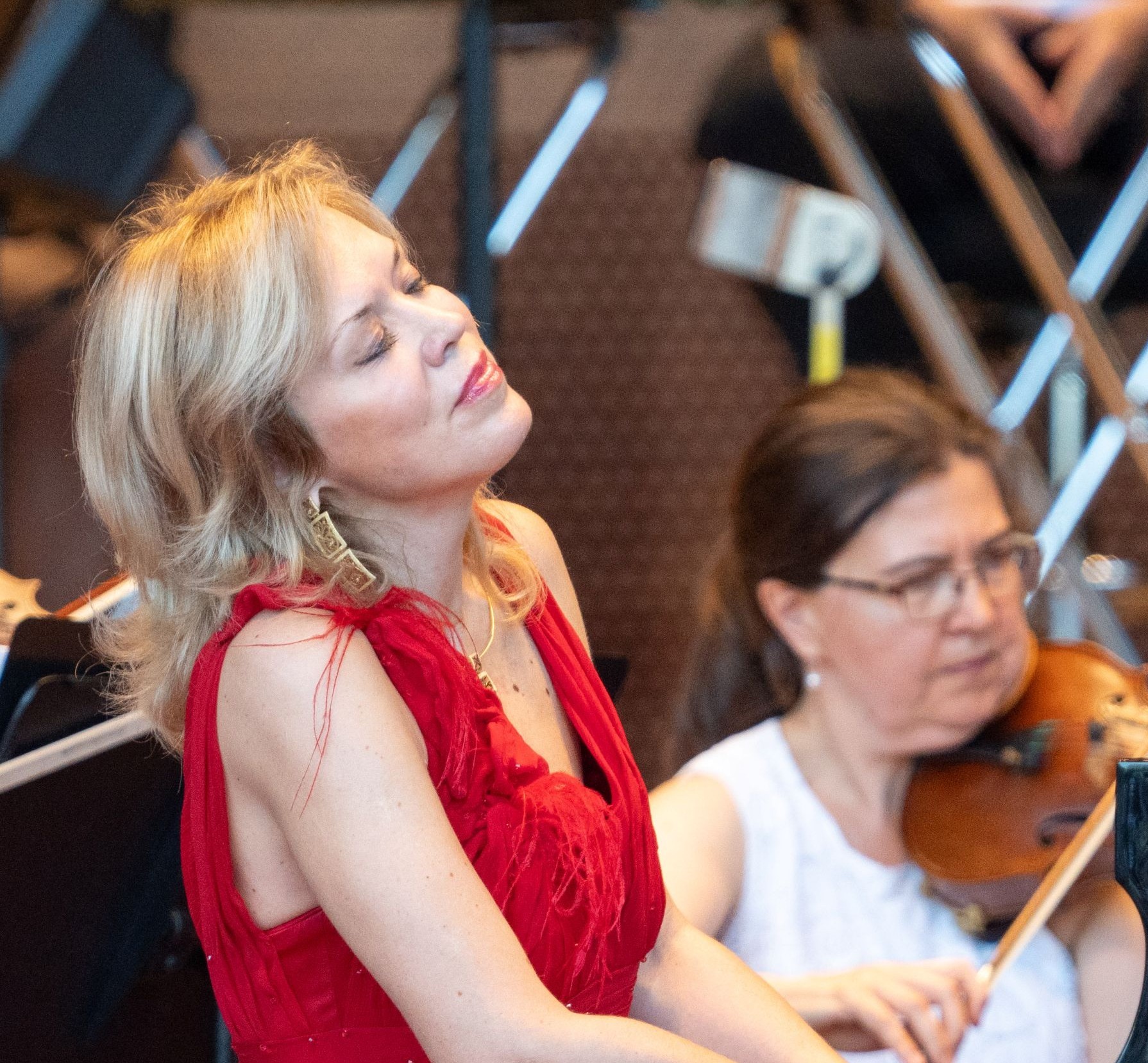

Artistic Director emeritus Carlos Kalmar returned to the Jay Pritzker Pavilion at Millennium Park to conduct a program that included a classical music chestnut and two rarely performed works on Wednesday evening. Opening the concert was what is widely considered to be the most difficult piano concerto ever written, Sergei Rachmaninoff’s Concerto No. 3 in D-minor, which has lovingly earned the sobriquet “Rach 3.” Every performance of the Rach 3 sounds impossible, and Olga Kern provided plenty of power and finesse to pull it off wonderfully.
Following intermission, Kalmar led the orchestra through Igor Stravinsky’s Jeu de cartes (Game of Cards) and Edward Elgar’s In the South (Alassio). In a lengthy explanation, he noted that both of these works, once popular in their day, are rarely heard today. These days performers frequently include something contemporary or recently composed by living composers who may not be well known. For this concert, Kalmar included some little know pieces from the early to mid-20th Century by well-known composers Stravinski and Elgar. It was very nice to hear this music.
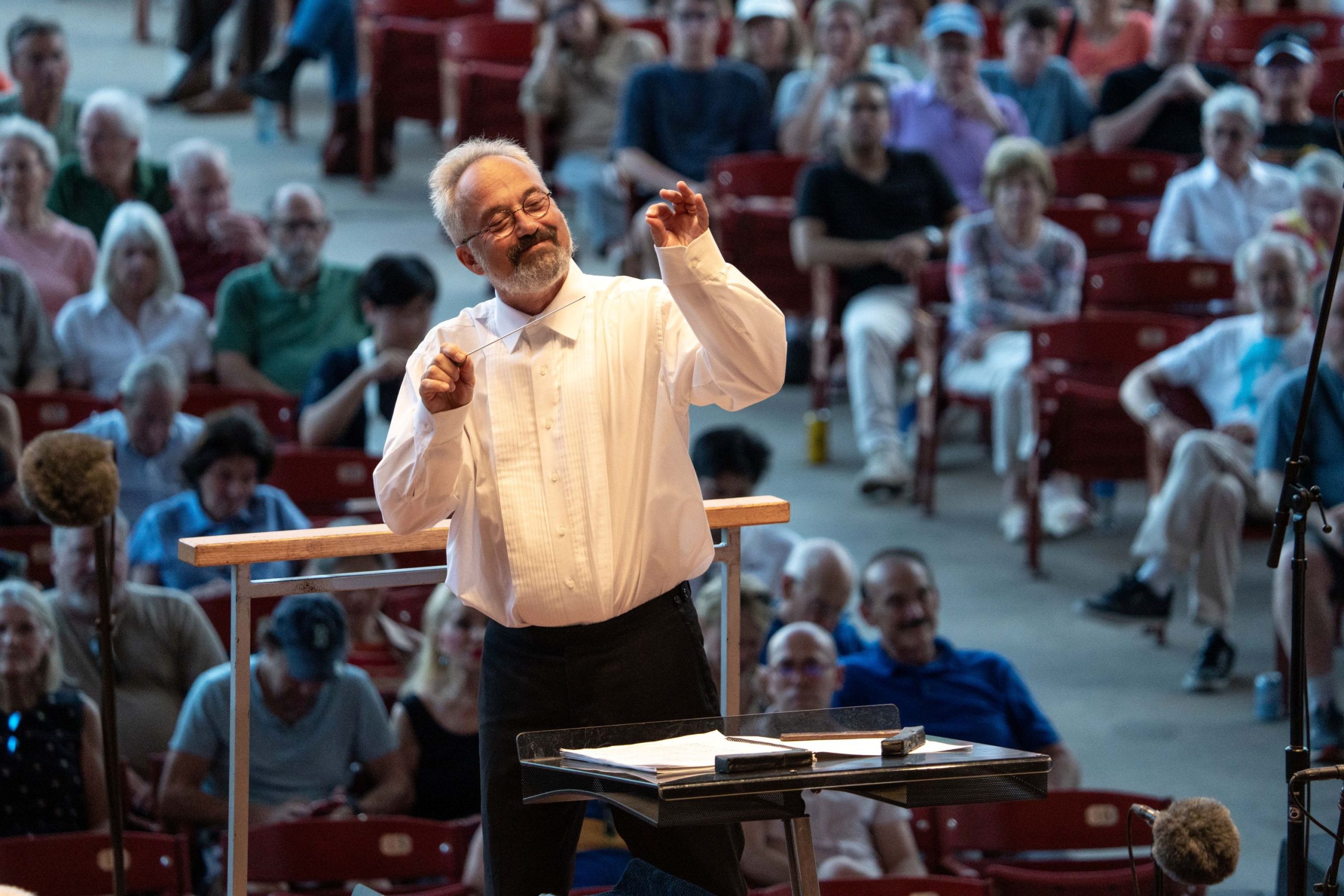
Wednesday was day three of the heat advisory bathing the Midwest. Temperatures were well into the 90s as the concert started, and pretty much stayed there through sundown. Luckily, the ambient noise around Grant Park, which can be very distracting, was fairly light, with only one helicopter and just a few revved-up engines disturbing the peace.
Carlos Kalmar had served as Principal Conductor of the Grant Park Music Festival for 25 years, during much of which he was also the Festival’s Artistic Director. Last year the festival’s leadership transitioned to the very capable hands of Giancarlo Guerrero, but it was nice to hear Kalmar again. Over many years he established great rapport with the orchestra, which responded precisely to his cues on Wednesday. That rapport extended to the audience through his explanations of the works being performed.
First up was Rach 3. It allows pianists to demonstrate smooth technique from the opening melodies in the Allegro ma non troppo, which starts on the piano. Kern played it like velvet, and quickly demonstrated technical prowess with the runs and arpeggios that followed. This performance illustrated the backup roll the orchestra plays at the start of the first movement. Under Kalmar the blend of the bassoon, brass, and violas with the piano was just right. When the full orchestra came forth to sound the secondary theme, it was careful, but bold.
As is typical of Rachmaninoff, this concerto has several rhythmic instances when one hand plays an even number of equal-length notes while the other hand plays an odd number at the same time. Kern delivered these passages well. As for the first solo cadenza, it is unbelievable that anyone has the power to perform one of the greatest in all of music, but she did it with gusto and near perfection, keeping the two distinct themes separate until they merge at the climax.
In response to the well-deserved standing ovation, Kern offered an interesting encore. Instead of more Rachmaninoff, she performed SPARKS by Moritz Moszkowski, arranged by Vladimir Horowitz. It was a very bright and sunny conclusion to the opening half.
The second half started with Igor Stravinsky’s Jeu de cartes (Game of Cards), scored for a ballet of the same name. Kalmar explained how the work sets to music three games of poker separated by a shuffle of the cards, which is represented by a loud ovation. Each hand of poker has three players with a joker getting in the way.
Kalmar noted how Stravinsky incorporated veiled references to the music by Beethoven, Ravel, Johann Strauss, other composers. They were hard to pick out, but Rossini’s Barber of Seville in the third deal was impossible to miss. It was fun and lively, but even with the explanation, it was hard to follow. This would have been much better accompanied with the ballet.
The big surprise was Edward Elgar’s In the South (Alassio), written while he was spending the summer in Alassio, a town on the coast in the Italian Riviera. As Kalmar explained, Elgar described it as a concert overture, but it has the feeling of a tone poem set to the Italian countryside.
Whatever it is, it is thematically beautiful, with pretty tunes in each of its different sections. Kalmar brought out the many gusty moments with the brass and strings. The quieter episodes were charming and bucolic. It is astonishing that this work gets so little play, and I’m very glad to have had the opportunity to hear it.
Carlos Kalmar and Olga Kern repeat this program tonight at Millennium Park, Friday, July 3, 6:30 pm. For more info click here.
Tomorrow night is Grant Park Music Festival’s Independence Day Salute. Chorus Director Christopher Bell, who’s contract was extended this week through 2029, will lead the orchestra through Aaron Copland, George Gershwin, John Philip Sousa, and several other composers. He will be joined by soloists Dario Brignoli on clarinet and Jeremy Black on violin. Saturday, July 4, 7:30 pm.
Support arts and culture journalism today. This his work doesn't happen without your support. Contribute today and ensure we can continue to share the latest reviews, essays, and previews of the most anticipated arts and culture events across the city.
