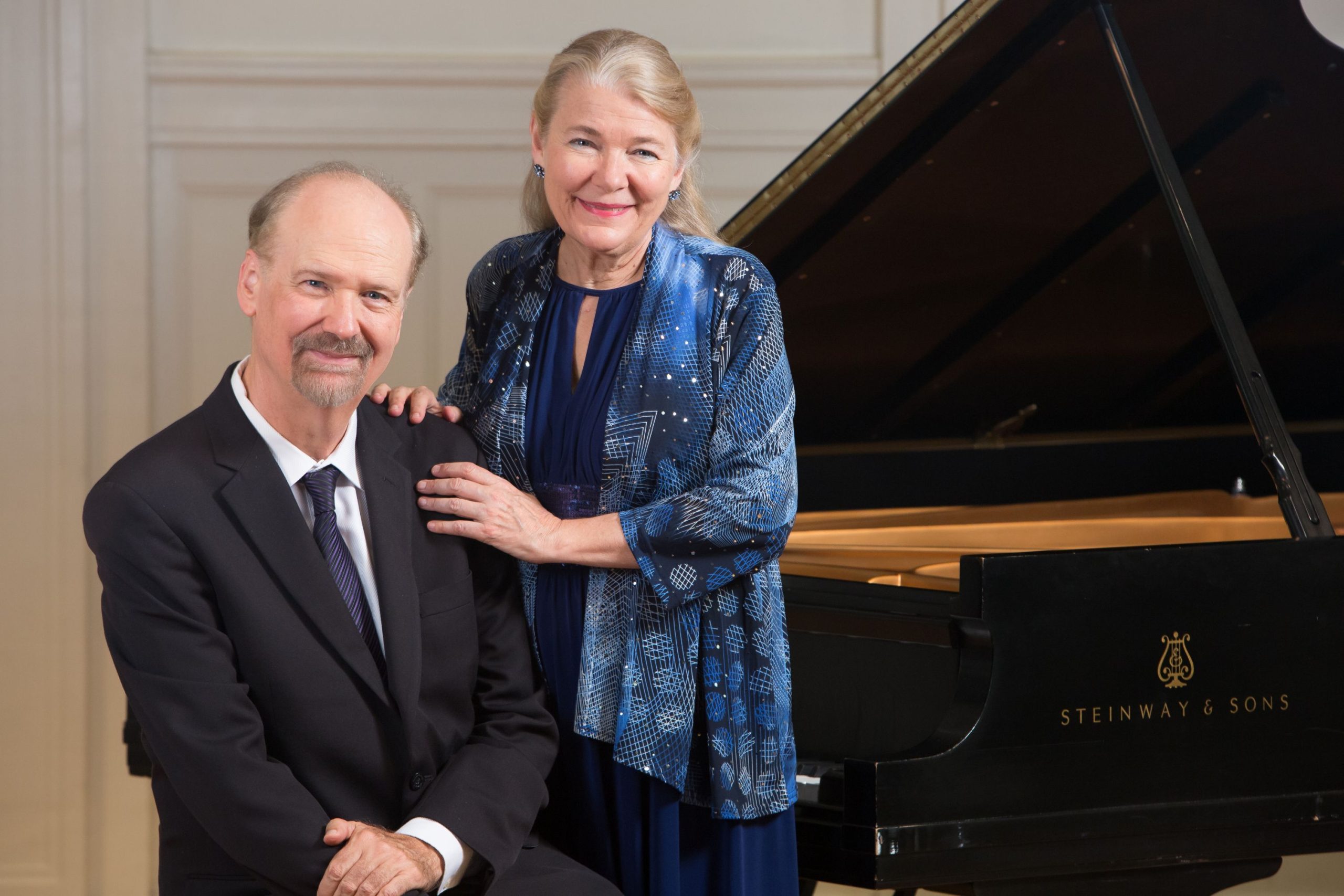

The 38th Chicago Duo Piano Festival kicked off at the Music Institute of Chicago’s Nichols Concert Hall in Evanston on Sunday. MIC faculty members Claire Aebersold and Ralph Neiweem, who started the festival in 1988, gave an enjoyable opening performance of Mozart, Respighi, Brahms, and Liszt. They also performed the world premiere of Through Time by MIC and festival alumnus Maddie Stephenson.
Music Institute of Chicago is a leading music academy in the United States, with many famous teachers and alumnae. The institute’s Nichols Concert Hall, formerly a church, is a bright and inviting space with great acoustics and a large stage that, on Sunday, boasted two mammoth, grand pianos.
Aebersold and Neiweem have specialized on piano music for four hands since they first started studying it in 1981. After they welcomed the start of the festival on Sunday, Neiweem discussed the opening work, Mozart’s Sonata for Piano four hands in F-Major, K.497. He noted that it was Mozart’s longest sonata of any form, and that it was reminiscent of his symphonies and piano concertos.
For the Mozart Aebersold was on the right, treble side of the keyboard, and Neiweem was on the left. Much of this performance had all that one would expect from such well-practiced pros, but their 20 fingers sounded a bit chunky and garbled in the Andante middle movement. They also ignored the repeats, which I think are necessary to maintain the classical balance in Mozart.
They switched sides for Ottorino Respighi’s Fountains of Rome, a symphonic piece in four sections that the composer himself transcribed for piano four hands. The opening, repetitive notes from Aebersold’s fingers sounded like bubbles in water, a feature that was expanded throughout the piece. Aebersold captured well the building intensity in chords in the right hand and low trills in the left. Meanwhile, Neiweem played frilly sounds higher up the keyboard. The transitions between the section were seamless, and their simultaneity was excellent.
The second half opened with Waltzer by Johannes Brahms, Op. 39, a set of 16 miniature waltzes that they played very skillfully. Brahms packed a lot of variety into this work, and Aebersold and Neiweem handled it well, although it seemed a bit rushed at times. Five of the waltzes, including the most famous one, No. 15, have been scored for two pianos, and it would have been nice to have heard it that way. It was a lovely performance overall.
The afternoon’s highlight was the world premiere of Through Time by Institute alumnus Maddie Stephenson, who was also a regular presence at the Chicago Duo Piano Festival over many years. She was present and described how Through Time is a reflection of her own time at MIC and the festival.
Stephenson scored it for two pianos, and Aebersold and Neiweem started with an iridescent feel with quiet, passages with damper pedals depressed the whole time. Eventually a waltz tune comes forth, and it ends very quietly with chords. Unfortunately, they were not in perfect sync at the end, but the performance was still very enjoyable.
The last work on the program continued the splashing water theme of fountains in or near Rome with The Fountains of Villa D’Este by Franz Liszt. This work for solo piano was adapted for two pianos, four hands, by one of Liszt’s students, Emil von Sauer. It’s an interesting choice for that treatment because, while difficult, it is not an especially flashy piece, and using two pianos did not seem to make it any easier. Aebersold and Neiweem showed off rapid fingering and, with two pianos, they were able to play the same notes from the same spot on the keyboard simultaneously. It was great to hear Liszt performed this way.
As an encore, they were tempted to perform the Brahms Waltz No. 15 on two pianos. Instead, they opted for something even more famous by Brahms on one piano: Hungarian Dance No. 5. It was a very nice way to end the show.
Tonight the Chicago Duo Piano Festival continues with Music Institute faculty playing a tribute to America 250 by American composers Copland, Bernstein, Ives, Corigliano, and others. Performers include Inna Chiu and Sung Mo; Louise Chan and Susan Tang; Matthew Hagle and Mio Isoda-Hagle; Claire Aebersold and Ralph Neiweem; and Xiaomin Liang and Jue He. Nichols Concert Hall, Evanston, 7:00 pm. For more information, click here.
On Friday night the The EStrella Piano Duo of Elena Doubovitskaya and Svetlana Belsky will be performing music of Gershwin, Rachmaninoff, Barber, and others. Nichols Concert Hall, Evanston, 7:00 pm.
Support arts and culture journalism today. This his work doesn't happen without your support. Contribute today and ensure we can continue to share the latest reviews, essays, and previews of the most anticipated arts and culture events across the city.
