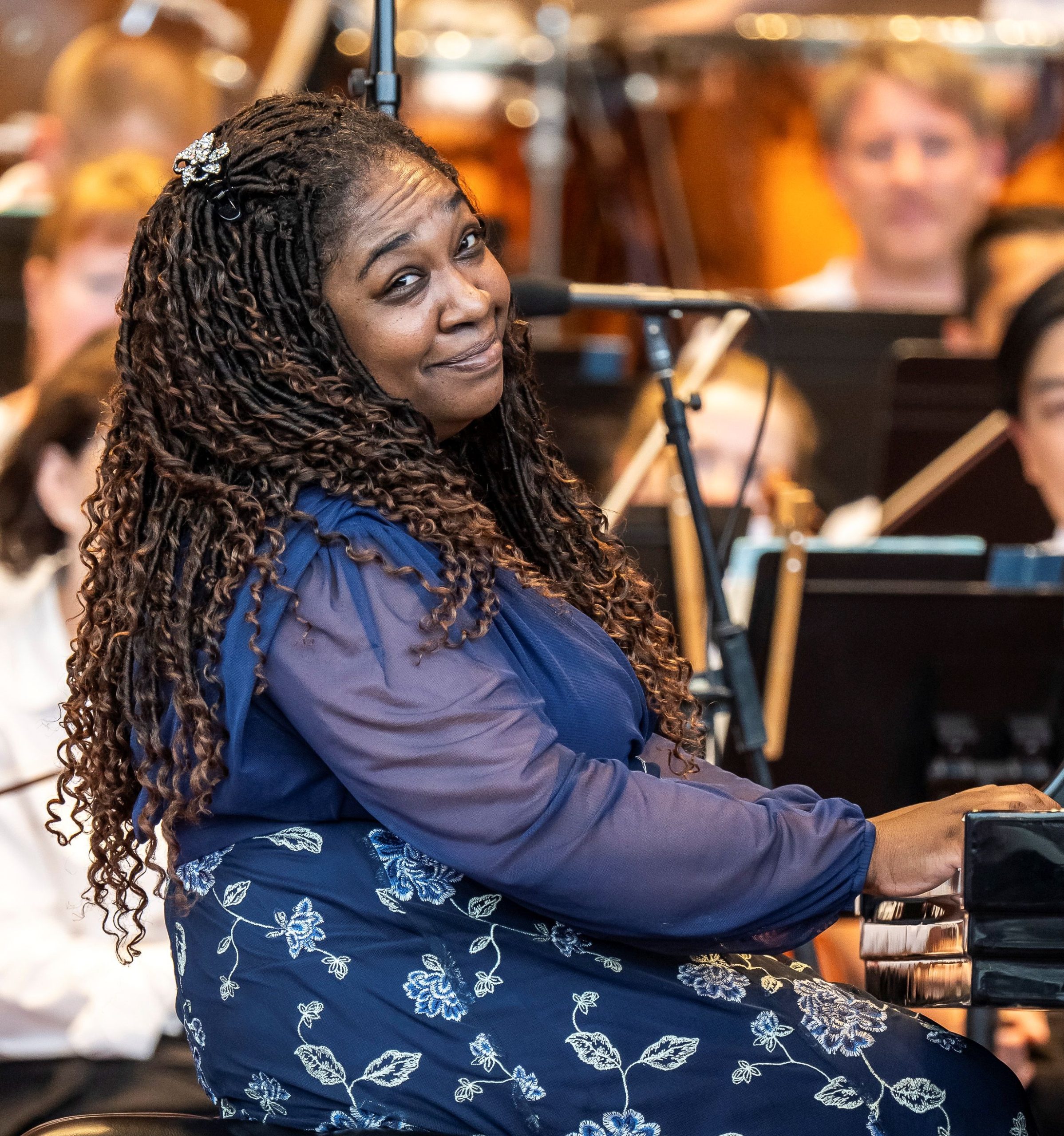

In a concert featuring African Americans performing African American composers, the Grant Park Festival Orchestra gave a wonderful concert at Jay Pritzker Pavilion on Wednesday evening. Jeri Lynne Johnson made her Grant Park conducting debut and was joined by Grant Park Artist in Residence Michelle Cann for Maurice Ravel’s Concerto for Piano and Orchestra in G-Major. Also on the program were William Grant Still’s Festive Overture and Florence Price’s Symphony No. 3 in C-minor.
While quite hot outside, it was a great evening for a concert with remarkably little ambient noises. Jeri Lynn Johnson dressed well for the heat, wearing a loose-fitting, sleeveless outfit with shorts and black slip-on shoes that sported flashy white soles. With a baton in her right hand, she conducted with exuberance, waving her arms high and moving with the music.
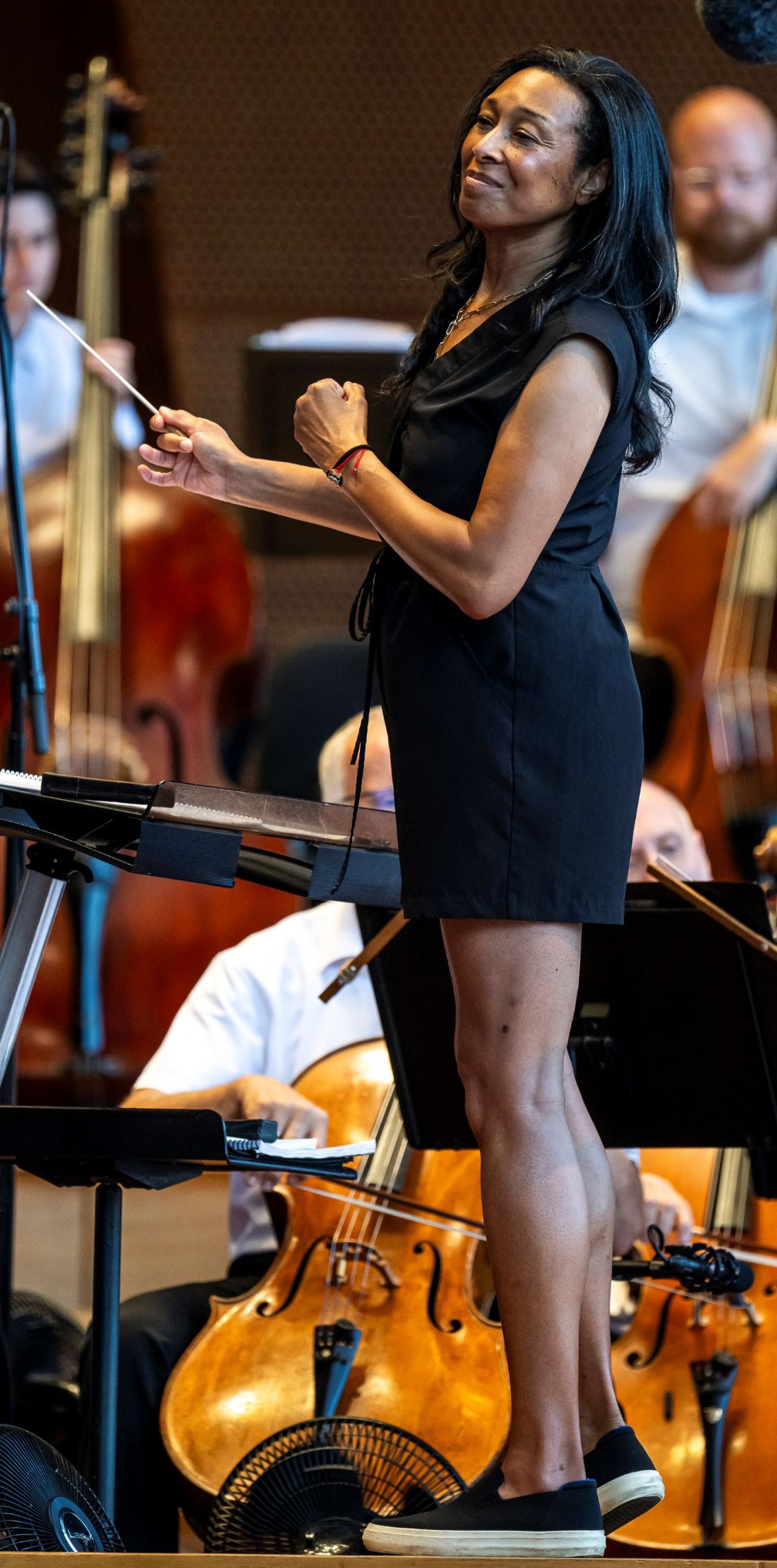
In remarks to the audience, Johnson noted how William Grant Still is regularly referred to as the Dean of African American Composers. He was the first to have a symphony performed by a major orchestra, the first to conduct a major orchestra, and the first to have an opera performed by a top-tier company. He was active in the middle half of the 20th Century.
The piece they performed, Festive Overture, was well named. It is a very celebratory work, starting with a fanfare on the brass. The strings sounded a lively tune, and the muted trumpets soon joined in. The percussionists kept up on marimbas, chimes, and snare drums. A slow middle section interposed to add some reflection to the celebration. The performance was great, with no evident errors, and no interruptions from the surrounding areas.
As the stage was being reset for the piano, Johnson discussed how Ravel, like many Parisians, became acquainted with American Jazz from the black US Servicemen who fought in France in World War I. The program notes described Ravel’s visit to America and interactions with George Gershwin in 1928. These influences inspired him to incorporate Jazzy rhythms and harmonies in his music.
Johnson discussed how this concerto integrates the orchestra and piano, with several members of the orchestra getting lengthy solos. After a loud crack from a slapstick, Michelle Cann showed off light and forceful technique from the opening rills of Allegramente. Soloists Jennifer Lawson, Anne Bach, David Gordon, and guest concertmaster Ilana Setapen played their first of many solos on picolo, English horn, trumpet, and violin, respectively. Especially cool was Lynn Williams playing the harp playing in transition in the opening movement. Musically, the opening movement is a romp, and Cann’s hands just bounced off the keyboard.
Cann beautifully played the beautiful theme that opens the middle movement, Adagio Assai. Johnson brought the orchestra in very quietly, and the blend was perfect. It was heavenly. High energy returned in the jazzy Presto finale, which also coincided with the evening’s only siren. Cann was excellent. Every note in the runs and arpeggios was perfectly even and totally controlled.
For an encore, Cann offered the famous Hungarian Rhapsody No. 2 by Franz Liszt, arranged for solo piano by Hazel Scott. This is very much a “wow” piece, and Cann had a lot of fun playing it. She paused halfway through to stretch her arms behind her back and glance at the audience.
Following removal of the piano, Johnson led the orchestra through Florence Price’s Symphony No. 3 in C-minor. An African American, Price composed and lived in Chicago in the middle of the 20th Century. Given its excellence, it is hard to believe that Price’s music was ignored for so long. In 2009 many of her scores were discovered in a trunk in the attic of her abandoned summer home 70 miles south of Chicago. That spurred on a well-deserved renaissance in her music.
Discussing her Third Symphony in a letter, Price said “it is intended to be Negroid in character and expression.” To that end, she noted that it incorporates tonal and rhythmic practices common to African American culture during and after slavery. She added that the slower second movement uses an African American spiritual theme. To me it has a rural feeling of life on the prairie. The dance-like third movement uses JUBA, syncopated rhythms. It is a pop masterpiece. The finale returns to the drama of the opening key.
This performance continued the greatness on Wednesday. The opening Andante; Allegro starts with a brass chorale that sounded very haunting. The strings started the faster main theme with the winds whirling around. Johnson was at one with the orchestra and this music. The JUBA was really enjoyable, with Johnson dancing at the podium.
Tonight and tomorrow night, Chorus Director Christopher Bell will be conducting the Grant Park Orchestra and Chorus in Gabriel Fauré’s Requiem. The soloists will be Soprano Janai Brugger and Baritone Sankara Harouna. Also on the program are James MacMillan’s Cantos Sagrados and Ralph Vaughan Williams’ Toward the Unknown Region. Pritzker Pavilion, Millennium Park. Friday, July 17, 6:30 pm, Saturday, July 18, 7:30 pm. Given today’s smoky conditions in Chicago, tonight’s performance may change. Any changes will be announced by 2:30 pm today. Click here for more information.
On July 26, Artist in Residence Michelle Cann will be joined by another Artist in Residence, Soprano Karen Slack, to perform Beyond the Years: Unpublished Songs of Florence Price indoors at the Pritzker Pavilion on Sunday, July 26, at 2:00 pm.
Support arts and culture journalism today. This his work doesn't happen without your support. Contribute today and ensure we can continue to share the latest reviews, essays, and previews of the most anticipated arts and culture events across the city.
