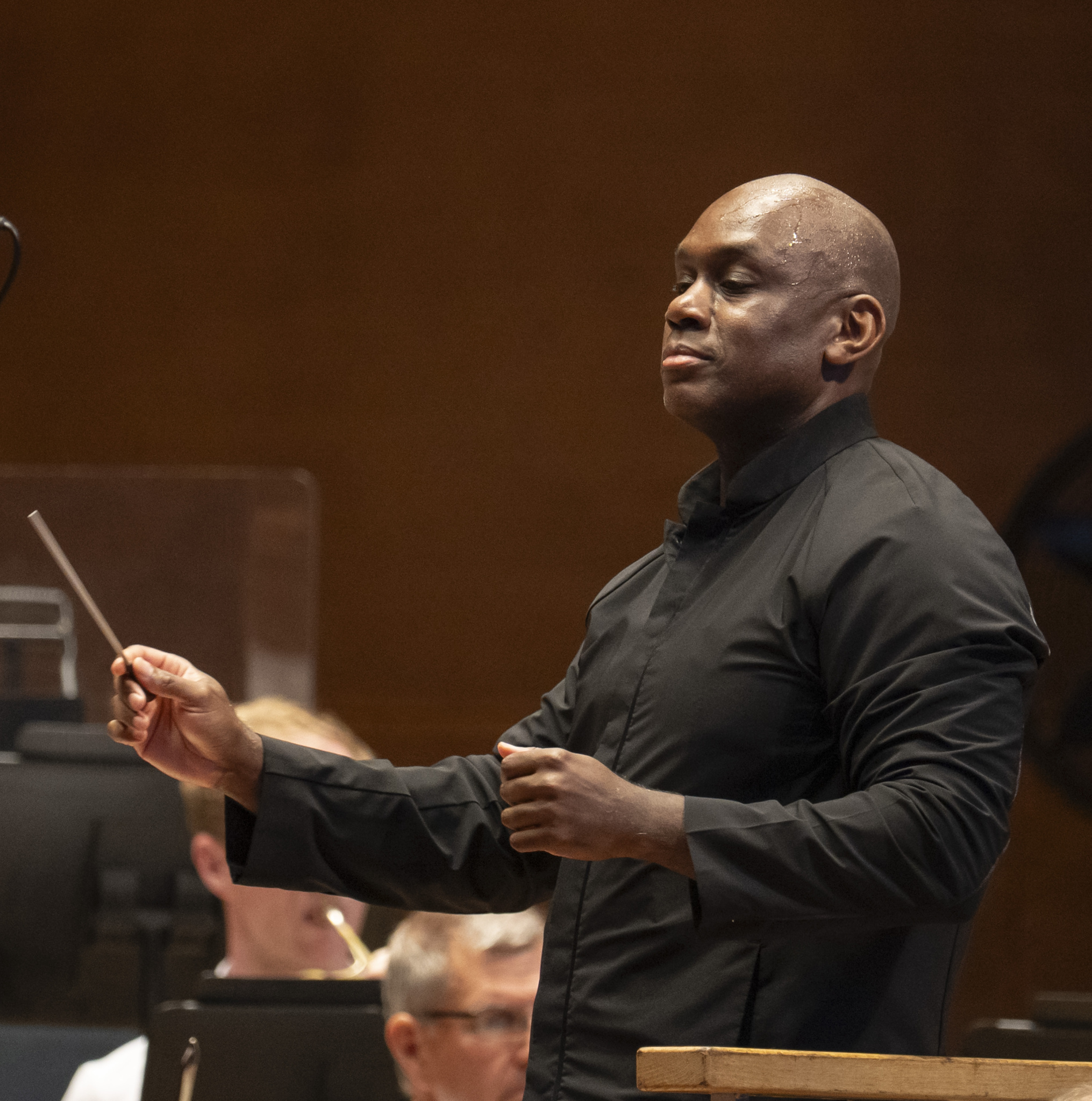

It was a dark and stormy night. ... Well, it seemed like it was going to be, but the Grant Park Orchestra managed to perform its regularly scheduled concert at Jay Pritzker Pavilion on Wednesday evening. Earlier in the day and later in the evening, much of Chicago experienced thunderous downpours, and the radar map did not look encouraging. Somehow, the heavy rain skipped Millennium Park for this brief period. There was no thunder, no lightning, not even any wind … just some light sprinkles.
The program was certainly worth hearing. With conductor Joseph Young at the podium, pianist Steven Osborne performed top-shelf Beethoven: Piano Concerto No. 4 in G-major, Op. 58. After the piano was quickly removed, the concert continued without intermission with Howard Hanson’s Symphony No. 2, Romantic. While there were some problems with the performance, and Grant Park’s ambient noise issues were especially bad during the Hanson, it was enjoyable and miraculous given the dark and stormy skies overhead.
Beethoven’s fourth piano concerto was one of a dozen revolutionary works that marked the beginning of what became known as the romantic style. Unusually, it starts with a piano solo, and Osborne appropriately approached it with soft and gentle tones. In response Joseph Young led the orchestra’s various sections to build the stunningly beautiful melody that Beethoven created out of the same four-note rhythmic motive he made famous in the Fifth Symphony. Instead of being fateful, however, the fourth piano concerto expresses joy, which came through in this performance. Helping things was Young’s spot-on interpretation of the Allegro moderato tempo marking.
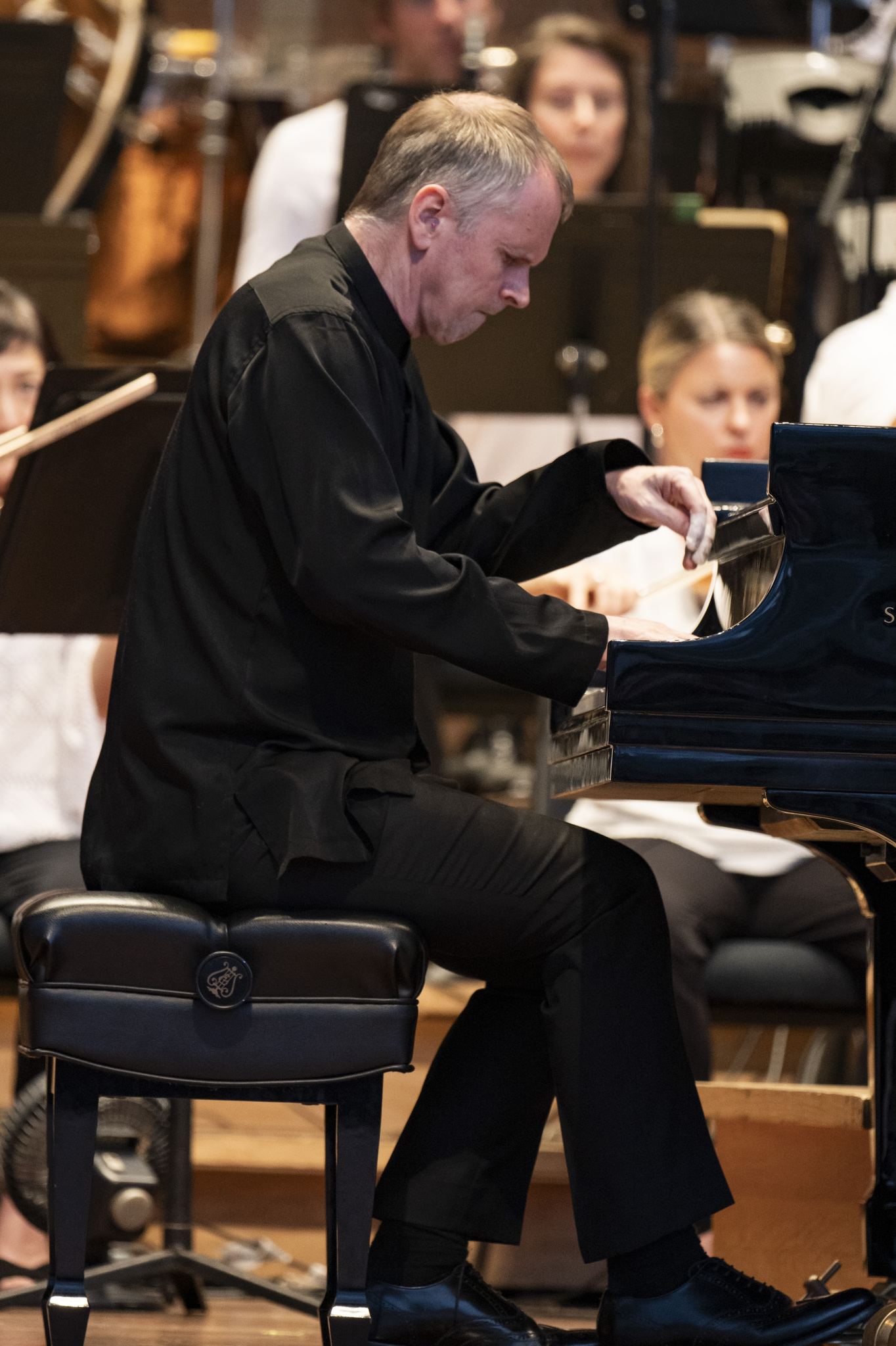
While very difficult, the piano part is not very bombastic. Rather, it requires lots of subtle phrasing and finesse. Osborne provided it with beautiful runs consisting of identically spaced and equally struck notes. His double trills and other techniques were flawless. The super-long cadenza of the opening movement was amazing.
The slower middle movement Andante con moto is an example of how Beethoven explored unusual tonalities and sounds. While other composers have used minor keys for slow movements, this one is moody and sorrowful. Here, the strings start with a loud and somber melody, to which the piano gives a quiet, eerie response. Young and Osborne were very effective going back and forth, which created a misty feel for a dark, nighttime vision—an uncanny reflection of the weather overhead. The transition from the sorrow to the joy in the Rondo: vivace finale was excellent, and Osborne interacted well with the orchestra.
There were times, however, when Osborne’s touch was not precise. At the start of the development in the opening movement, he missed several notes in a series of chords that ascended the keyboard. In the finale, he also missed a few notes that, collectively, were distracting. Overall, while not perfect, it was still an enjoyable performance, and the audience was very appreciative. So much so, that Osborne provided a charming encore, Keith Jarrett’s Improvisations on a Theme.
The Beethoven also benefited from a rather quiet ambiance around Grant Park, which, unfortunately, changed with Howard Hanson’s Symphony No. 2, Romantic. The excellent program notes described the compositional approach used by this American composer. When he was active in the 20th century, many composers were exploring dissonant sounds, which he did not. That said, the title of this symphony is not accompanied with an indicated key. While largely tonal, there are passages that veer toward atonal.
As illustrated by an engrossing YouTube video of him conducting it with the Peabody Symphony Orchestra, Joseph Young has a deep understanding of this symphony. The opening movement starts slowly with an Adagio, but soon ramps up to a faster Allegro moderato. Using a baton in his right hand, Young massaged the orchestra to create a remarkably lush sound, where the music just absorbed itself into the atmosphere.
The second movement features tenderness, a word that is actually in the Italian tempo marking, Andante con tenerezza. Starting with a woodwind chorale, the brass gently took up the theme. By the time it was done, Young had quietly worked everyone up to a loud climax.
Throughout this symphony Hanson calls on the brass and winds extensively, with each of the three movements starting with woodwind and brass chorales. There are plenty of solo opportunities. Especially effective and omnipresent was Patrick Walle on the French horn.
There were also opportunities for the string sections, with, for example, the cellos and basses carrying the tune in the finale. Whoever had the spotlight, Young ensured that the rest of the orchestra had the right balance in the overall mix.
There were some challenges. Toward the end some of the phrasing and synchronization became less precise. Also, the nearby sirens and motorcycles got in the way. On the whole, however, it was a very enjoyable performance.
As Lollapalooza takes over Grant Park this weekend, the Grant Park Music Festival heads indoors to the Harris Theater. Tonight and tomorrow night mezzo-soprano J’Nai Bridges joins conductor Giancarlo Guerrero and the Grant Park Orchestra for a performance of the late Peter Lieberson’s Neruda Songs. Also on the program is Pulse by Brian Nabors and These Worlds In Us by Chicago-based Missy Mazzoli. The program ends with Richard Strauss’ Death and Transfiguration. Friday, August 1, 6:30pm, and Saturday, August 2, 7:30pm.
On Wednesday, violin virtuoso Joshua Bell joins Guerrero and the Grant Park Orchestra for Édouard Lalo’s Symphonie Espagnole. The program also includes Tchaikovsky’s Romeo and Juliet Overture-Fantasy, and Franz von Suppe’s Poet and Peasant Overture. Wednesday, August 6, 6:30pm. For more information on these performances click here.
Support arts and culture journalism today. This work doesn't happen without your support. Contribute today and ensure we can continue to share the latest reviews, essays, and previews of the most anticipated arts and culture events across the city.
