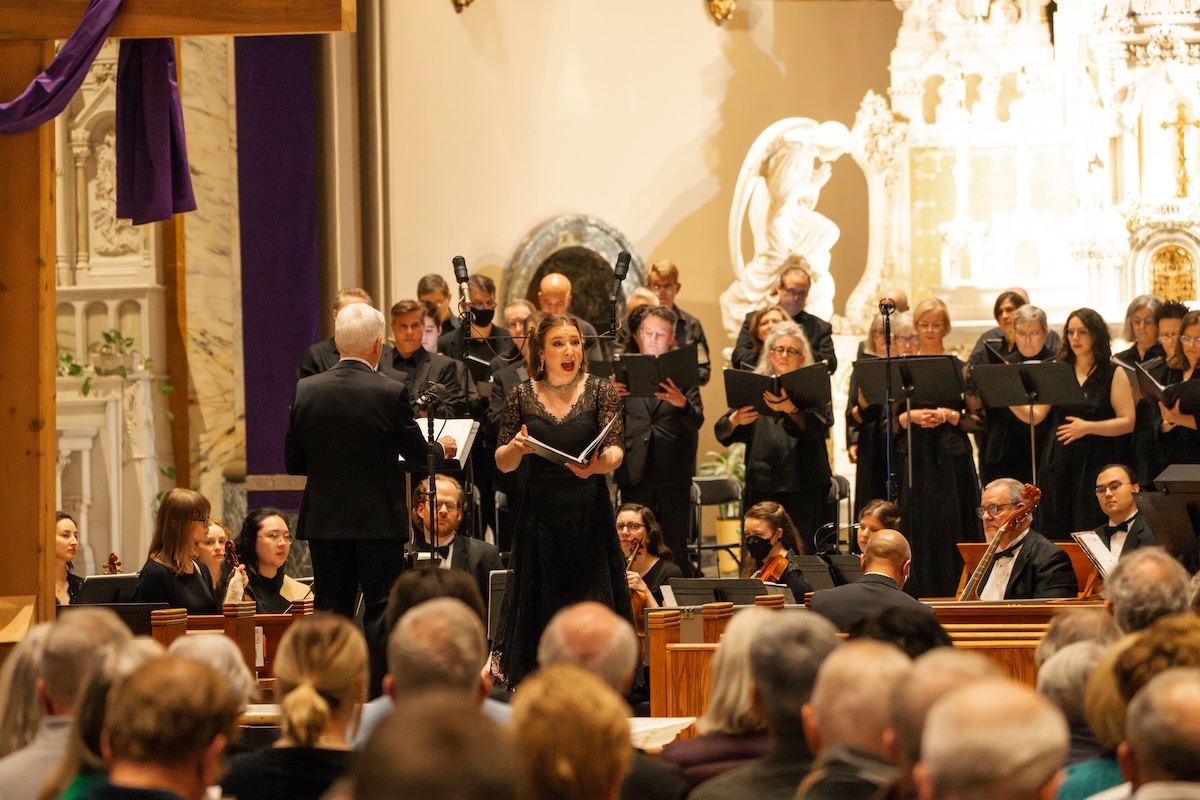

Bach in the City performed the Passion of St. Mark at St. Vincent DePaul Church in Lincoln Park on Friday. The chorus and an orchestra of authentic Baroque-period instruments performed under the baton of music director Richard Webster. The concert was beautiful and moving, perfect for the first day of spring and close to the beginning of Holy Week celebrated by Christians worldwide.
Johann Sebastian Bach is one of the most revered composers of all time. Jesu, Joy of Man's Desiring and Toccata and Fugue in D Minor immediately come to mind at the mention of his name. Most are also familiar with the Passion of St. Matthew, played at Palm Sunday services, and the Passion of St. John on Good Friday in Catholic and many Protestant churches.
The Passion of St. Mark was thought to be a lost composition, with only the libretto and some musical passages surviving after Bach's death in 1750. At least two other versions of a reconstructed composition have been performed in 1744 and then in 1964. Musicologist Malcolm Bruno did a meticulous reconstruction in 2019 based on Bach's libretto and Trauer-Ode (Cantata 198). I learned something new from the concert program, written by Richard Webster: that Bach parodied his own music. That is, he would take pieces from other compositions he had written and integrate them into new works. I had never thought of parody as a musical term, but I like this definition better than comic mockery. Bruno compiled a powerful work for chorus, soloists, and Baroque instruments. This was meant to be heard in a church just as it was almost three centuries ago.
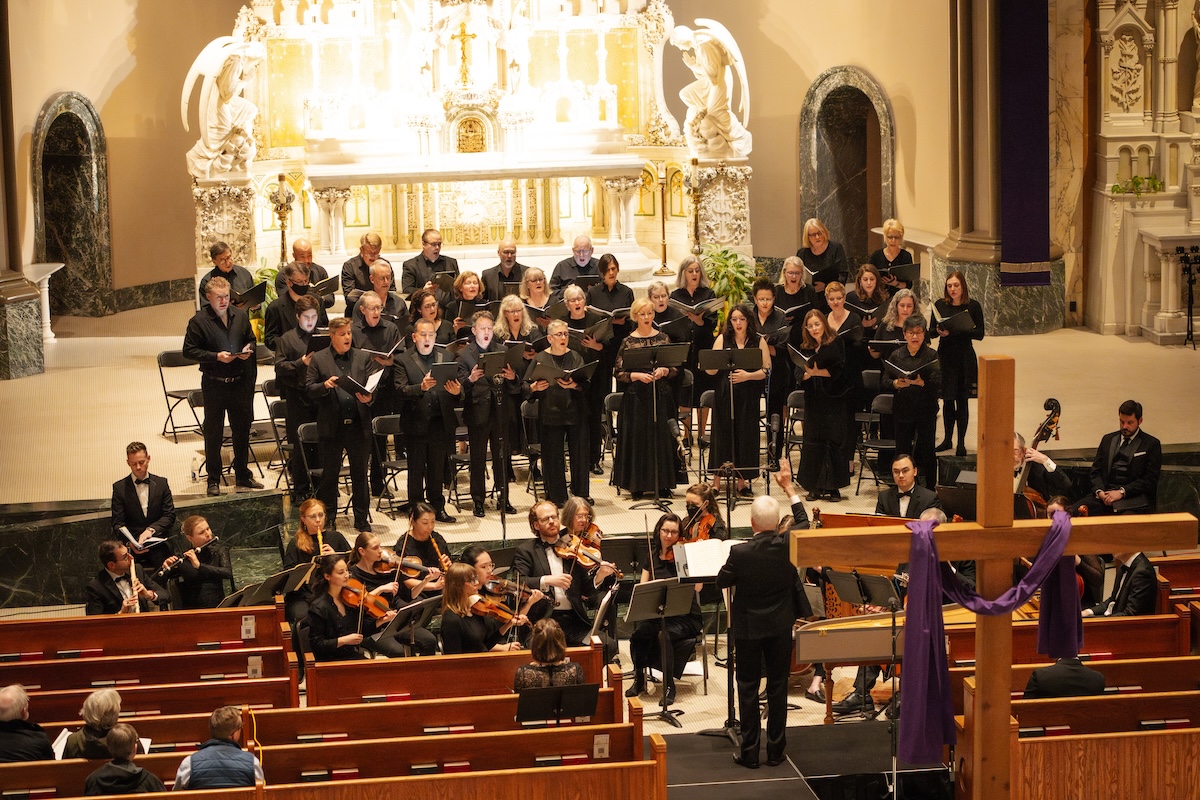
The Bach in the City chorus sounded heavenly with well-trained choral voices. The dialogue was in German and English, and the transition between the two was seamless. The audience received a program with translations to follow along. I mostly listened and let the sound flow through me. As a Chicago Catholic, I felt that I was back at my home parish during Holy Week. The voices soared to the domed rafters and gilded paintings over a stunning Carrara marble altar and a gilded tabernacle. This was a spiritual experience that was sung and played with passion.
Four soloists sang the parts of Evangelist St. Mark, Jesus, and other personae involved in the Crucifixion in the Gospel of St. Mark. Soprano Hannah De Priest performed with exceptional tone and dramatic inflection. Not only was she singing, but she was also telling a story from the viewpoint of an apostle of St Peter who witnessed and was involved in the events of the Crucifixion, as described in the Bible. De Priest's enunciation, phrasing, and tone were impeccable. It was a masterful interpretation of Baroque music, which is intricate with melisma held across several measures. DePriest shared the Evangelist role with Oliver Camacho.
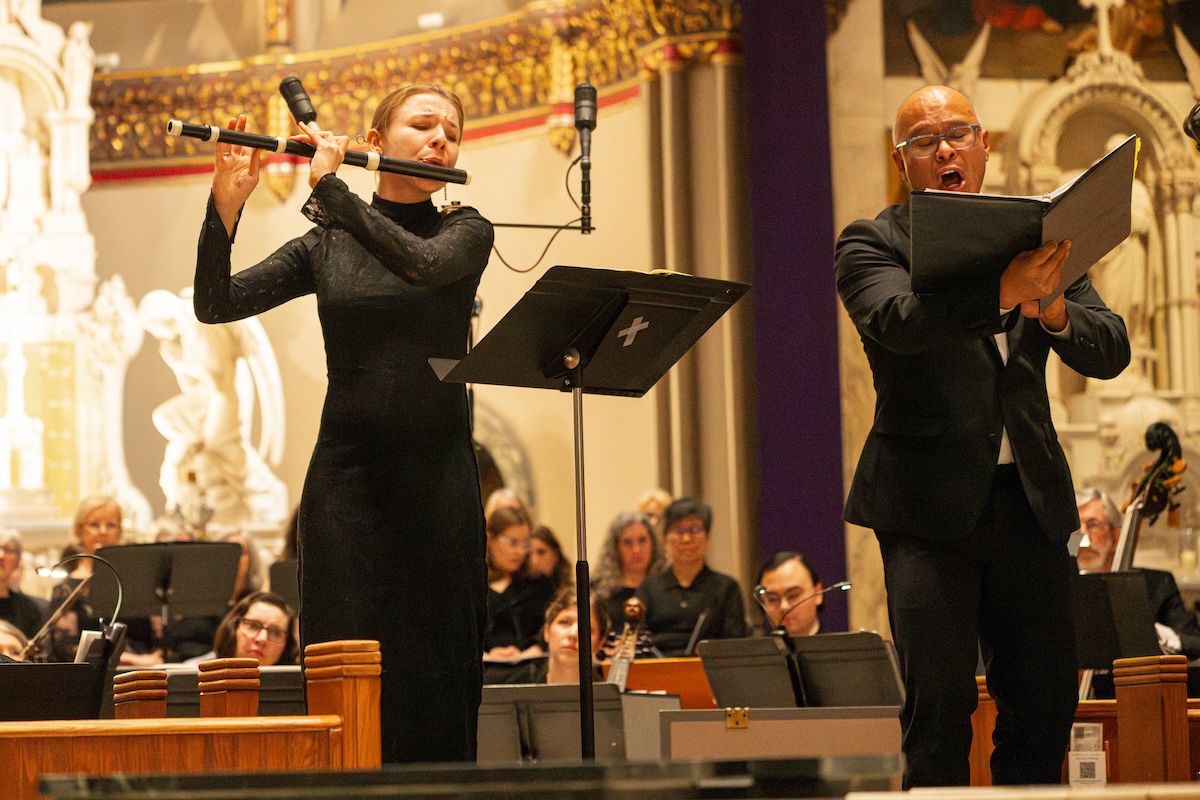
Tenor Oliver Camacho's performance was thrilling. He has given lectures at the Lyric and is the music director at classical music station WFMT. He has an ebullient personality that comes across in his singing. He was a soloist in Bella Voce and the Madison Bach Musicians for a program of holiday music. His role was expanded in the Passion of St. Mark, and what a performance he gave. His tenor is powerful and emotive, with a crisp, sparkling tone. I was stunned by his breath control on the melodic and long holds. This is Bach, and if you have heard the Toccata and Fugue in D Minor, you will recall the intricacy and range that are inherent in his compositions. I had to catch my breath with one particular phrase that ended with a climb up the scale and a high note held for at least three bars.
Countertenor Ryan Belongie was a brilliant addition to the soloists. I have heard more countertenor voices recently in performances like Orff's O Fortuna—Carmina Burana at the Lyric Opera of Chicago. Belongie possesses a strong and unwavering pure sound. He sang the role of St. Peter, who denied knowing Jesus three times. It was a small but crucial part of the story of the days leading up to the Crucifixion. Belongie also sang a gorgeous aria after the intermission when Jesus is being mocked and spat upon. His countertenor is sweet without being treacly, and his projection was perfect as he sang from different parts of the sanctuary and once on the riser behind the conductor. I could hear every succinct and crisp note.
Baritone David McFerrin sang most of the role of Jesus. He has a charismatic stage presence and a great voice. He did not have the intricate notes and long phrasing to sing, but gave a compelling performance. In the opening part, a couple of his lower notes got lost. I could not hear them even though I could see him singing. His projection improved after the intermission, and I could hear more color in his voice. His projection was better, and he put more emotion into the roles.
There were some notable instrumental solos in the Passion of St. Mark. Sarah Schilling played an oboe d'amore, which is most familiar in Baroque music. It is in a lower register and is made completely of wood, without the silver keys of a modern oboe. Schilling's solo made me feel as if we were back in the time of wandering minstrels and troubadours. She excelled at playing Bach's intricate patterns and extended phrases.
Taya König-Tarasevich had a beautiful traverso (Baroque flute) solo. I loved watching her as she allowed her body to follow the notes that flowed from her traverso. Like the oboe d'amore, the traverso has a lower tone and is made of wood. The sound is richer and fuller without the sharpness of the modern flute. Jason J. Moy, associate music director of Bach in the City, played the harpsichord. Jacob Reed played Bach's primary instrument, the organ. Moy and Reed provided what I call the backbone of the music. When I think of Bach, my mind goes to the organ, and the harpsichord is essential to Baroque music. The very bones of the Passion of St Mark reside in prodigious playing of both instruments. There were also two viola da gamba played by Katherine Shuldiner and Russell Wagner. The viola da gamba is played like a cello, but has a different tone. It is not as low in tone, adding a lighter touch to the music.
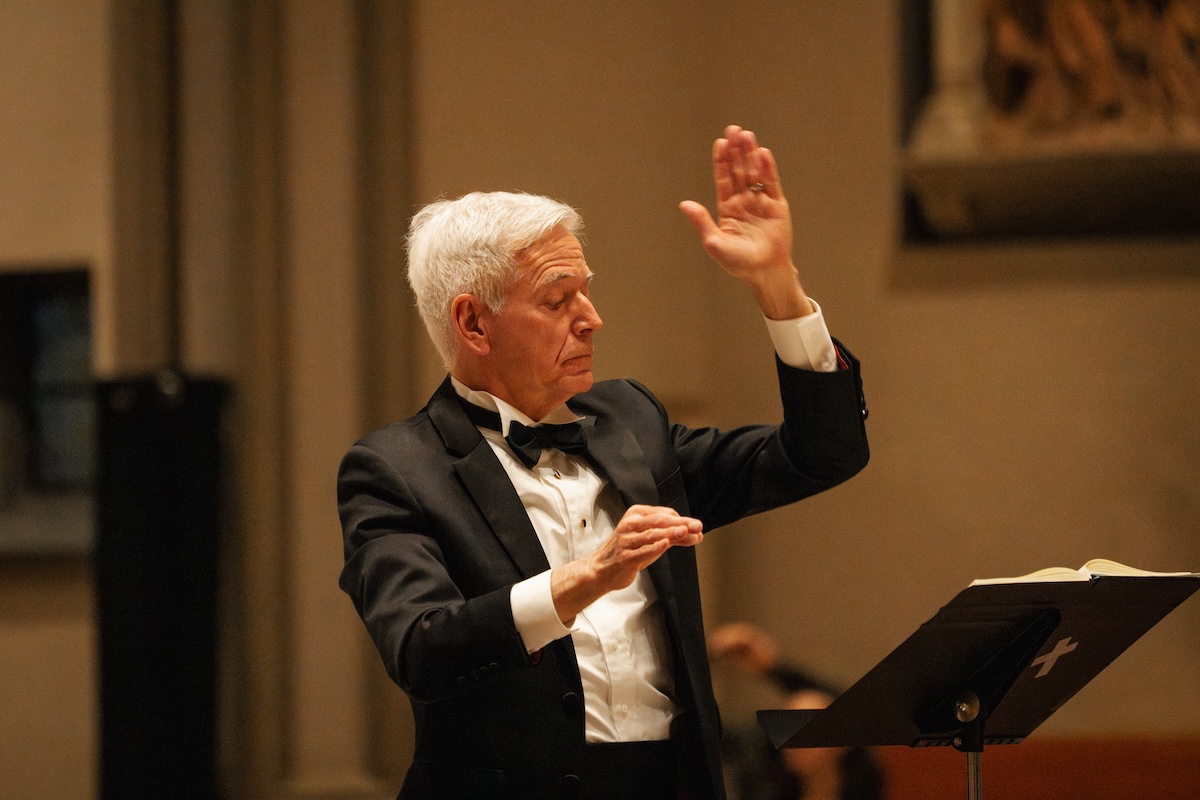
Music director Richard Webster was indeed a maestro of this performance. Conducting a chorus and an orchestra is a feat that I don't see that often. I have traditionally seen an orchestra or ensemble of musicians with soloists, but not a chorus of over 30 voices. Bach in the City evolved from the Bach Week Festival in Evanston. The chorus and orchestra are now headquartered at St. Vincent De Paul Church. The Passion of St. Mark concert was tremendously enjoyable. The acoustics were perfect, as that particular church would be similar to where Bach played his compositions. I hope the reconstructed Passion of St. Mark becomes a Holy Week tradition. I highly recommend attending a Bach in the City performance.
The Passion of St. Mark was 2.5 hours, including an intermission, performed at St. Vincent DePaul Catholic Church, 1010 West Webster Ave. For more information about Bach in the City and the Passion of St. Mark, please visit bachinthecity.org.
Support arts and culture journalism today. This work doesn't happen without your support. Contribute today and help us continue sharing the latest reviews, essays, and previews of the most anticipated arts and culture events across the city.
