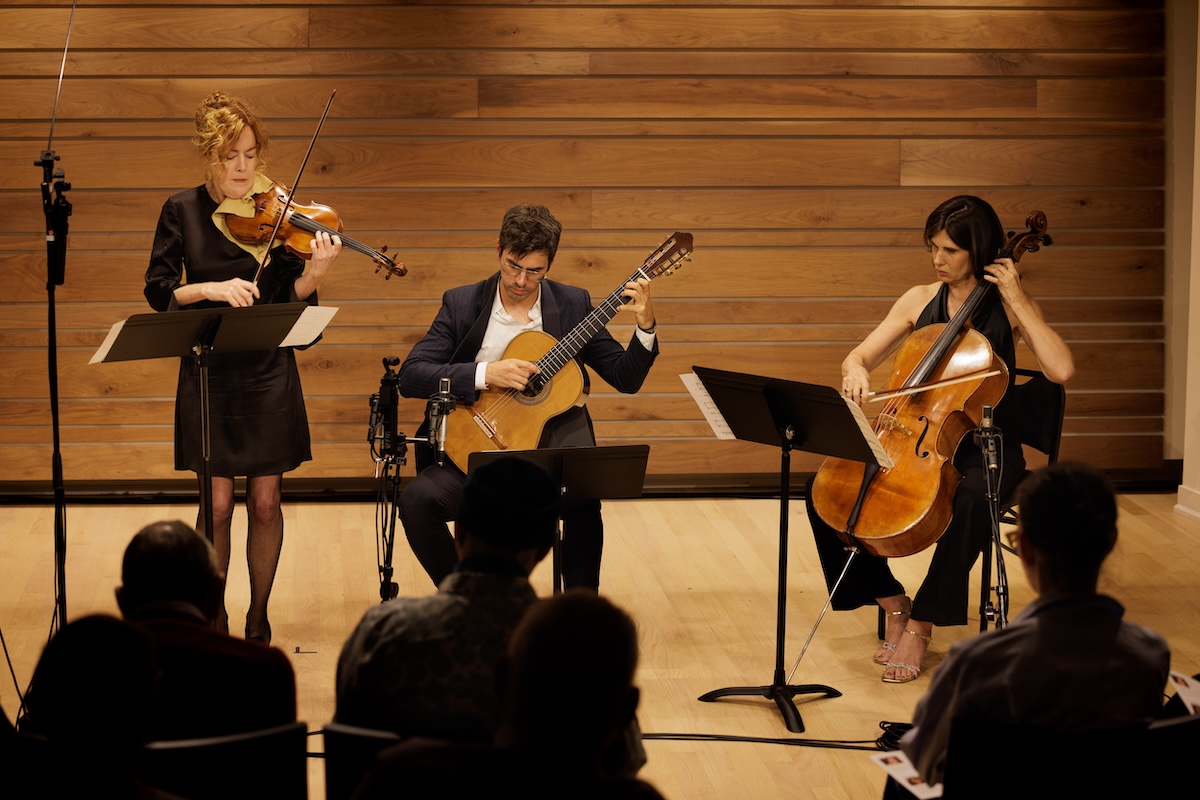

Nova Linea Musica completed their season on Wednesday with Blooming Under Blue Skies, a journey beyond the standard chromatic scales to pastoral tunes from the Balkans, the Mediterranean, and South America. Performing mainly at Guarneri Hall in the Loop, NLM has now finished its second season as an incubator for new compositions and as a provider of residencies to established and promising musicians in Chicago.
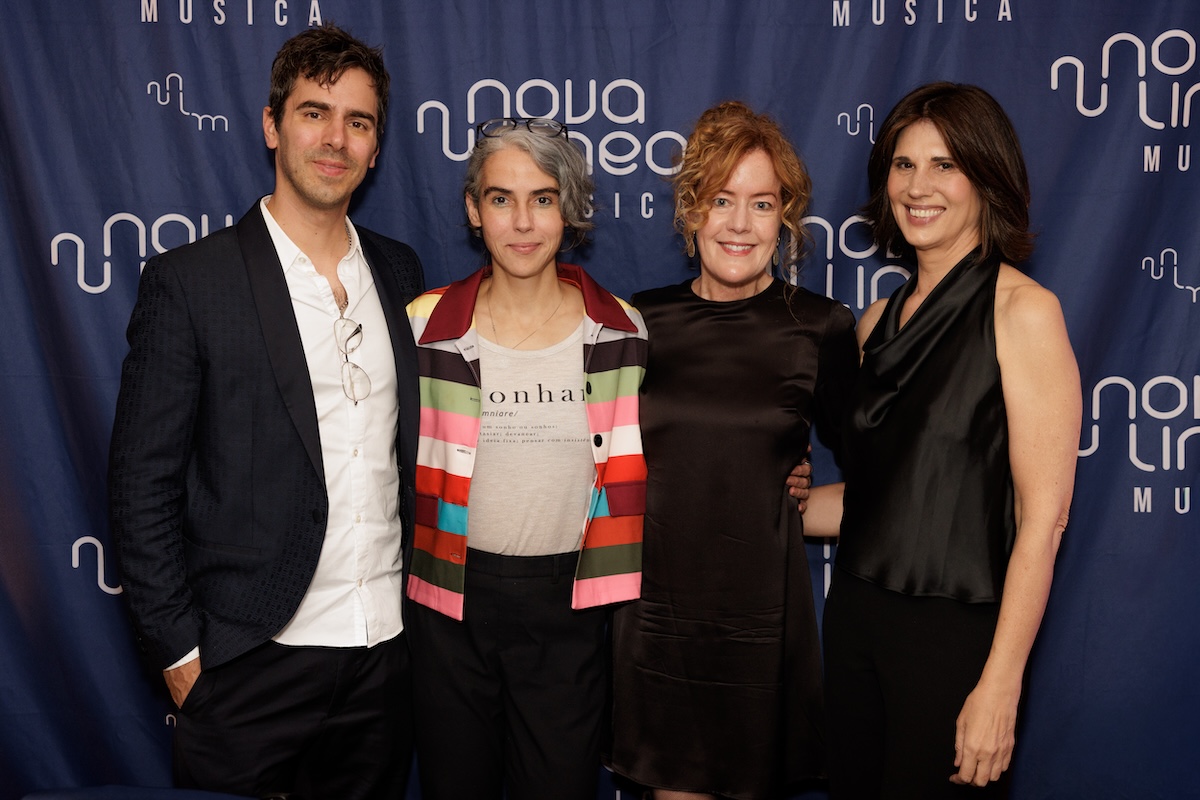
The program featured a world premiere by Chicago-based Brazilian composer Clarice Assad, who joined Doyle Armbrust, violinist, and NLM Artistic Director Desirée Ruhstrat, guitarist Mak Grgić, and cellist Wendy Sutter for a discussion of the unique relationship between composer and musician. Assad referred to her work bringing music to schools and the process of mentoring young composers. That process aligns with NLM's programs, including mentoring young musicians through chamber competitions. Executive Director Michele Mohammadi told me that NLM will be expanding the call for composers beyond the Midwest to the rest of the USA.
The music on the program was distinctive for its microtonality and polyharmonics. Armbrust asked the audience whether they believed music was a universal language, and a couple of people said no. Assad spoke of music as a language that each composer or player interpreted differently, especially when mentoring new composers. It must be like balancing on the tip of a sword to help a new composer find their own voice without imposing your own.
To start the program, guitarist Mak Grgić performed three songs by fellow Slovenian Leon Firšt. Grgić opened with a song that had similar chords and the form of the blues, with half tones from the multitonal scale. One of the songs was about a shepherd, with special meaning, as Grgić's mother was a shepherd in the Balkan Alps; the other was about wheat at the perfect ripeness for beer. These are folk songs that reflect the inner workings of a culture, which, in my opinion, is soul music. He played Three Portals by Turkish composer Hakki Cengiz Eren, reminiscent of the music heard at some Middle Eastern markets on Devon Avenue. When I heard it, I was transported.
The trio of performers then played April Variations for violin, guitar, and cello by American composer David Ludwig. This piece comprises 10 parts that create a warm, verdant vibe. Each musician shone while coalescing perfectly in harmonies and rhythmic playing, with one taking the lead. Ludwig wrote April Variations with spring and nature's beauty in mind.
Every NLM concert features a commissioned work by a living composer, and Clarice Assad provided The Raven. She wrote of the raven's place in various mythologies and with alchemists in Europe. To me, her composition also spoke to the metaphysics and symbolism of the raven. In the pre-concert talk, Assad noted that music has physical and emotional effects. The Raven is a beautiful composition with elements of mystery and being in touch with one's wildness.
I felt a connection to the musicians playing The Raven. Sutter's cello reverberated in my chest, eloquent and resonant. Grgić's guitar playing is virtuosic. The microtones of a makam scale, when played alongside the Western chromatic scale, are mind-blowing. In the pre-concert talk, Armbrust described the guitar as horizontal and vertical relative to the piano keys, which are linear. Grgić said he called the "makro-tones" an amusing play on his first name. Ruhstrat is a violin rock star. She has a precise, flowing style that can be both dramatic and playful, as heard and seen in Astor Piazzolla's compositions.
The last four songs for Blooming Under Blue Skies were by the Argentinian tango master of the bandoneon, Astor Piazzolla. It is almost certain that everyone has heard his music, as it is a classic of the tango art form. Grgić pointed out that Piazzolla was banned from Argentina for a while until it became "respectable," and he was then welcomed back as a national treasure. Tango has its roots in the seaside communities of Argentina. It is a blend of African candombe rhythms and European folk music. This music was played and danced in marginalized communities, whereas in Argentina, the ruling class was considered white of European descent and promoted traditional classical music. The same thing happened with flamenco in Spain because its origins were in Catalan and Romany communities. It's an old story. Once something becomes profitable and brings praise to a country, it is claimed by the ruling class.
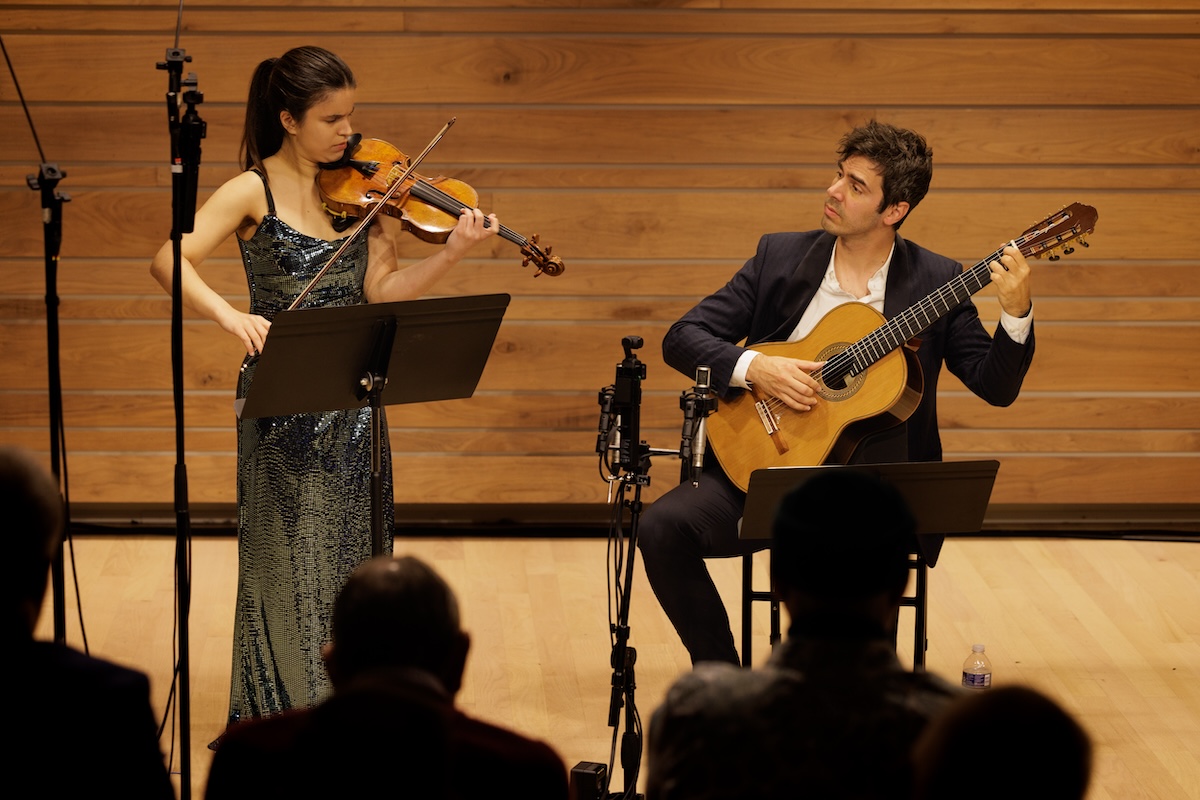
The first of Piazzolla's compositions was Histoire du Tango, performed by NLM Artist-in-Residence Rabia Brooke on violin and Grgić on guitar. Brooke strikes me as someone who feels the drama of whatever music she is playing. The notes are to be tamed and bent to her will. The duet was emotional and soothing, and I could see workers taking solace in its melancholy sound. It is beautiful to see music take over and imbue the player with a palpable energy. Oblivion was played by all four musicians. I closed my eyes to listen to the music and envisioned the dark, candlelit pubs and taverns.
It is astonishing that this was ever considered lower-class music. The complexity, silky rhythm, and polytones are seductive and evocative of heat and movement. Perhaps the upper classes would never think of such debauchery of carnal matters. Of course, they did, and wanted to keep such things restrained. I considered the time when this was becoming popular, and remembered that Eva and Juan Peron were in power and had ties with the fascists who escaped Europe. I also recall that Eva Peron was a dance hall girl and a part of life from the edge of town.
Ruhstrat and Sutter played a duet titled Calle, which was filled with quirks and jabbing notes. Grgić did not leave the stage and became something of a comic foil as Ruhstrat literally aimed some of the notes at him. The sound was exciting and energetic, with great climactic measures. The musicians enjoyed playing as much as the audience delighted in it. The finale was Libertango with all four players at hand. I always marvel at how dedicated musicians are, and can get into a groove with fellow musicians of the same caliber. The finale was immaculate, and it is always a pleasure to watch NLM artists, in which the instrument is a physical extension of the player. This quarter had magic in its fingers as the notes traveled from synapse to implementation. Excellent!
Blooming Under Blue Skies transported me to foreign lands to hang out in the tavernas of Turkey, the fields of wheat in the Balkans, and the seaside of Argentina, where the marginalized danced in the cafés cantante and the conventillos in the tenements.
For more information about Nova Linea Musica and their 2026-27 season, check their website. Past performances may also be viewed on YouTube.
Support arts and culture journalism today. This work doesn't happen without your support. Contribute today and ensure we can continue to share the latest reviews, essays, and previews of the most anticipated arts and culture events across the city.
