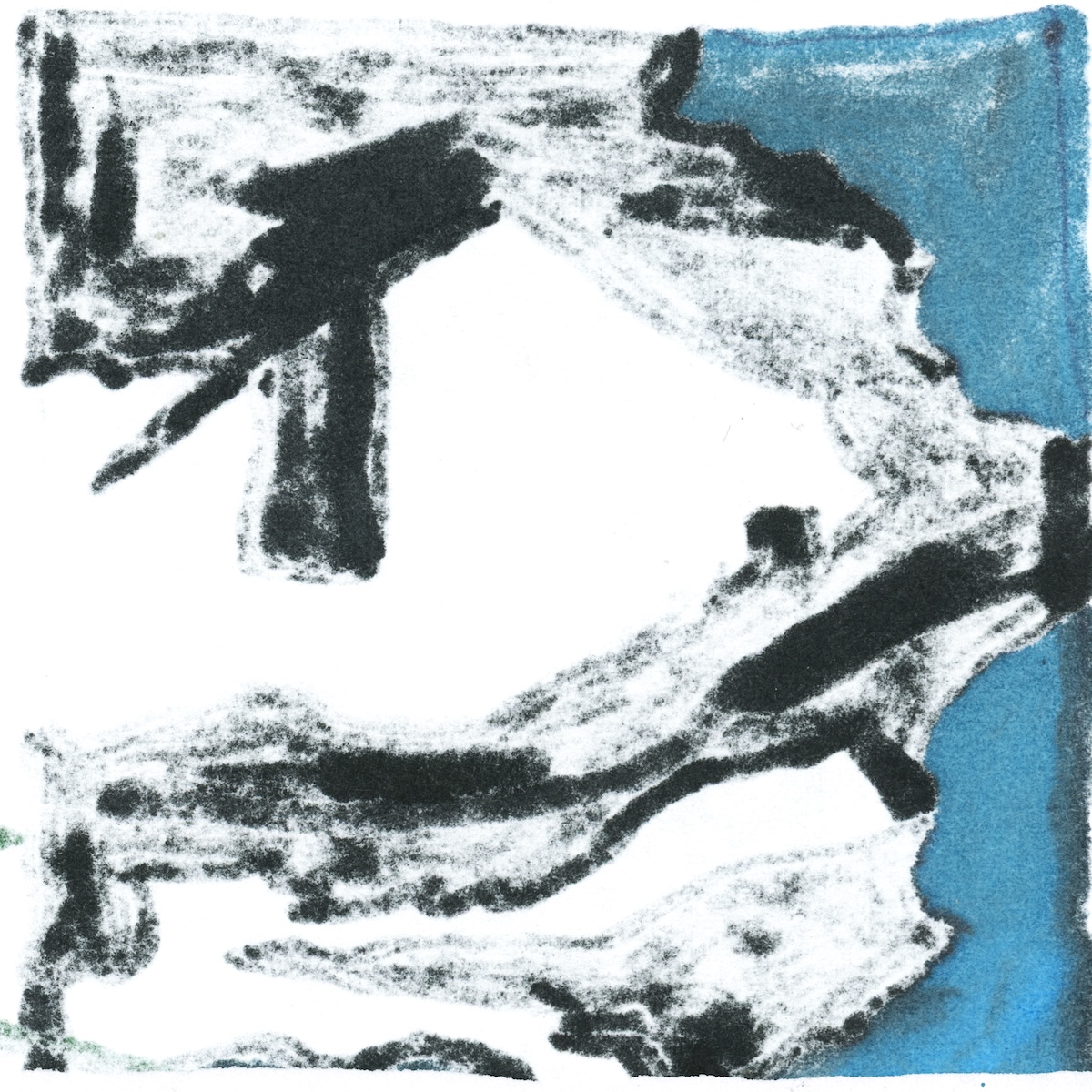
The year is 2026, the month is April, and we finally have the debut album from Accessory. Dust is the first full-length musical statement from acclaimed, revered, and beloved Chicago songwriter and multi-disciplinary artist Jason Balla under his Accessory moniker, but you probably know him best as the singer and guitarist of Chicago indie pop/post-punk outfit Dehd.
Jason Balla has been releasing music as Accessory since 2018, when he put out Accessory’s first EP, Blue Tape, a smoldering eight-song collection of moody, experimental, minimalist avant-garde electro-folk that focused less on the idea of song and melody and more on the sonic world one can create and encapsulate in a three to five-minute track. There are moments in Blue Tape that I think are well worth a listen, like the jangly and serene “Empty Sky”, the simplistic meditations of “Flowers on the Highway”, and the catchy twee of closing track “Ahead”, but the majority of the EP exists in these experimental corners of a small, damp, flutteringly lit room that are just not very cozy and hospitable for me. I’d have no problem putting the record on while cleaning my apartment, but it’s not something I’m likely to throw on and listen intently from beginning to end.
Accessory’s 2020 single “Eyes for Berlin”, on the other hand, is an absolute earworm of slow, brooding, synth-soaked post-punk that harkens back to the sounds of Joy Division and New Order that I could listen to all day. We got our first taste of what Dust would become with “Wherever You Are Tonight” in 2023. That followed by a few songs released in 2025 that would not end up being included in Dust, most notably, in my opinion, is the song “Chain Link”, an ethereal drifter that floats high above your head with a seriously catchy melody that is a little hard to pick up on with all the reverb it’s swimming in, but not so much you can’t hear the trademark affirmation of the song, “Too loved to die alone”, a line we’d all want inscribed in neon and hanging on our living room drywall.
Besides “Wherever You Are Tonight”, Balla didn’t release a whole lot as Accessory that would adequately prepare you for what Dust would turn out to be. I would say if you stumbled upon Accessory as a Dehd fan before Dust came out, you might not totally vibe with what Balla was doing. However, Dust is a very approachable and friendly album to the Dehd-heads out there wanting something more experimental from their favorite Windy City indie trio. That being said, I could totally see a good chunk of Dehd fans being put off by Dust and wanting something more pop-forward, something more glittery, songs that glisten more intensely with that hopeful light of summer.
Personally, I think Dust blows any Dehd album out of the water, and I do say that as a big Dehd fan, especially of their last album, Poetry. Now, I wouldn’t want to be on some desert island with just one; I need my Dehd, and my Accessory, both complete each other in ways you couldn’t understand until you’ve spent an intimate amount of time with both bands’ music. The music that Jason Balla is making as Accessory couldn’t be released as Dehd and vice versa, so I’m very happy that Balla has the time, space, and support needed to write, record, release, and tour as Accessory for an album that will likely climb the ranks of my album of the year list for 2026.

Dust opens on “Other World”, a sprawling, dreamy-eyed instrumental that stands firmly on two feet and states Dust’s intentions proudly. Even though there are no lyrics or drums, “Other World” represents Dust better than almost any other song on the album. It’s weird, it’s experimental, it’s warm, it’s cold, it’s distant, it’s intimate, it’s melodic, it’s droning, and above all else, it feels organic even with all the electronic elements to it. When I’m listening to “Other World”, it does impart the feeling of drifting through space, en route to another planet, from one bucket of soil and water to another. Dust was recorded on equipment mostly built by Balla in his home studio, and it’s fun listening to this opening track, followed by the rest of the album, knowing that all these sounds we’re hearing were not only performed by Balla but very likely recorded on equipment he built himself, which quite simply blows my mind. “Other World” kickstarts the ethos of this album, imploring listeners to take note of the increasingly automated aspects of our lives that we so very often have no control over, so that we may be more purposeful in holding sacred the moments of our days that are real, pure, and honest at heart.
Balla laments the current state of America and the world at large on “World Of Pain”. Through lyrics like, “My world is built on pain // It’s worse to know that I will gain”, Balla almost seems like he’s lamenting the privilege that comes from living in a city like Chicago, a million light years away from a place like Gaza, where there’s more rubble on the ground than there are standing buildings. Trying to find happiness day-to-day while other human beings are experiencing so much pain and suffering is, even if we don’t like it, all part of the human experience, and we all have to take care of ourselves before we can take care of others. Musically, I love how the song rattles you at the start with some abrasive, metallic sounds before settling into a warm, swaying melody that complements Balla’s minimalist, mumbly vocals. I can almost picture swirling through a dust storm while listening to the chorus of this song, and the saxophone that plays in between verses only adds to the perfectly honed mellowness of the track.
“Other World” and “World Of Pain” do a great job opening the album’s front door for the listener, but “Angelfire” sets the table and gets you hungry for more. Much like the title suggests, “Angelfire” burns with a greater intensity and energy than the previous two tracks. The verses in the song are a bit deconstructed and shapeless, but the guitar and drums in the choruses give the song weight, structure, and a sense of urgency that the verses are building towards something explosive. There’s a lot to this song that one could associate with Dehd, like Balla’s vocal style and the ripping drums and guitar in the chorus, but it’s the patience and restraint that flow throughout the song like layered background tracks that give me the confidence to say that this could never be a Dehd track in its current state.
Even though, to my ear, the “Wherever You Are Tonight” sounds re-recorded for Dust, I can’t quite make out if anything about the 2026 version has changed besides having a slightly more polished production. “Wherever You Are Tonight” might be the most Dehd-sounding song Accessory has written so far, especially in the way the song begins, but it’s pure Accessory in how it ends. It’s definitely one of the catchiest songs on the record, which is a real testament to the songwriting on display here, considering the entire song is in 5/4 (or one 4/4 combined with a 6/4 depending on how you count it). At no point does the song sound or feel irregular, which is a big feat in and of itself. The extra beats lend a sense of yearning and longing to the track, as is the Accessory special, and all would be lost without them.
Lead single “Calcium” tells a tale of living while the world slowly burns, waking up each day to news that’s worse than the day before. Even with all that doom and gloom in the lyrics, some hopefulness can be distilled from the gentle, rhythmic sway of the instrumental. Balla is responsible for almost all the noise you hear on this album, but the tender yet bold string arrangements found soaring through the DNA of this track are all from Chicago local Whitney Johnson. On top of all that is Balla’s soft, murmuring monotone that still finds a way to brighten up your day even though the words he is singing aren’t the happiest. There are only a couple of songs on this album that I would label as potential songs of the summer, and this would surely be one of them; after only a few listens, it should be clear why this was made the lead single.
Coming in at just two minutes and fifteen seconds, “Safeword” is tied for the shortest song off the album (excluding the instrumental intro “Other World”), but it sure does make the most of the time it has. The melodies in this song are brighter than most on the album, and Balla’s vocals are stronger and more melodically pronounced. The layered acoustic and electric guitars playfully pair with the subtle yet driving drums, all while Balla sets off on a lyrical voyage, grappling with the inner emotional turmoil that comes with losing oneself in the pursuit of the unknown. Lyrics like “I see what I’m missing // I’m seeing what the trade was” and the powerful brevity of “Beat me until I’m more” show Balla in a state of restless curiosity about what could be, of what love waits for him in places unknown. The lyrics read as though the chase is better than the catch, and the lovelorn restlessness of “Safeword” will be perfect in the coming summer months. Rest assured.
When I think of the word “static”, I think of something that is without change; there is no movement, there is no dynamicism, there is simply nothing but what that something is. On the other hand, thinking of static in terms of what you see on your TV when your satellite’s out, there is nothing but movement. When it comes to “This Is Not Your Life (Static)”, the song is luckily in the latter as this might be the most cinematic song on the record. The sounds you hear at the beginning of the song are not unlike a TV’s static, just more melodic and controlled, obviously. Balla’s vocals go through so many different twists and turns in terms of effects and layering that you’re always on your toes. This song feels like it’s always building to something and takes a blissful left turn in the last minute or so when the outro transforms the song into this gorgeous wall of sound. It’s probably not an actual wall of sound since I know that’s a real production technique, but to me, a wall of sound is also a feeling that a song imparts when all the instrumentation and vocals overwhelm and envelope you in the best way possible, and that’s what this song’s outro makes me feel. Everything about this song is just astonishing, but for some reason, I feel like this will be among the most underrated and underappreciated songs on the album, just because it’s more nuanced and mysterious. It doesn’t give you the same sense of instant gratification that many of the other songs provide; if you want that static to cling, you really have to work for it.
Perched right next to “This Is Not Your Life (Static)” on the shelf of the underrated would surely have to be “Dogbite”. Few songs on this album have such a pressurized sense of anxiety, where it feels like much of the song is spent building towards this climactic finish, almost like it’s a threat. Well, with “Dogbite”, it’s not really a sense, it’s how it actually is. Similar to how your body would heal an actual dog bite over time, “Dogbite” builds gradually, slowly developing its sonic identity through dreamy guitars and reverb-soaked vocals with only the lightest hint of percussion fluttering in the background. Around the halfway point, as Balla wails out “Animal” as the final word, the song erupts into a glistening and triumphant cloud of sound that is by far one of the most satisfying parts of the record for me, if not the most satisfying. Some of the last lyrics in the song double almost as a grim metaphor for the song itself where Balla sings, “You feed it ‘til it’s real // Scared of your own tail”. Going back to the start of the song having already heard that lyric completely recontextualizes even the sonic elements of the song into a darkness more urgent and destructive Balla is trying to hold at bay but knows there’s nothing he can do to truly stop it from coming out.
Now we find ourselves uncovering the other song of the summer, the very aptly titled “Sunshine”. “Sunshine” walks with a swagger in its step; if it’s not the song of the summer, then it is at the very least its ugly cousin twice removed. Blossoming with an East Coast sensibility and some entrancing sonic textures that only serve to accentuate rather than detract, “Sunshine” struts and sways through lyrical fields of gold with some of Balla’s best lines on display. “In the failure of the morning light // I didn’t want to make a stranger out of you this time” is simply an insane lyric bursting with incredible diction and a spectacular delivery. One of my favorite moments on the track is when Balla utters the song’s title, with an effect placed atop his vocals that makes it sound as if the word itself is disintegrating from stepping too close to the sun. Couple that with how the chorus of “World Of Pain” sounds like Balla is walking through a dust storm, there are some really fantastic sonic metaphors on this album that make repeat listens so noteworthy.
Coming up on what might be my favorite song off the album and the song that makes me believe the second half of Dust is the strongest half (although it’s a very close fight), “Blood (Magnetic)” is an electrifying journey through the softer, gentler side of Jason Balla’s songwriting as the orchestrator of Accessory. Akin to how “Hard to Love” was a standout song off Dehd’s last album from a more country-focused perspective, “Blood (Magnetic)” stands out to me on Dust for its folk-twinged chord progressions and singer/songwriter sensibilities. If you were to strip this song for parts until the only thing left was the supple rhythm guitar underneath it all, you’d basically have Balla’s version of a folk song. The chorus, sounding larger than life itself, is as powerful as it is addictive. The line encapsulated within its shimmering walls, “Who can you trust with your heart?”, feels like the thesis of the song, and maybe the whole album overall, that is, if you want to believe in a good conspiracy theory. Balla never tries to get too wordy on Dust, or with any Accessory song in general, because the long-winded and verbose style of lyric writing wouldn’t work well with this project. Balla isn’t trying to be a Nick Cave or a David Berman here; he’s writing two-to-three-minute-long songs about anxiety, fear, love, despair, grief, and hope with a diction and meter that can be easily understood and relatable. In “Blood (Magnetic)”, Balla sings, “Let all my clothes pile up on the floor // I used to step over yours”, and in only two straightforward, no-nonsense lines, Balla is able to illustrate the heartache, depression, and acceptance that comes through the passage of time after a breakup or a death. This album is full of these lines that stop you in your tracks and give you a jolt of bittersweet nostalgia for the people you once entrusted with your heart, happiness, and well-being. You simply cannot put a price on songs like this.
With the dust now settling, “Lightning” closes out the album in a strong yet understated manner. This song will most likely be many listeners’ least favorite off the album at first, but if they all give the album the time it needs to grow and prosper, I’m sure this song will grow into a favorite with proper nurturing. One could also make a similar flower-growing metaphor regarding the overall sound of the song itself. Whenever I listen to “Lightning”, I’m immediately reminded of a flower trying to grow in a dark room with only a sliver of light shining in through a crack in the door; it grows slowly, but it does grow, prosper, and blossom into a strikingly beautiful flower with a hue as lush as it is vibrant, it just takes quite a bit of time. I always pay close attention to intro and outro songs on albums because I’m always curious to see if a band gets it right. There are so many instances where the album goes on two or three songs more than it should, or where the second song should have been the first. On Dust, Balla knows how to sequence an album just right, as “Other World” into “World Of Pain” makes for the perfect opener, and “Lightning”, in my eyes, is the only song on this album that could work as a finale, both lyrically, sonically, and instrumentally. The song is bittersweet, but it feels more sweet than bitter, which is how we should be closing albums these days; the people can’t take any more disappointment and chaos.
If you’ve made it all the way to this conclusion, you’ve realized that I have yet to pinpoint a low point in this album, and that might be because this album really doesn’t have one. I love every verse, chorus, bridge, and song on this album, and I haven’t found a new album like that in quite some time. Dehd will always be the band you go to for those runaway minimalist summer indie pop hits, but what Balla was able to achieve on his first full-length debut under Accessory is nothing short of astonishing.
None of Dust is groundbreaking, but not one of us needs music to be that. Balla needed to have an outlet for writing a different type of song to satisfy that itch that only fellow musicians ten plus years in with another band could possibly understand. Through waves of distorted guitar, gentle balladry, euphoric synths, and his minimalist delivery of everyday poetry, Balla finds his footing as an emerging figurehead in the experimental pop movement. A great many of the songs that appear on Dust were born into this world in the quiet light of early morning, when Balla would take to his piano, a gift bestowed upon him by his late mother, to find a throughline from his grief to his mother’s memory. Not only is it clear that so many of these songs would work if they were stripped back to their embryonic stages, but even on the songs that read like they have nothing to do with grief, you can still feel that grief-stricken undercurrent rattling throughout Dust as a companion that helps Balla explore both the melancholy and intimate beauty found in everyday life. It breaks my heart I wasn’t able to make Accessory’s album release show at The Empty Bottle this past Saturday, as I can’t even imagine how good this album would sound live, but I hope to see Accessory around at another Bottle show when they return from their well-deserved headlining North American tour, but I also wouldn’t be mad if this year marks the return of Dehd. Either way, more Balla the better.
