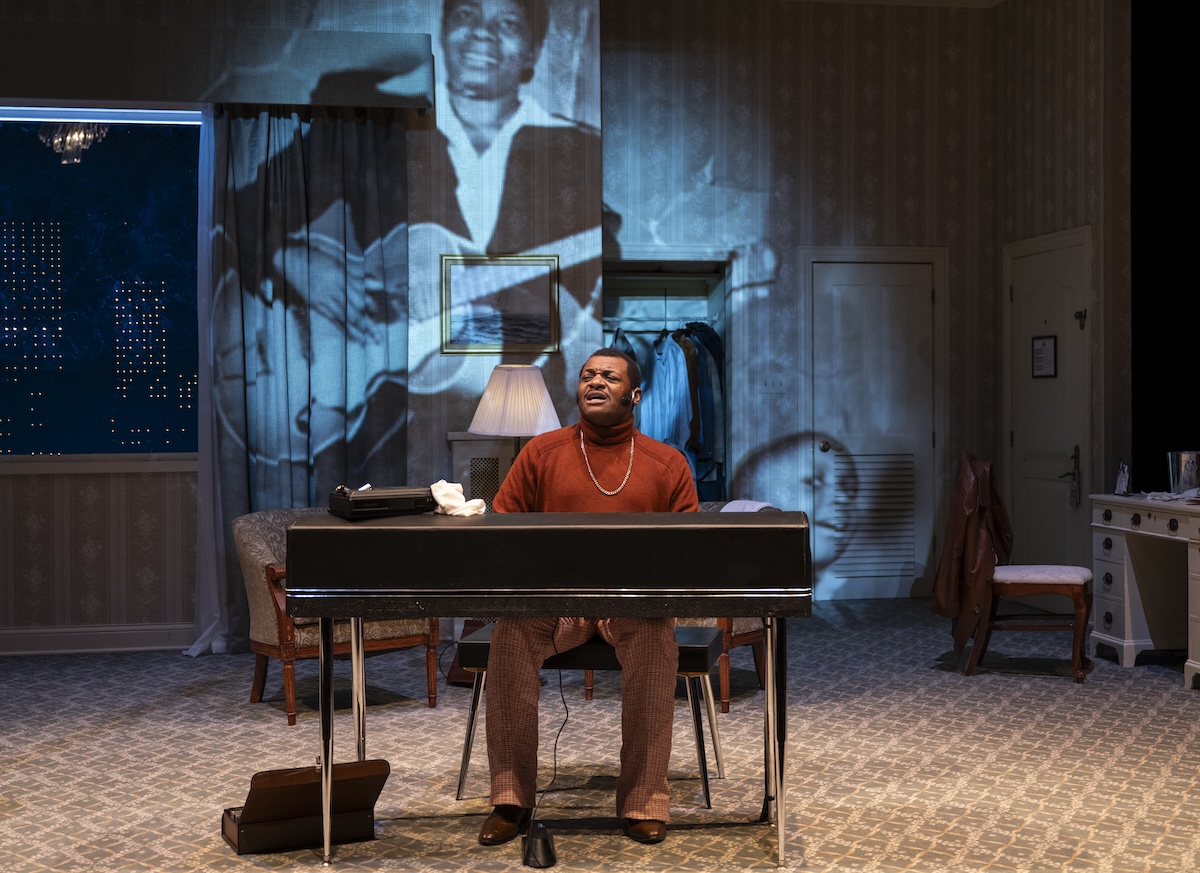

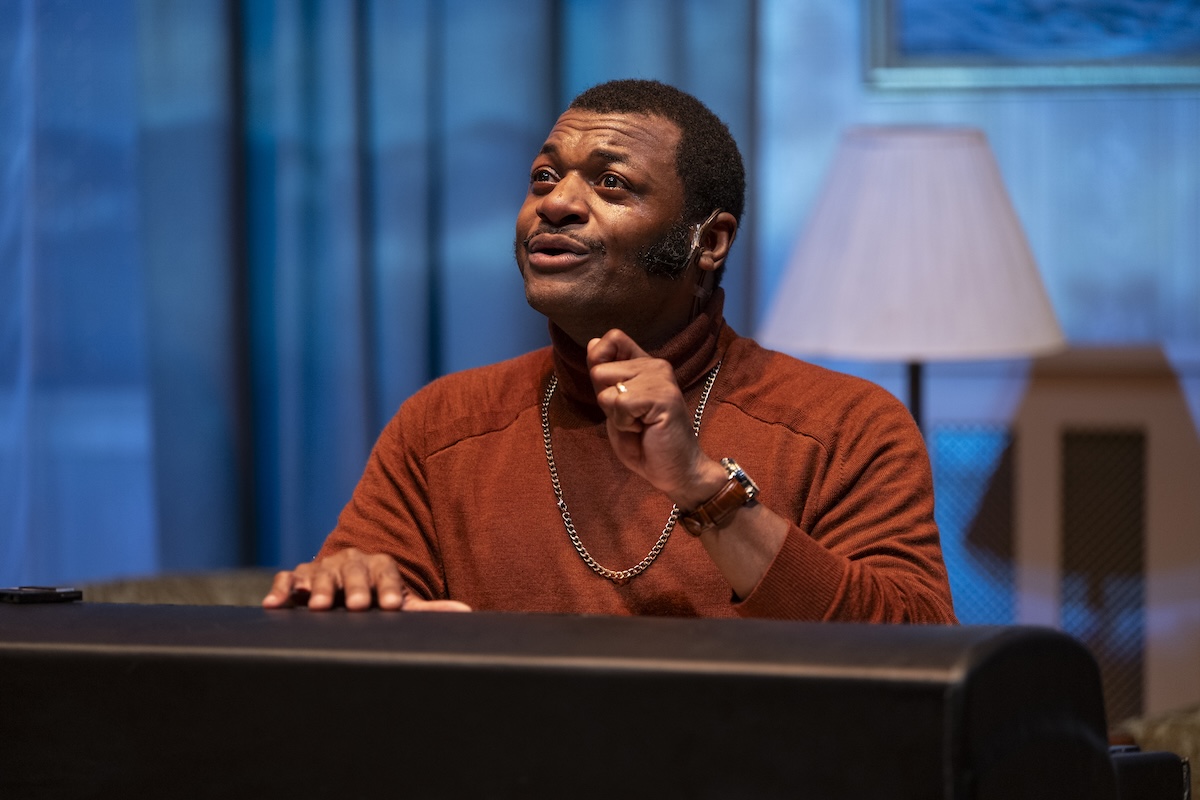
Donny Hathaway is a name tattooed in my mind since childhood. His singing style was otherworldly, blending traditional gospel with R&B and funk. He could bend a note like no other singer and was a virtuosic piano player. Kelvin Roston Jr. inhabits the soul, genius, and suffering that defined Hathaway's music and his life in Twisted Melodies. It is a one-man show at Northlight Theatre written by Roston Jr., who also serves as music director, and he stars with a bravura performance as Donny Hathaway.
I cannot imagine how anyone in the Chicago theater scene has not seen a performance by Roston. He is a member of the Congo Square Ensemble and has acted in numerous prestigious plays, from Shakespeare to August Wilson. I first saw him in the Black Ensemble Theater's production of Jackie Wilson, My Heart Is Crying, and was amazed by his vocals and energetic stage presence. You can hear the Black church in his voice in The Gospel at Colonus at Court Theatre, where Oedipus is redeemed of his sins.
I interviewed Roston in December 2024, when he co-directed a Christmas season classic, A Nativity Tribute, with TaRon Patton. He spoke of being raised in the church where his grandfather was the pastor. Roston is from St. Louis, as was Donny Hathaway. He also learned to play the piano at a very young age, like Hathaway, even though he initially wanted to play the drums. Roston as Donny Hathaway embodies a parallel universe with love and empathy for the suffering Hathaway endured with schizophrenia.
Ron OJ Parson, who directs Twisted Melodies, brings historic authenticity to his direction as seen in the Timeline Theater production of Relentless about racial unrest and class division in 1919 Philadelphia. Parson has impeccable pacing with a full cast, and it remains the same in Twisted Melodies. Schizophrenia can be a frightening disease with paranoia and sudden outbursts. Alexis J. Roston is a brilliant talent in her own right and serves as the associate director. She is Roston Jr.'s spouse and partner in their own production company. She played Billie Holiday in Lady Day at Emerson’s Bar and Grill. Holiday was a tormented and brilliant talent who took to drugs as a salve for past trauma and pain.
Roston Jr. has a voice and physical appearance that is almost eerie in its resemblance to Donny Hathaway. Gregory Graham's costume design nails the pizza hat and rust-colored leather jacket featured on the cover of several albums. The sound design by Eric Backus is perfect, with the phantom phone ringing, knocks at the door, and the demon voice pulling the audience into Hathaway's terror that the voice in his head named "Duke" and others were trying to take his gift and genius. Rasean Davonté Johnson's projection design is magical. Pictures of Hathaway's grandmother and the late Roberta Flack are touching. The projection of music notes evokes the synesthesia of musical geniuses like Mozart, Hendrix, and Hathaway, who all professed to see and sometimes inhabit the notes in their bodies, becoming one with their instruments. Kudos to Sotirios Livaditis's scenic design, bringing the mid-century design imagining of the Essex Hotel, where Hathaway spent his final night, to life.
The mental illness receives empathetic treatment, with Roston speaking a litany of medications to treat schizophrenia. The unholy cocktail of Risperidone, Thorazine, and Haloperidol numbed Hathaway's thoughts and had horrifying physical effects like tardive dyskinesia and feeling frozen in place. Roston's physique transforms when he describes being in the hospital and possibly suffering from ECT treatments and being fed a constant diet of drugs. There is a subtlety to Roston's performance of mental illness and the terror of losing the music that Hathaway played.
The dialogue is poetic and evokes memories of the turbulent 1960s. Hathaway's "The Ghetto" is an amalgamation of the social terror and unrest that occurred worldwide during that time. Assassinations, riots, and the war in Vietnam were a daily diet of anxiety in our nation. Hathaway lived in Chicago during that time and witnessed the protests and violence of 1968. As Hathaway descends further into despair, he explains how he wanted to take that pain, anger, and grief into himself and transmute it with music. "Someday We'll All Be Free" took on a different meaning with Roston's interpretation. Hathaway wanted to be free of his demons and to set everyone within the sound of his music free as well.
I highly recommend Twisted Melodies for both the music and the dialogue.Kelvin Roston Jr. is a consummate performer in the traditional sense. He is an old-school performer with a multitude of talents. If you are from that era, you may find that tears fall without warning, as they did for me, when the tinkling sound of the intro to "A Song for You" ended a passage of tense dialogue.
Twisted Melodies by Northlight Theatre continues through August 10 at the North Shore Center for the Performing Arts, 9501 Skokie Blvd, in Skokie. Running time is 90 minutes with no intermission. For more information and tickets, please visit www.northlight.org.
Donny Hathaway's legacy lives on through his daughters, Layah, Kenya, and Donnita. Lalah is immensely talented and can sing chords, more than one note at a time. Kenya is also a fantastic singer. Donnita started the Donny Hathaway Legacy Project to provide a holistic approach to mental health services, combining music and entertainment with support for at-risk and marginalized communities. For more information, visit www.donnyhathaway.org
For more information on this and other productions, see theatreinchicago.com.
If you enjoyed this post, please consider supporting Third Coast Review’s arts and culture coverage by making a donation. Choose the amount that works best for you, and know how much we appreciate your support!
